
Consider the following statements about the Mahanavami Dibba: 1. It was the name of a giant box of sweets distributed at the Mahanavami festival. 2. It was the name of a massive platform with a base covered with relief carvings. Which of the statements given above is/are correct?
- (a)1 only
- (b)2 only
- (c)Both 1 and 2
- (d)Neither 1 nor 2
Answer
Why
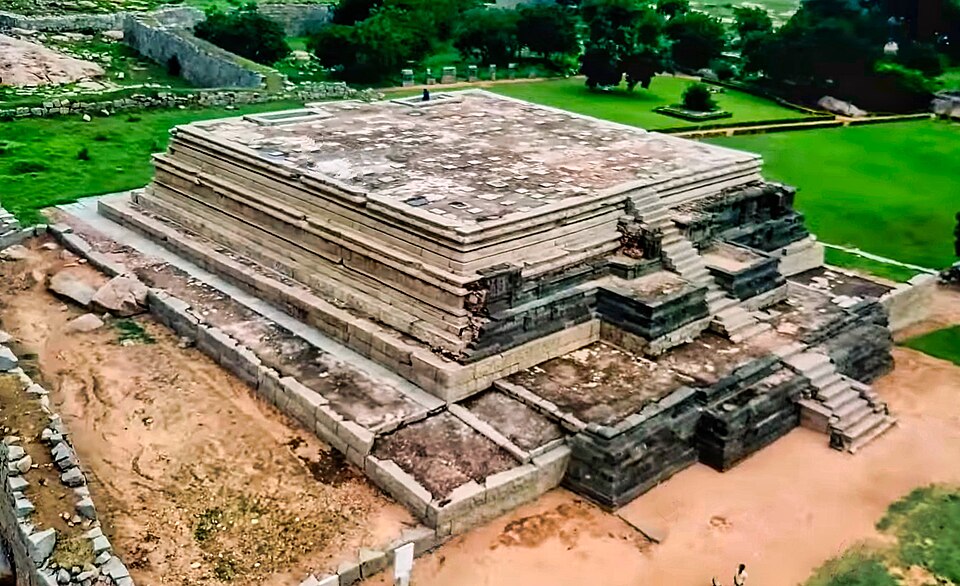
Correct — B, 2 only. The Mahanavami Dibba is a massive stone platform in the royal centre of Vijayanagara (Hampi), its base covered with relief carvings of horses, elephants, dancers, hunting and processions — so statement 2 is correct. Statement 1 (a 'giant box of sweets') is invented; the name comes from the Mahanavami (Navaratri/Dussehra) festival, during which the king used the platform for ceremonies, receiving tribute and reviewing his troops.
Why the others are wrong
- (a)1 only — Statement 1 is false — the Mahanavami Dibba is a stone platform, not a box of sweets.
- (c)Both 1 and 2 — Only statement 2 is correct; statement 1 is fabricated.
- (d)Neither 1 nor 2 — Statement 2 is a correct description of the platform, so this cannot be right.
Concept
Vijayanagara (the 'city of victory', modern Hampi in Karnataka) was the capital of the Vijayanagara Empire (founded 14th century). Its royal centre contains the Mahanavami Dibba — a large, tiered stone platform, also called the 'Great Platform' or 'House of Victory' — associated with the ten-day Mahanavami (Navaratri) festival, the empire's most important state ritual.
The question tests whether a student can separate a real archaeological feature from a made-up definition. The word 'Mahanavami' points to the festival; the 'Dibba' is the raised platform used for the ceremonies, its base decorated with carved reliefs.
Key facts
- The Mahanavami Dibba stands in the royal centre of Vijayanagara (Hampi).
- It is a massive tiered stone platform whose base carries relief carvings.
- It was used during the Mahanavami (Navaratri/Dussehra) festival for royal ceremonies, tribute and troop reviews.
- Vijayanagara was sacked in 1565 after the battle of Talikota and later abandoned.
Study next
Common traps
- Reading 'Mahanavami' as a sweet or offering rather than a festival platform.
- Confusing the royal centre (Mahanavami Dibba) with the sacred temple complexes.
Asked through statement-based items on Vijayanagara architecture or by matching monuments to their function.
Related PYQs
Consider the following events: I. Reign of Krishna Deva Raya of Vijayanagara. II. Construction of Qutab Minar. III. Arrival of Portuguese in India. IV. Death of Firoz Tughlaq. Which one of the following is the correct chronological order?
- (a) II, IV, III, I
- (b) II, IV, I, III
- (c) IV, II, I, III
- (d) IV, II, III, I
Answer(a) II, IV, III, I
Same theme — the Vijayanagara Empire and Krishna Deva Raya, whose capital housed the Mahanavami Dibba.
Vijayanagara rulers claimed that they were ruling on behalf of
- (a) Lord Murugan
- (b) Lord Venkateshwara
- (c) Shri Virupaksha
- (d) Shri Vallabha
Answer(c) Shri Virupaksha
Same subject — the Vijayanagara Empire and its royal-ritual ideology, of which the Mahanavami Dibba was the physical stage.
The ruins of Vijayanagara (Hampi) were brought to public light in the year 1800 by the following British surveyor and engineer:
- (a) James Prinsep
- (b) Colin Mackenzie
- (c) James Rennell
- (d) Charles Metcalfe
Answer(b) Colin Mackenzie
Same site — the ruined capital of Vijayanagara (Hampi) where the Mahanavami Dibba stands.
Practice
- practice — not a real PYQ
The Mahanavami Dibba at Hampi is located in the
- (a)sacred centre
- (b)royal centre
- (c)urban core bazaar
- (d)irrigation zone
Answer(b) royal centre — it was the ceremonial platform of the king. - practice — not a real PYQ
The Vijayanagara capital of Hampi is situated on the banks of which river?
- (a)Krishna
- (b)Kaveri
- (c)Tungabhadra
- (d)Godavari
Answer(c) Tungabhadra — Hampi lies on the Tungabhadra in Karnataka.