
Who among the following invented the flying shuttle?
- (a)James Hargreaves
- (b)John Kay
- (c)Richard Arkwright
- (d)Humphry Davy
Answer
Why
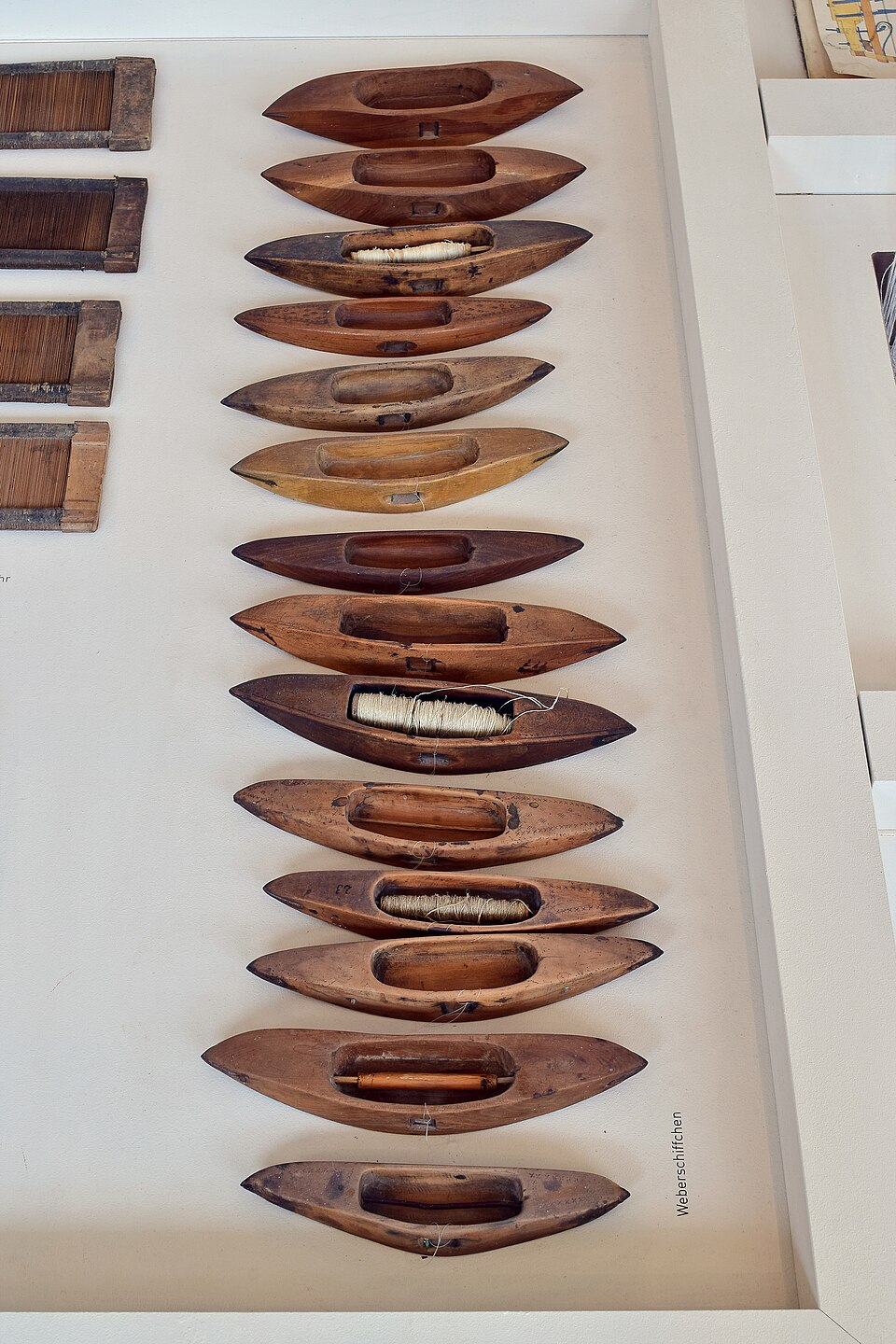
Correct — B, John Kay. John Kay, an English inventor born in 1704, patented the flying shuttle in 1733. It let the weaver shoot the shuttle across the warp by pulling a cord instead of passing it from hand to hand, which sped weaving up sharply, widened the cloth that could be woven, and allowed a broad loom to be worked by one weaver where two had been needed before.
Why the others are wrong
- (a)James Hargreaves — Hargreaves is credited with the spinning jenny of 1764, a multiple-spindle machine that raised the thread output of a single worker. Spinning makes the yarn; weaving turns it into cloth, and the flying shuttle belongs to weaving.
- (c)Richard Arkwright — Arkwright developed the water frame in 1771, again on the spinning side, and is associated with factory-based cotton spinning rather than with the loom.
- (d)Humphry Davy — Davy was a British chemist, remembered for the miner's safety lamp and for isolating elements such as potassium and sodium by electrolysis. He had no connection with textile machinery at all.
Concept
The mechanisation of the British textile industry ran as a chain reaction, with each invention creating the bottleneck that the next one solved. Kay's flying shuttle of 1733 made weaving so much faster that weavers began outrunning the supply of yarn. That shortage drove the spinning inventions — Hargreaves's spinning jenny in 1764, Arkwright's water frame in 1771 and Crompton's spinning mule in 1779 — and once yarn was abundant again, Cartwright's power loom of 1784 mechanised weaving in turn.
Three of the four options are genuine Industrial Revolution names, so the question is really asking whether you can place each man on the right side of the process. Fix one anchor — Kay is the weaving man, everyone else in the textile list is a spinning man — and the rest of the chain becomes easy to reconstruct. The fourth option, Humphry Davy, is from the science of the same era rather than its textile machinery, and is there to catch the student who recognises the period but not the person.
Key facts
- John Kay, an English inventor, patented the flying shuttle in 1733.
- The flying shuttle increased the width of cotton cloth and the speed of a single weaver, and cut the crew of a broad loom from two workers to one.
- By making weaving faster it created a yarn shortage, which spurred the spinning jenny (Hargreaves, 1764), the water frame (Arkwright, 1771) and the spinning mule (Crompton, 1779).
- Edmund Cartwright's power loom of 1784 finally mechanised weaving itself.
Study next
Common traps
- Swapping the spinning inventions (jenny, water frame, mule) with the weaving inventions (flying shuttle, power loom).
- Including Humphry Davy in a textile list because his name belongs to the same era of British science.
A direct 'who invented this' recall, with the other great names of the textile revolution supplied as options.
Related PYQs
Which of the following statements correctly explains the impact of Industrial Revolution on India during the first half of the nineteenth century?
- (a) Indian handicrafts were ruined.
- (b) Machines were introduced in the Indian textile industry in large numbers.
- (c) Railway lines were laid in many parts of the country.
- (d) Heavy duties were imposed on the imports of British manufactures.
Answer(a) Indian handicrafts were ruined.
The other half of the same story. The machinery that began with Kay's shuttle made British cloth so cheap that it flooded the Indian market, and UPSC asks about the consequence — the collapse of Indian handloom and handicraft production.
During the Industrial Revolution, who among the following designed the ‘flying shuttle loom’?
- (a) Samuel Crompton
- (b) Edmund Cartwright
- (c) John Kay
- (d) Richard Arkwright
Answer(c) John Kay
The identical fact asked one year earlier, with a different set of decoys — Crompton for the spinning mule, Cartwright for the power loom and Arkwright for the water frame. Learn the whole chain once and both questions fall together.
Practice
- practice — not a real PYQ
The spinning jenny was invented by
- (a)John Kay
- (b)James Hargreaves
- (c)Edmund Cartwright
- (d)Samuel Crompton
Answer(b) James Hargreaves — his multiple-spindle spinning jenny of 1764 answered the yarn shortage created by the flying shuttle. - practice — not a real PYQ
The flying shuttle was used in which stage of textile manufacture?
- (a)Spinning
- (b)Weaving
- (c)Dyeing
- (d)Printing
Answer(b) Weaving — it carries the weft thread across the warp on a loom.