
Human eye can see objects at different distances with contrasting illuminations. This is due to
- (a)far-sightedness
- (b)near-sightedness
- (c)far-sightedness and near-sightedness
- (d)accommodation of eye
Answer
Why
Correct — D, accommodation of eye. Accommodation is the eye's own ability to adjust itself so that objects lying at very different distances still form a sharp image on the retina — the ciliary muscles change the curvature, and therefore the focal length, of the crystalline lens, while the iris changes the size of the pupil and so controls how much light is let in. The other three choices are refractive defects of vision; they describe situations in which the eye fails to focus, not the adjusting ability that lets a normal eye cope with varied distances and varied brightness.
Why the others are wrong
- (a)far-sightedness — Far-sightedness (hypermetropia) is a defect in which nearby objects come to a focus behind the retina, so near vision is blurred. It restricts what the eye can see rather than explaining how a normal eye adjusts.
- (b)near-sightedness — Near-sightedness (myopia) is the opposite defect — distant objects focus in front of the retina. Again this is a failure of focusing, not the mechanism that makes normal focusing possible.
- (c)far-sightedness and near-sightedness — Combining two defects still leaves you with defects. Someone with both sees worse at both ranges; nothing in that combination explains the ability to adjust to changing distance and illumination.
Concept
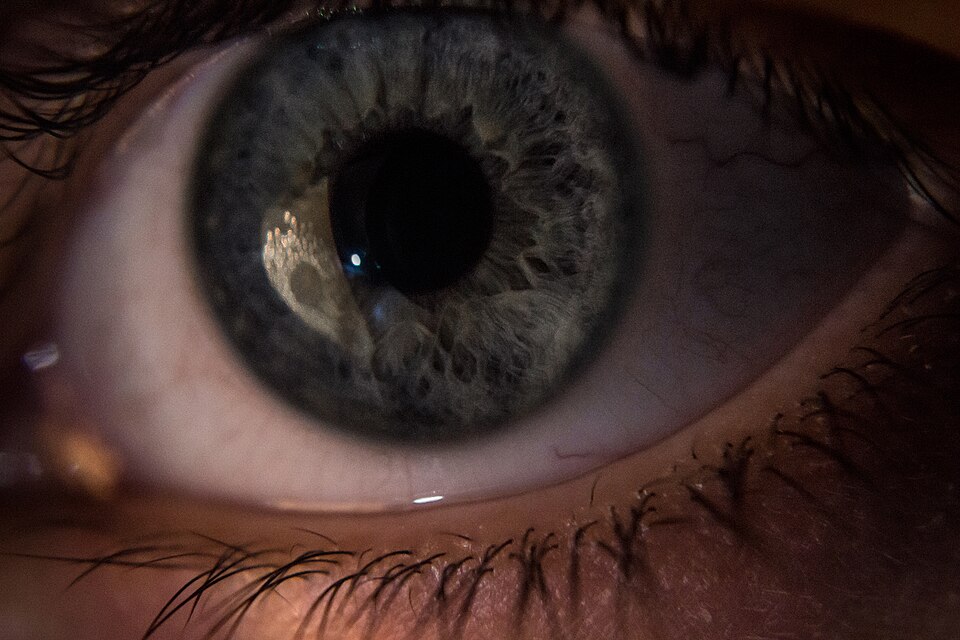
The human eye focuses light with a lens whose shape can be changed by the ciliary muscles. When the muscles contract, the lens becomes thicker and its focal length shorter, so near objects are focused on the retina; when they relax, the lens flattens and distant objects are focused. This adjustment is called the power of accommodation. Separately, the iris opens and closes the pupil to regulate the quantity of light reaching the retina.
Read the four options as a set and the answer falls out — three of them are named defects of vision, and only one is a normal ability. Be honest about the wording, though: strictly, changing the focal length of the lens (accommodation) is what handles different distances, while the iris and pupil, plus the retina's own light and dark adaptation, are what handle contrasting illumination. The official key marks accommodation because it is the only option that describes the eye adjusting itself at all.
Key facts
- Accommodation is produced by the ciliary muscles changing the curvature, and hence the focal length, of the eye lens.
- For a normal young adult eye the near point (least distance of distinct vision) is about 25 cm and the far point is at infinity.
- The iris controls the diameter of the pupil, which regulates how much light enters the eye.
- Myopia is corrected with a concave lens and hypermetropia with a convex lens — both are refractive defects, not adjustment mechanisms.
Study next
Common traps
- Treating myopia and hypermetropia as mechanisms of normal vision when they are defects of it.
- Assuming the eye lens slides back and forth like a camera lens — in the human eye the lens changes its curvature instead.
A one-line statement about something the normal eye can do, with vision defects planted as tempting options.
Related PYQs
The human eye is like a camera that has a lens with:
- (a) fixed focal length and fixed aperture size.
- (b) variable focal length and fixed aperture size.
- (c) fixed focal length and variable aperture size.
- (d) variable focal length and variable aperture size.
Answer(d) variable focal length and variable aperture size.
The same idea stated as a camera analogy — variable focal length is accommodation by the lens, variable aperture is the iris adjusting the pupil for brightness. Between them they are exactly why the eye copes with different distances and different illuminations.
Practice
- practice — not a real PYQ
The change in the focal length of the human eye lens is brought about by the
- (a)ciliary muscles
- (b)iris
- (c)cornea
- (d)optic nerve
Answer(a) ciliary muscles — they change the curvature of the lens, which changes its focal length. - practice — not a real PYQ
The least distance of distinct vision for a normal human eye is about
- (a)15 cm
- (b)25 cm
- (c)50 cm
- (d)100 cm
Answer(b) 25 cm — the near point of a normal young adult eye.