
The human eye is like a camera that has a lens with:
- (a)fixed focal length and fixed aperture size.
- (b)variable focal length and fixed aperture size.
- (c)fixed focal length and variable aperture size.
- (d)variable focal length and variable aperture size.
Answer
Why
Correct — D, variable focal length and variable aperture size. The eye focuses by accommodation: ciliary muscles change the curvature of the flexible eye lens, altering its focal length so that near and far objects both form a sharp image on the retina — so the focal length is variable, unlike a simple camera. At the same time the iris acts as an automatic diaphragm, opening and closing the pupil to control how much light enters, which is a variable aperture. Both quantities adjust, so option (d) is right.
Why the others are wrong
- (a)fixed focal length and fixed aperture size. — This describes a cheap fixed-focus camera, not the eye. The eye changes both its focal length (by accommodation) and its aperture (the pupil), so neither is fixed.
- (b)variable focal length and fixed aperture size. — It is right that the focal length varies, but the aperture is not fixed — the iris continually widens or narrows the pupil as light levels change.
- (c)fixed focal length and variable aperture size. — This has the focal length wrong. The eye lens does change its focal length through accommodation; it does not keep a single fixed value the way a rigid camera lens does.
Concept
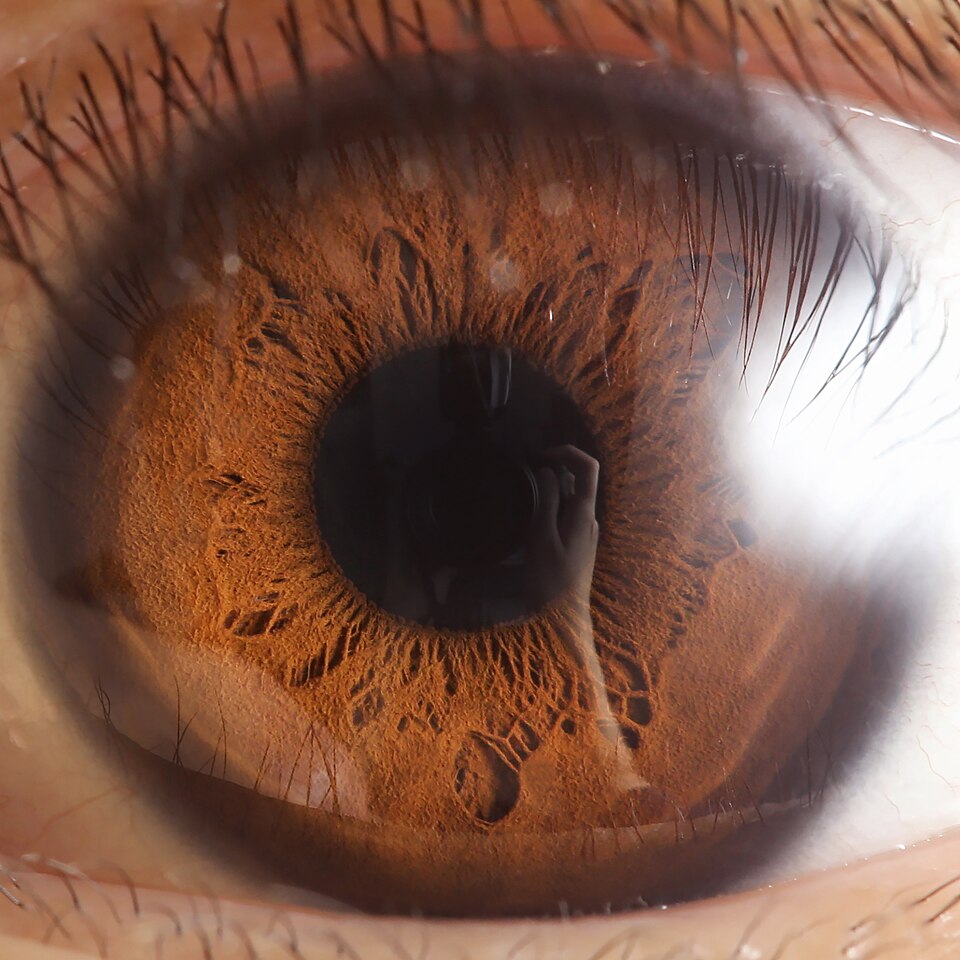
The eye is often compared to a camera: the cornea and lens focus light onto the retina (the 'film'), and the iris controls the light entering through the pupil (the aperture). The key difference is that the eye's lens is flexible — ciliary muscles reshape it to change its focal length — whereas a simple camera keeps a rigid lens and focuses by moving it.
Test each half of the option. The eye adjusts focus by accommodation, so the focal length is variable — this eliminates the 'fixed focal length' options. The pupil visibly widens in dim light and narrows in bright light, so the aperture is also variable — this eliminates the 'fixed aperture' options. Only the choice that makes both variable survives.
Key facts
- By accommodation, ciliary muscles change the curvature of the eye lens and so its focal length, focusing objects at different distances.
- A normal eye can focus from the near point (about 25 cm) out to the far point (infinity).
- The iris controls the pupil, which is the eye's aperture — it narrows in bright light and widens in dim light.
- A simple camera keeps a fixed-focal-length lens and focuses by moving the lens, unlike the reshaping eye lens.
- The image on the retina is real, inverted and smaller than the object; the brain interprets it as upright.
Study next
Common traps
- Assuming the eye focuses by moving the lens (as a camera does) rather than by reshaping it.
- Thinking the pupil size is fixed — it changes constantly with light level.
- Confusing the retina (the light sensor) with the aperture (the pupil).
NDA/UPSC compare the eye to a camera or ask how it focuses and controls light — remember accommodation (variable focal length) and the iris/pupil (variable aperture).
Related PYQs
No directly related past PYQ was found.
Practice
- practice — not a real PYQ
The ability of the eye lens to change its focal length to focus objects at different distances is called
- (a)persistence of vision
- (b)accommodation
- (c)dispersion
- (d)total internal reflection
Answer(b) accommodation — the ciliary muscles reshape the flexible lens to change its focal length. - practice — not a real PYQ
Which part of the human eye controls the amount of light entering by adjusting the size of the pupil?
- (a)Cornea
- (b)Retina
- (c)Iris
- (d)Lens
Answer(c) Iris — it acts as a diaphragm, widening or narrowing the pupil with the light level.