
Which one of the following metals floats in cold water?
- (a)Magnesium
- (b)Calcium
- (c)Potassium
- (d)Copper
Answer
Why
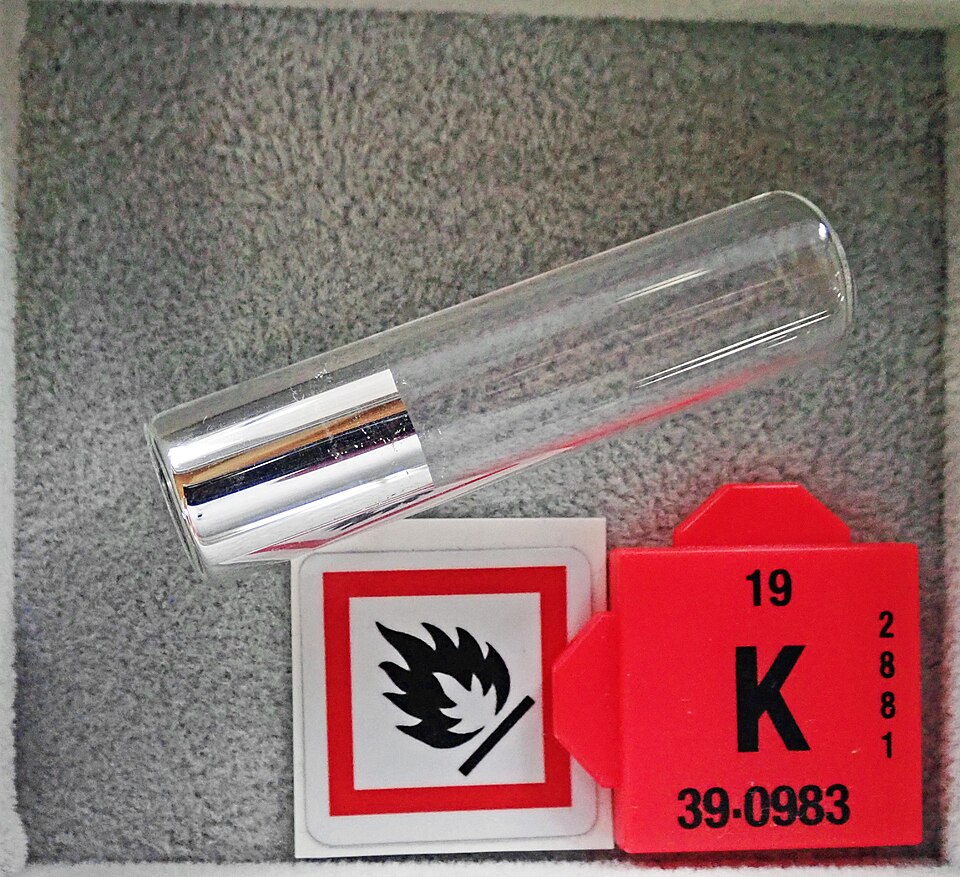
Correct — C, Potassium. Potassium metal has a density of about 0·86 g/cm³ against water's 1·0 g/cm³, so a piece of it is genuinely lighter than the water it displaces and rides on the surface. It is the only metal among the four that is less dense than water. It also reacts violently with cold water, releasing hydrogen that the heat of the reaction usually ignites, so the floating lump skates about burning with a lilac flame.
Why the others are wrong
- (a)Magnesium — Magnesium is denser than water, so it sinks. It also does not react with cold water at all — it needs hot water or steam, and only then can hydrogen bubbles lift it.
- (b)Calcium — Calcium's density is about 1·53 g/cm³, above water's, so on density alone it sinks. It is the tempting choice because textbooks describe calcium as 'starting to float' in water — but that is bubbles of hydrogen clinging to the metal lifting it while the reaction runs, not the metal being lighter than water.
- (d)Copper — Copper is many times denser than water and sinks at once. It also lies below hydrogen in the activity series, so it does not react with water at all and generates no bubbles either.
Concept
Whether a solid floats is decided by one comparison — its density against the density of the liquid. The alkali metals are remarkable because they break the intuition that metals are heavy — lithium, sodium and potassium are all less dense than water, and all three float on it while reacting to give a hydroxide and hydrogen gas. Reactivity within the group rises down the group, so potassium reacts far more violently than sodium, which is why both are stored under kerosene or mineral oil.
Two quite different mechanisms can put a metal on the surface of water and the question turns on telling them apart. One is density — potassium at 0·86 g/cm³ simply floats, whether or not it reacts. The other is buoyancy from adhering gas, which is what school textbooks mean when they say calcium 'starts floating' — calcium at about 1·53 g/cm³ is denser than water, and it rises only because hydrogen bubbles stick to its surface while the reaction lasts. The official key marks potassium, the density answer, and that is the reading to carry into the exam; the calcium description is worth knowing precisely so that it does not pull you off the correct option.
Key facts
- Potassium's density is about 0·86 g/cm³, below water's 1·0 g/cm³, so it floats.
- Calcium is denser than water at about 1·53 g/cm³; when it appears to float it is being buoyed by hydrogen bubbles sticking to the metal.
- Lithium, sodium and potassium are all less dense than water and all react with cold water to release hydrogen.
- Sodium and potassium are stored under kerosene or mineral oil to keep air and moisture away from them.
- Copper lies below hydrogen in the activity series and does not react with water at all.
Study next
Common traps
- Choosing calcium because a textbook says it 'starts floating' — that is bubble buoyancy, not low density.
- Assuming every metal is denser than water.
- Mixing up magnesium's behaviour in hot water with the cold water this question specifies.
As a single pick like this, as a 'which metal reacts with cold water' item, or as an assertion-and-reason pair about storing sodium under kerosene.
Related PYQs
Assertion (A): Sodium metal is stored under kerosene. Reason (R): Metallic sodium melts when exposed to air.
- (a) Both A and R are true, and R is the correct explanation of A
- (b) Both A and R are true, but R is NOT a correct explanation of A
- (c) A is true, but R is false
- (d) A is false, but R is true
Answer(c) A is true, but R is false
The same alkali-metal chemistry from the storage side. Sodium and potassium are kept under kerosene precisely because they attack air and water so readily — the reaction that accompanies potassium's float in this NDA item.
Which one of the following reactions does not result in the evolution of hydrogen gas?
- (a) Reaction of zinc metal with dilute sulphuric acid solution
- (b) Mixing water to Plaster of Paris
- (c) Heating zinc metal with sodium hydroxide solution
- (d) Reaction of potassium metal with water
Answer(b) Mixing water to Plaster of Paris
Its option (d) is the very reaction behind this item — potassium metal with water, releasing hydrogen. One paper tests that the reaction gives hydrogen, the other that the metal floats while it happens.
Practice
- practice — not a real PYQ
Sodium metal is stored under kerosene because
- (a)it is a liquid at room temperature
- (b)it reacts vigorously with air and moisture
- (c)kerosene dissolves sodium slowly
- (d)it prevents sodium from evaporating
Answer(b) it reacts vigorously with air and moisture — kerosene keeps both away from the metal. - practice — not a real PYQ
A solid floats on a liquid when the density of the solid is
- (a)greater than that of the liquid
- (b)less than that of the liquid
- (c)equal to that of the liquid
- (d)unrelated to that of the liquid
Answer(b) less than that of the liquid — the weight of liquid displaced then exceeds the solid's own weight before it is fully submerged.