
Which one of the following metals is most commonly used for making filament of incandescent electric bulbs?
- (a)Aluminium
- (b)Silver
- (c)Copper
- (d)Tungsten
Answer
Why
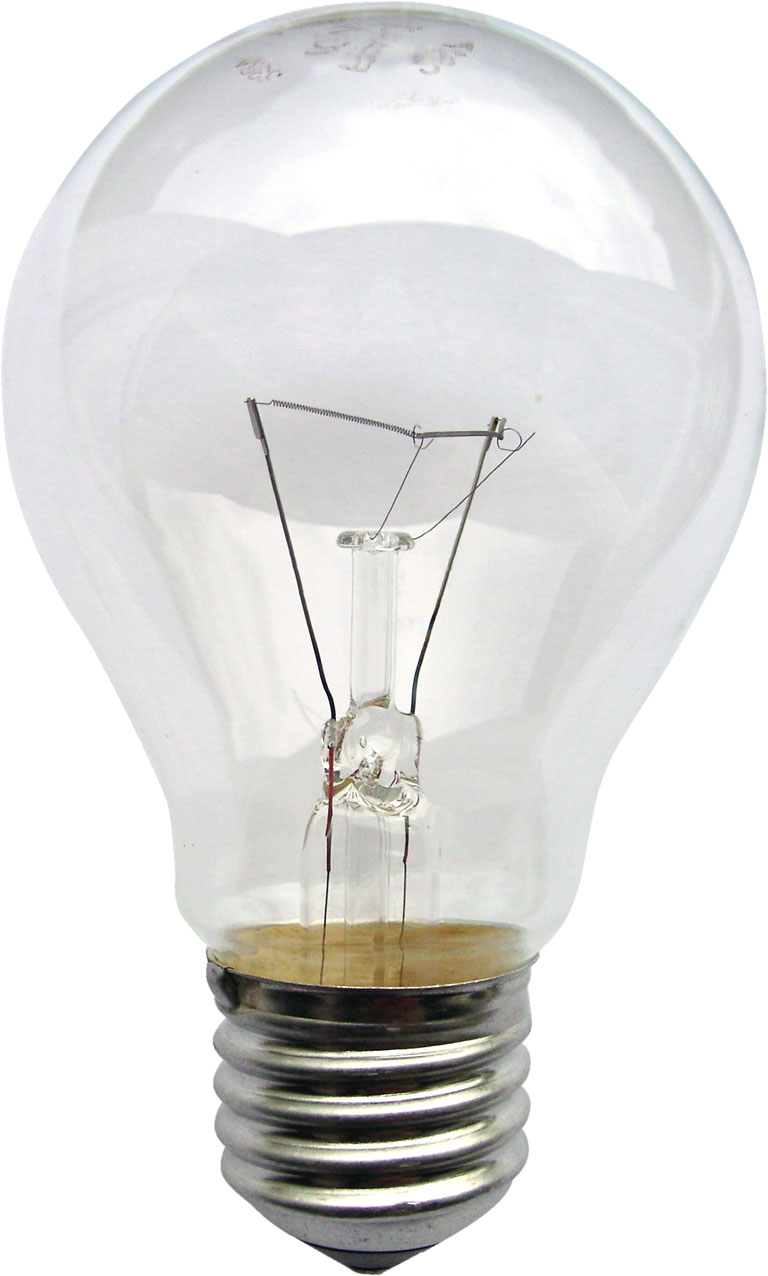
Correct — D, tungsten. A filament has to be driven white hot before it gives useful light, so the metal chosen must survive a temperature of a couple of thousand degrees without melting or boiling away. Tungsten has the highest melting point of all metals, about 3400 degrees Celsius, which is the decisive property. It also has a high electrical resistivity, so a short thin coil dissipates a lot of power as heat, and it can be drawn into a fine wire and wound into the tight coiled-coil that packs a long filament into a small glowing volume. The bulb is filled with an inert gas such as argon, or evacuated, to stop the hot tungsten from burning in air and to slow its evaporation.
Why the others are wrong
- (a)Aluminium — Aluminium melts at about 660 degrees Celsius, far below the temperature at which a filament must glow. It would melt long before the bulb produced any useful light.
- (b)Silver — Silver is the best electrical conductor of all metals, which is exactly the wrong property for a filament — a low resistance would mean little heat generated. It also melts at about 960 degrees Celsius, and it is far too expensive for the purpose.
- (c)Copper — Copper is an excellent conductor with low resistivity, which is why it is used for the connecting wires that must not heat up, and it melts near 1085 degrees Celsius. Its role in a circuit is precisely the opposite of a filament's.
Concept
An incandescent lamp produces light by heating a conductor until it glows, so its filament is chosen on three properties — a very high melting point, a high resistivity so that a modest current develops a large amount of heat, and enough ductility to be drawn into fine wire. Tungsten meets all three better than any competitor, which is why it displaced carbon filaments early in the twentieth century. Only a small fraction of the electrical energy supplied emerges as visible light and the rest is lost as heat, which is what makes incandescent lamps so much less efficient than fluorescent tubes and light-emitting diodes.
The option set is arranged around a single confusion — the difference between a conductor meant to carry current without heating and a resistor meant to heat. Copper and silver are the best conductors, and a student who reasons that a bulb needs a good conductor picks one of them. The filament needs the opposite: a high resistance to convert electrical energy into heat, and a melting point high enough to survive it. Ranking the four melting points settles the question on its own, since aluminium, silver and copper all melt well below the working temperature of a filament while tungsten stays solid. It also explains the design details around the filament — the coiled-coil geometry, the inert gas fill and the blackening of an old bulb, which is evaporated tungsten condensed on the glass.
Key facts
- Tungsten has the highest melting point of any metal, about 3400 °C, which is why it is used for lamp filaments.
- A filament needs high resistivity so that electrical energy is converted into heat and light; copper and silver, being excellent conductors, are unsuitable.
- Incandescent bulbs are evacuated or filled with an inert gas such as argon to prevent the hot filament from burning and to slow evaporation.
- The filament is wound as a coiled coil to pack a long wire into a small glowing volume.
- Most of the energy consumed by an incandescent bulb leaves as heat rather than visible light, making it far less efficient than an LED.
Study next
Common traps
- Reasoning that the best conductor makes the best filament, when a filament needs high resistance.
- Confusing the filament metal with the metal used for connecting wires, which is copper.
- Forgetting that the bulb must be gas-filled or evacuated, without which the filament would burn out at once.
As a straight recall of the filament metal, or through the property that justifies it — highest melting point or high resistivity.
Related PYQs
Consider the following statement: An ordinary light bulb has a rather short life because the I. Filament wire is not uniform. II. Bulb cannot be evacuated completely. III. Wires supporting the filament melt at high temperatures. Which of the above statements are correct?
- (a) I and III
- (b) II and III
- (c) I and II
- (d) I, II and III
Answer(b) II and III
Goes one step past this NDA item into why a tungsten filament eventually fails — residual gas inside the bulb speeds up the evaporation of the hot metal.
In an incandescent electric bulb, the filament of the bulb is made up of which metal?
- (a) Aluminium
- (b) Copper
- (c) Tungsten
- (d) Silver
Answer(c) Tungsten
The identical question with the identical option set, only reshuffled — a clean demonstration that NDA repeats settled science verbatim across sittings.
Practice
- practice — not a real PYQ
The filament of an incandescent bulb is enclosed in an inert gas or a vacuum mainly because
- (a)the filament would otherwise oxidise and burn out rapidly
- (b)an inert gas increases the resistance of the filament
- (c)it makes the light whiter
- (d)it reduces the voltage needed
Answer(a) the filament would otherwise oxidise and burn out rapidly — the inert filling also slows the evaporation of tungsten from the hot wire. - practice — not a real PYQ
The element used in the heating coils of electric irons and room heaters is usually
- (a)copper
- (b)nichrome
- (c)silver
- (d)aluminium
Answer(b) nichrome — an alloy with high resistivity and a high melting point that does not oxidise readily when hot.