
At which among the following Harappan sites are fire altars found?
- (a)Kalibangan
- (b)Harappa
- (c)Mohenjo-daro
- (d)Rakhi Garhi
Answer
Why
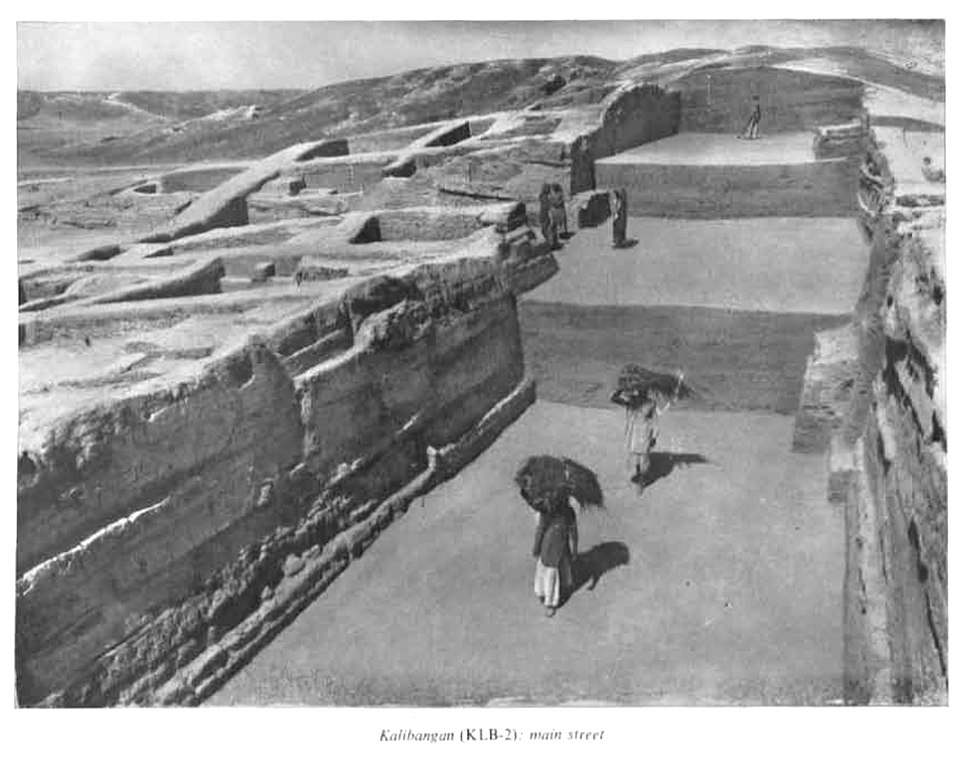
Correct — A, Kalibangan. Kalibangan, on the dried bed of the Ghaggar in Hanumangarh district of Rajasthan, is the Harappan site whose fire altars are its defining find. They turn up in three separate settings — a row of them on raised platforms in the southern half of the citadel, household ones inside houses of the lower town, and a further group of four or five in an isolated spot about eighty metres east of the lower town. The excavators describe them as oval fire-pits lined with burnt brick, containing a central sacrificial post, terracotta cakes, charcoal and animal bone, which is why they are read as ritual rather than domestic hearths.
Why the others are wrong
- (b)Harappa — Harappa's signature finds are of a different kind — the granaries, the rows of workmen's quarters and the R-37 cemetery. It is not the site the fire altars are associated with.
- (c)Mohenjo-daro — Mohenjo-daro is remembered for the Great Bath, the great granary, the bronze dancing girl, the bearded priest-king figure and the Pashupati seal. Its water-ritual evidence is the Great Bath, not fire altars, and it is chosen here mainly because it is the best-known site.
- (d)Rakhi Garhi — Rakhigarhi in Haryana is known chiefly as the largest Harappan settlement in India, for its several mounds, its planned streets and its cemetery. It is the weakest of the three wrong options, because later excavation reports there do also mention fire altars — but the site that syllabus material and the official key attach fire altars to is Kalibangan, where they are the central discovery.
Concept
Individual Harappan sites are learnt through the one find that distinguishes each of them — a dockyard at Lothal, a chain of rock-cut reservoirs and the ten-sign board at Dholavira, bead-making workshops at Chanhudaro, shell-working at Balakot, the Great Bath at Mohenjo-daro, and fire altars plus the earliest ploughed field at Kalibangan. Because the Harappan script is undeciphered, ritual life has to be reconstructed from objects, and the fire pits of Kalibangan are the strongest surviving evidence for organised fire ritual in the Indus cities.
The safest way to handle this family of questions is to fix one distinctive find per site and answer by elimination rather than by trying to remember every excavation. Here Mohenjo-daro is the tempting choice simply because it is the most famous name in the list. One honest wrinkle is worth carrying — fire altars have also been reported from Lothal and Banawali, and from Rakhigarhi, so the claim that they occur only at Kalibangan does not survive close reading of the excavation literature. What is uncontested, and what the option set is built on, is that Kalibangan is the site where fire altars are the headline discovery, and that is how the official key reads it.
Key facts
- Kalibangan lies in Hanumangarh district, Rajasthan, on the dry bed of the Ghaggar.
- Fire altars were found there in three settings — on raised platforms in the southern citadel, inside houses in the lower town, and in a separate group about eighty metres east of the lower town.
- The citadel altars are described as oval fire-pits of burnt brick with sacrificial posts, terracotta cakes, charcoal and animal bone.
- Kalibangan also produced the earliest ploughed field known to archaeology, a criss-cross grid of furrows dated to about 2800 BC.
Study next
Common traps
- Reaching for Mohenjo-daro because it is the most famous site; its ritual signature is the Great Bath.
- Assuming fire altars occur at exactly one site — Lothal, Banawali and Rakhigarhi have reported them too, but exams pair them with Kalibangan.
- Confusing Kalibangan's ploughed field with Banawali's terracotta plough model.
As a site-to-find match, as a 'which of these is not a Harappan site' item, or as a statement-based question on Harappan religion.
Related PYQs
Which one of the following ancient towns is well-known for its elaborate system of water harvesting and management where a series of bunds created check-dams and canals carried the water to connected reservoirs?
- (a) Dholavira
- (b) Kalibangan
- (c) Rakhigarhi
- (d) Ropar
Answer(a) Dholavira
The same question type with the same option pool — match the Harappan site to its distinguishing feature. Note that Kalibangan appears here as the wrong answer and in the NDA item as the right one, which is exactly why the one-find-per-site habit pays.
Which one of the following Harappan sites was a specialised centre for making shell objects?
- (a) Lothal
- (b) Balakot
- (c) Amri
- (d) Kot Diji
Answer(b) Balakot
NDA asks this family of questions repeatedly. One paper wants the shell-working centre, the next wants the fire-altar site; both are answered from a single table of sites and their signature finds.
Practice
- practice — not a real PYQ
The earliest ploughed agricultural field so far discovered in the Indian subcontinent was found at
- (a)Lothal
- (b)Kalibangan
- (c)Banawali
- (d)Ropar
Answer(b) Kalibangan — a pre-Harappan field of about 2800 BC with a criss-cross grid of furrows. - practice — not a real PYQ
Kalibangan is situated on the bed of which river?
- (a)Indus
- (b)Ravi
- (c)Ghaggar
- (d)Sutlej
Answer(c) Ghaggar — the site lies in Hanumangarh district, Rajasthan, on the dried Ghaggar-Hakra bed.