
Which one of the following Harappan sites was a specialised centre for making shell objects?
- (a)Lothal
- (b)Balakot
- (c)Amri
- (d)Kot Diji
Answer
Why
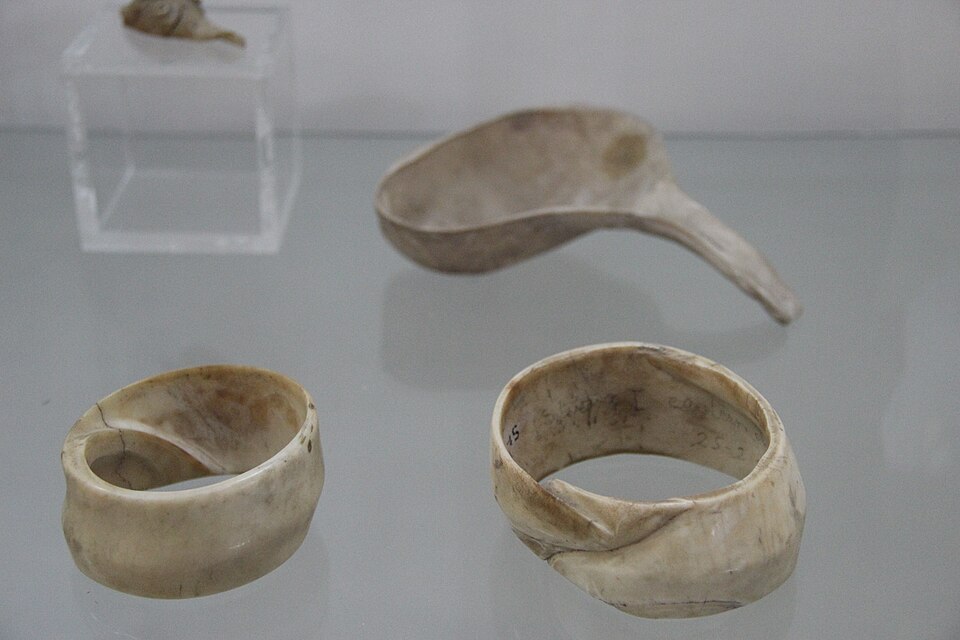
Correct — B, Balakot. Balakot was a coastal Harappan settlement (on the Makran coast, in present-day Pakistan) sitting close to rich marine-shell sources; it worked shell into bangles, ladles and inlay pieces and is the standard NCERT example — along with Nageshwar in Gujarat — of a settlement specialising in the manufacture of shell objects.
Why the others are wrong
- (a)Lothal — Lothal was a major Harappan craft town, but its signature is its brick tidal dockyard and its bead-making workshops (carnelian and agate) — not shell working; it is the tempting wrong answer because it is the best-known 'workshop' site.
- (c)Amri — Amri is a pre-/early-Harappan site in Sindh that lends its name to the Amri culture; it is known for its distinctive pottery, not as a specialised shell-object centre.
- (d)Kot Diji — Kot Diji is another early-Harappan site in Sindh (the Kot Dijian phase precedes the Mature Harappan); it is cited for fortification and pottery, not for specialised shell manufacture.
Concept
The Indus (Harappan) Civilization showed marked craft specialisation: different settlements concentrated on particular crafts largely according to their access to raw materials. Coastal sites near shell beds — Balakot and Nageshwar — became centres for making shell objects (bangles, ladles, inlay), while inland/manufacturing towns such as Lothal and Chanhudaro focused on stone beads, seals and weights.
Candidates are drawn to Lothal because it is the most famous Harappan 'factory' town, but its fame rests on the dockyard and bead industry. The discriminator is location and raw material: shell working clusters at the coast (Balakot), so the coastal site is the answer.
Key facts
- Balakot and Nageshwar were specialised centres for shell objects such as bangles, ladles and inlay.
- Lothal is famous for its brick dockyard and for bead-making in carnelian and agate.
- Chanhudaro was a manufacturing hub for beads, seals and weights.
- Amri and Kot Diji are early-Harappan cultures (Sindh), each named after its type-site, and predate the Mature Harappan phase.
Study next
Common traps
- Picking Lothal (dockyard + beads) when the question asks specifically about shell objects.
- Treating Amri and Kot Diji as Mature-Harappan craft towns — they are early-Harappan type-sites.
Usually as 'which site was known for X craft' or as a site-feature matching set (Lothal–dockyard, Balakot–shell, Chanhudaro–beads).
Related PYQs
Which of the following pairs are correctly matched? I. Lothal: Ancient dockyard II. Sarnath: First Sermon of Buddha III. Rajgir: Lion capital of Asoka IV. Nalanda: Great seat of Buddhist learning
- (a) I, II, III and IV
- (b) III and IV
- (c) I, II and IV
- (d) I and II
Answer(c) I, II and IV
Same concept — Harappan site-feature identification. This item tests that Lothal is the dockyard site, the flip side of knowing that shell working belongs to Balakot/Nageshwar rather than Lothal.
Which among the following materials was used in making the Harappan seals?
- (a) Sandstone
- (b) Lapis lazuli
- (c) Jasper
- (d) Steatite
Answer(d) Steatite
Same theme — Harappan material culture and craft (which material/craft is tied to which product), the exact reasoning needed to link shell objects to coastal Balakot.
In the Harappan Civilization, traces of canals have been found at
- (a) Banawali
- (b) Lothal
- (c) Shortughai
- (d) Dholavira
Answer(c) Shortughai
Same 'site-known-for-a-feature' pattern used across Harappan questions — matching a specific settlement to its distinctive characteristic.
Practice
- practice — not a real PYQ
Which one of the following Harappan sites is best known for its tidal dockyard?
- (a)Balakot
- (b)Lothal
- (c)Kalibangan
- (d)Ropar
Answer(b) Lothal — its brick-lined basin on the Gujarat coast is widely interpreted as a dockyard, and it was also a bead-making centre. - practice — not a real PYQ
Nageshwar and Balakot were Harappan settlements specialised in making
- (a)stone beads
- (b)shell objects
- (c)copper tools
- (d)cotton textiles
Answer(b) shell objects — both lay near the coast and worked marine shell into bangles, ladles and inlay.