
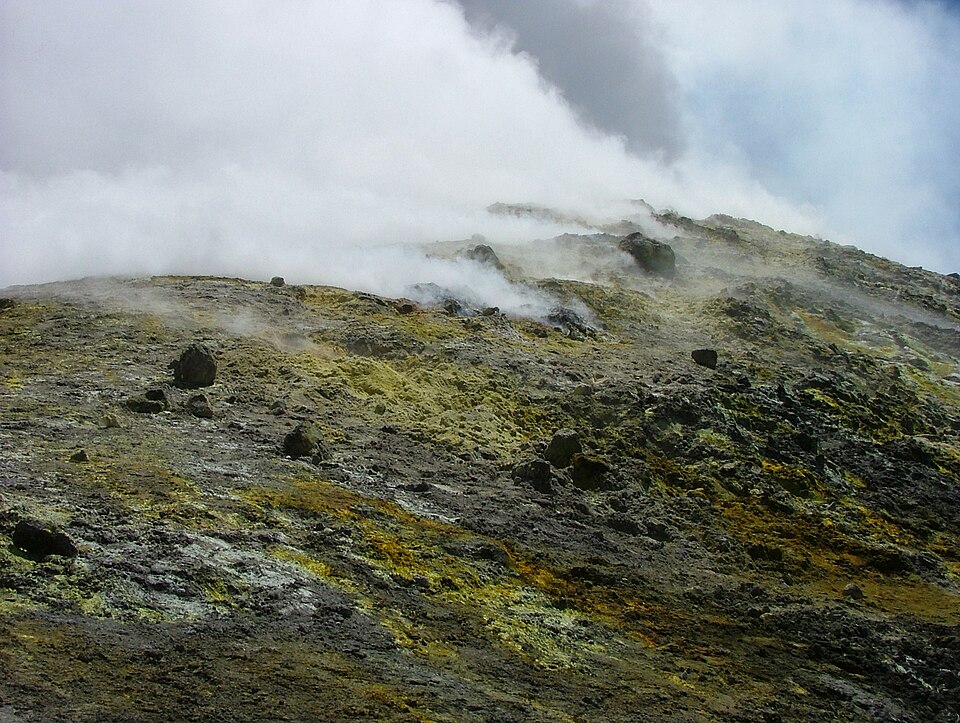
Vapours of sulphur escaping from a volcano often form a crust on the rocks. The process involved is an example of
- (a)condensation
- (b)precipitation
- (c)deposition
- (d)evaporation
Answer
Why
Correct — C, deposition. Deposition is the direct change of a substance from the gaseous state to the solid state without passing through the liquid state — the exact reverse of sublimation. Sulphur vapour driven out of a volcanic vent meets cold rock and cold air, loses energy, and its molecules lock straight into an ordered solid, building the yellow crust the question describes. No liquid sulphur forms in between, and it is that missing liquid stage which rules out condensation.
Why the others are wrong
- (a)condensation — Condensation is a gas turning into a liquid, as when water vapour forms dew or fog on a cold surface. The sulphur here builds a solid crust directly on the rock, so no condensation step occurs.
- (b)precipitation — In chemistry, precipitation is an insoluble solid separating out of a solution; in meteorology it is rain, snow or hail falling from the atmosphere. Neither describes a vapour turning solid on a rock face.
- (d)evaporation — Evaporation is a liquid turning into vapour. It is the reverse of what the stem describes, and it would carry material away from the rock rather than lay it down.
Concept
Changes of state are named after the two states involved. Solid to liquid is melting and liquid to solid is freezing; liquid to gas is vaporisation and gas to liquid is condensation. The two transitions that skip the liquid state altogether are sublimation, solid straight to gas, and deposition, gas straight to solid. Deposition releases energy, because particles move from a high-energy disordered state to a low-energy ordered one.
Students reach for condensation because it is the only gas-to-something process they meet regularly, but condensation specifically yields a liquid. The decisive clue in the stem is the word crust — a solid coating formed directly out of a vapour. Frost is the everyday parallel: on a cold night water vapour in the air turns straight to ice on a leaf or a windowpane, which is deposition, and it is not the same process that produces dew. Volcanic vents and fumaroles are the classic natural setting for this, where escaping sulphur builds up as bright yellow encrustations around the opening.
Key facts
- Deposition is the direct change from gas to solid, with no intervening liquid state.
- Sublimation is the reverse change, solid directly to gas, shown by camphor, naphthalene, iodine, ammonium chloride and dry ice.
- Condensation is gas to liquid, and freezing is liquid to solid.
- Frost forms by deposition of water vapour as ice, whereas dew forms by condensation into liquid water.
- Yellow sulphur encrustations around volcanic vents and fumaroles are built up by deposition.
Study next
Common traps
- Picking condensation because it is the familiar gas-to-something word.
- Confusing chemical precipitation with meteorological precipitation.
- Treating frost as ordinary condensation when it is in fact deposition.
By describing a real situation and asking which change of state it illustrates, or by pairing named substances with the transitions they undergo.
Related PYQs
Which one of the following is not a form of condensation?
- (a) Dew
- (b) Fog
- (c) Frost
- (d) Sleet
Answer(d) Sleet
The same family of vapour-to-solid and vapour-to-liquid changes, asked through weather instead of a volcano. It is a useful companion because geography textbooks group frost with the condensation forms, even though in physics terms water vapour turning straight into ice is deposition.
Practice
- practice — not a real PYQ
The direct conversion of a gas into a solid, without passing through the liquid state, is called
- (a)sublimation
- (b)condensation
- (c)deposition
- (d)fusion
Answer(c) deposition — sublimation is the reverse change, solid straight to gas. - practice — not a real PYQ
The formation of frost on a cold winter night is an example of
- (a)condensation
- (b)deposition
- (c)evaporation
- (d)melting
Answer(b) deposition — water vapour in the air turns directly into ice crystals without first becoming liquid water.