
Which one of the following allotropes of carbon is isomorphous with crystalline silicon?
- (a)Coke
- (b)Diamond
- (c)Graphite
- (d)Coal
Answer
Why
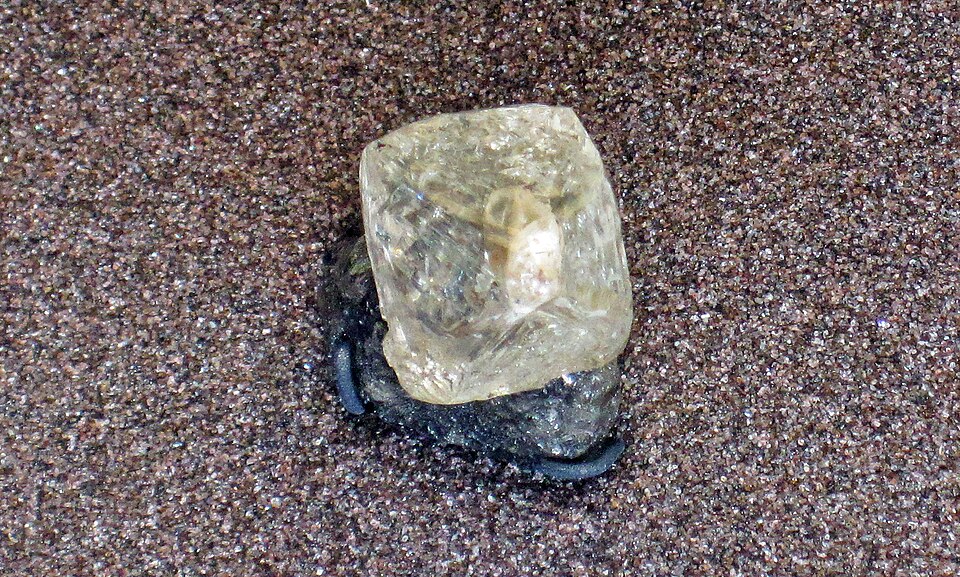
Correct — B, Diamond. Diamond crystallises in the diamond-cubic lattice — the same structure as crystalline silicon (and germanium) — in which each atom is bonded tetrahedrally to four neighbours, so diamond is isomorphous with silicon. Carbon and silicon are both Group-14 elements, which is why they share this structure.
Why the others are wrong
- (a)Coke — Coke is an impure, largely amorphous form of carbon obtained from coal; it has no ordered crystal lattice matching silicon.
- (c)Graphite — Graphite is built from layered hexagonal sheets, a quite different structure from silicon's tetrahedral diamond-cubic lattice.
- (d)Coal — Coal is a heterogeneous carbon-rich fossil material, not a crystalline allotrope, so it cannot be isomorphous with silicon.
Concept
Two substances are isomorphous when they crystallise in the same structural form. Diamond and crystalline silicon both adopt the diamond-cubic lattice, in which every atom is tetrahedrally bonded to four others. Carbon and silicon sit one above the other in Group 14, so this shared structure is expected.
Graphite is the reflex wrong answer because it is the most familiar carbon allotrope, but its layered sheets are nothing like silicon's tetrahedral network. Coke and coal are not even crystalline.
Key facts
- The diamond-cubic lattice (each atom bonded to four neighbours) is shared by diamond, silicon and germanium.
- Graphite has a layered hexagonal structure — different from silicon.
- Coke and coal are impure, non-crystalline forms of carbon.
- Carbon and silicon are congeners in Group 14 of the periodic table.
Study next
Common traps
- Picking graphite because it is the best-known carbon allotrope, though its structure is layered, not tetrahedral.
- Treating coke or coal as crystalline allotropes — they are impure, non-crystalline carbon.
Asked as which carbon allotrope shares silicon's crystal structure — the diamond-cubic (tetrahedral) lattice.
Related PYQs
Match List I (Naturally occurring substances: I. Diamond, II. Marble, III. Sand, IV. Ruby) with List II (Elements: A. Calcium, B. Silicon, C. Aluminium, D. Carbon) and select the correct code.
- (a) I-C, II-A, III-B, IV-D
- (b) I-D, II-B, III-A, IV-C
- (c) I-B, II-A, III-C, IV-D
- (d) I-D, II-A, III-B, IV-C
Answer(d) I-D, II-A, III-B, IV-C — diamond is carbon, marble calcium, sand silicon, ruby aluminium.
Reinforces that diamond is elemental carbon — the very fact behind its being a carbon allotrope isomorphous with silicon.
Match List-I with List-II and select the correct answer using the code given below the Lists: List-I (Allotrope of Carbon) A. Graphite B. Diamond C. Fullerene D. Graphene List-II (Property) 1. Thinnest and strongest material 2. Hardest natural substance 3. Very light and strong material 4. Soft and slippery material Code:
- (a) A-4, B-2, C-3, D-1
- (b) A-4, B-3, C-2, D-1
- (c) A-1, B-3, C-2, D-4
- (d) A-1, B-2, C-3, D-4
Answer(a) A-4, B-2, C-3, D-1
Same topic — the allotropes of carbon and how their structures differ; diamond (hardest) versus layered graphite, the distinction that matters here.
The elemental composition of diamond is
- (a) Carbon and Hydrogen
- (b) Carbon and Oxygen
- (c) Pure Carbon
- (d) Pure Silicon
Answer(c) Pure Carbon
Establishes that diamond is pure carbon — an allotrope of carbon, not silicon, even though it shares silicon's crystal structure.
Practice
- practice — not a real PYQ
Diamond and crystalline silicon both crystallise in the
- (a)hexagonal layered structure
- (b)diamond-cubic (tetrahedral) structure
- (c)body-centred cubic structure
- (d)amorphous form
Answer(b) diamond-cubic (tetrahedral) structure — each atom is bonded to four neighbours. - practice — not a real PYQ
Which one of the following is a crystalline allotrope of carbon?
- (a)Coke
- (b)Coal
- (c)Graphite
- (d)Soot
Answer(c) Graphite — a crystalline allotrope; coke, coal and soot are impure/amorphous carbon.