
The elemental composition of diamond is
- (a)Carbon and Hydrogen
- (b)Carbon and Oxygen
- (c)Pure Carbon
- (d)Pure Silicon
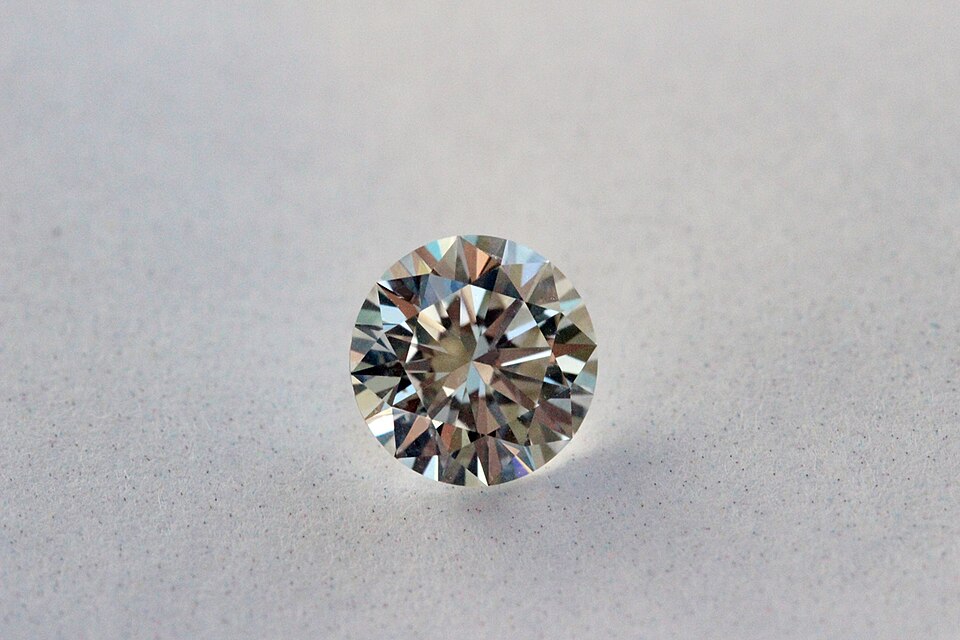
Correct — C, Pure Carbon. Diamond is an allotrope of carbon: it is made entirely of carbon atoms, each covalently bonded to four others in a rigid three-dimensional tetrahedral network. That giant covalent lattice is what makes diamond the hardest known natural material. It contains no element other than carbon.
- (a)Carbon and Hydrogen — Carbon and hydrogen make up hydrocarbons (such as methane or petrol), not diamond — diamond contains no hydrogen.
- (b)Carbon and Oxygen — Carbon and oxygen form gases such as CO2 and CO; diamond contains no oxygen.
- (d)Pure Silicon — Silicon is a different element (used in chips and, as SiO2, in sand and quartz). Diamond is carbon, not silicon.
Allotropes are different physical forms of the same element. Carbon's allotropes include diamond, graphite, fullerenes and graphene — all pure carbon but with different atomic arrangements. In diamond every carbon is bonded to four neighbours in a hard 3-D lattice; in graphite carbons form soft, slippery layers.
Diamond, graphite and charcoal are all forms of one element — carbon. Any option adding hydrogen, oxygen or a different element (silicon) must be wrong; the only choice consistent with an allotrope of carbon is 'pure carbon'.
- Diamond and graphite are both allotropes of pure carbon, differing only in atomic arrangement.
- In diamond each carbon bonds covalently to four others (tetrahedral 3-D lattice) — the hardest natural substance.
- In graphite carbon atoms form flat layers that slide, making it soft and a good conductor of electricity.
- Silicon and carbon are different elements; sand/quartz is silicon dioxide, not diamond.
- Thinking diamond contains silicon (confusing it with sand or quartz).
- Assuming a gemstone must be a compound — diamond is a pure element.
- Forgetting that graphite is the same element as diamond.
Exams ask the composition of diamond/graphite or to identify allotropes of carbon — remember both are pure carbon differing only in structure.
Match List I (Naturally occurring substances: I. Diamond, II. Marble, III. Sand, IV. Ruby) with List II (Elements: A. Calcium, B. Silicon, C. Aluminium, D. Carbon) and select the correct answer using the codes given below.
- (a) I-C, II-A, III-B, IV-D
- (b) I-D, II-B, III-A, IV-C
- (c) I-B, II-A, III-C, IV-D
- (d) I-D, II-A, III-B, IV-C
Answer(d) I-D, II-A, III-B, IV-C
UPSC matched diamond to its constituent element — carbon (Diamond to Carbon) — exactly the fact tested here: diamond is pure carbon (marble to calcium, sand to silicon, ruby to aluminium).
- practice — not a real PYQ
Graphite and diamond are:
- (a)Isotopes of carbon
- (b)Allotropes of carbon
- (c)Isomers of carbon
- (d)Compounds of carbon
Answer(b) Allotropes of carbon — the same element in different atomic arrangements.
- practice — not a real PYQ
Diamond is the hardest natural substance mainly because:
- (a)It is a metal
- (b)Each carbon is covalently bonded to four others in a 3-D network
- (c)It contains silicon
- (d)Its atoms are held by weak forces
Answer(b) Each carbon is covalently bonded to four others in a rigid three-dimensional lattice.