
A person had visited a region in India and found trees, such as Khair, Neem, Khejri and Palas. Which one of the following regions is she/he expected to have visited?
- (a)Malabar Coast
- (b)Garo Hills
- (c)Sunderban Delta
- (d)Desert Region
Answer
Why
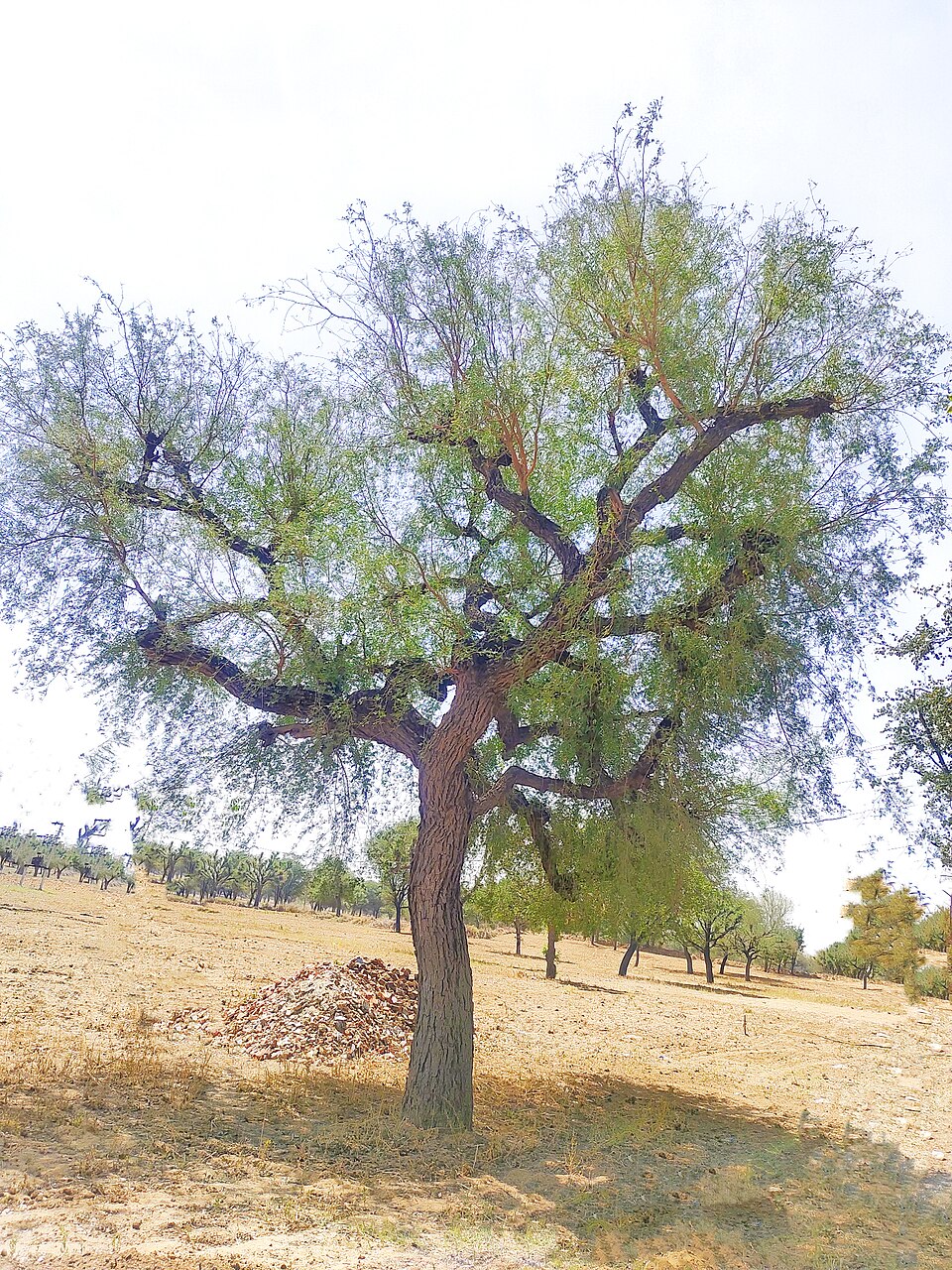
Correct — D, Desert Region. Khair (Acacia catechu), Neem, Khejri (Prosopis cineraria) and Palas (Butea monosperma) are drought-hardy trees of dry, arid and semi-arid tracts — the thorn and scrub vegetation of India's desert region, the Thar in Rajasthan. Khejri, in fact, is the state tree of Rajasthan and the mainstay of desert agro-forestry.
Why the others are wrong
- (a)Malabar Coast — The Malabar Coast is hot and very wet, covered in tropical evergreen rainforest, not drought-tolerant thorn trees.
- (b)Garo Hills — The Garo Hills of Meghalaya are among the wettest places on Earth, with dense moist forest — not desert species.
- (c)Sunderban Delta — The Sunderbans are tidal mangrove swamps (with species such as Sundari), utterly different from arid-zone trees.
Concept
Natural vegetation reflects climate. Arid and semi-arid regions carry tropical thorn forest and scrub — widely spaced, drought-resistant trees with deep roots, small or waxy leaves and thorns. Khejri, Khair, Neem, Ber and Palas are typical of this desert and dry-region flora.
This is an indicator-species question: identify the climate from the plants. All four listed trees are xerophytic (drought-adapted), so the visitor must have been in the arid desert region, not a wet coast, hill or delta.
Key facts
- Khejri (Prosopis cineraria) is the state tree of Rajasthan and central to desert life.
- Khair, Neem and Palas are drought-tolerant trees of dry and semi-arid tracts.
- Arid regions carry tropical thorn forest and scrub, with thorny, deep-rooted, small-leaved plants.
- The Bishnoi community's Khejarli sacrifice (1730) was made to protect Khejri trees.
Study next
Common traps
- Being distracted by 'green' regions (coast, hills, delta) — the listed trees are all desert-adapted.
- Confusing mangroves (Sundari) with arid-zone trees.
Lists indicator tree species and asks the region — recognise Khejri, Khair and Palas as desert flora.
Related PYQs
The natural vegetation which covers the maximum geographical areas of India is
- (a) Tropical deciduous forests
- (b) Tropical thorn forests
- (c) Montane forests
- (d) Tropical evergreen forests
Answer(a) Tropical deciduous forests
Same concept — matching India's vegetation types to climate. That item ranks the vegetation classes by area; this one uses indicator trees to pin down the arid, thorn-forest desert region.
Practice
- practice — not a real PYQ
The Khejri tree, the state tree of Rajasthan, is best adapted to which environment?
- (a)Wet coastal
- (b)Arid or desert
- (c)Alpine
- (d)Mangrove swamp
Answer(b) Arid or desert — Khejri is a hallmark of the Thar's thorn vegetation. - practice — not a real PYQ
Which type of natural vegetation is characteristic of India's arid regions?
- (a)Tropical evergreen forest
- (b)Tidal mangrove forest
- (c)Tropical thorn forest and scrub
- (d)Montane temperate forest
Answer(c) Tropical thorn forest and scrub — thorny, drought-adapted vegetation.