
The natural vegetation which covers the maximum geographical areas of India is
- (a)Tropical deciduous forests
- (b)Tropical thorn forests
- (c)Montane forests
- (d)Tropical evergreen forests
Answer
Why
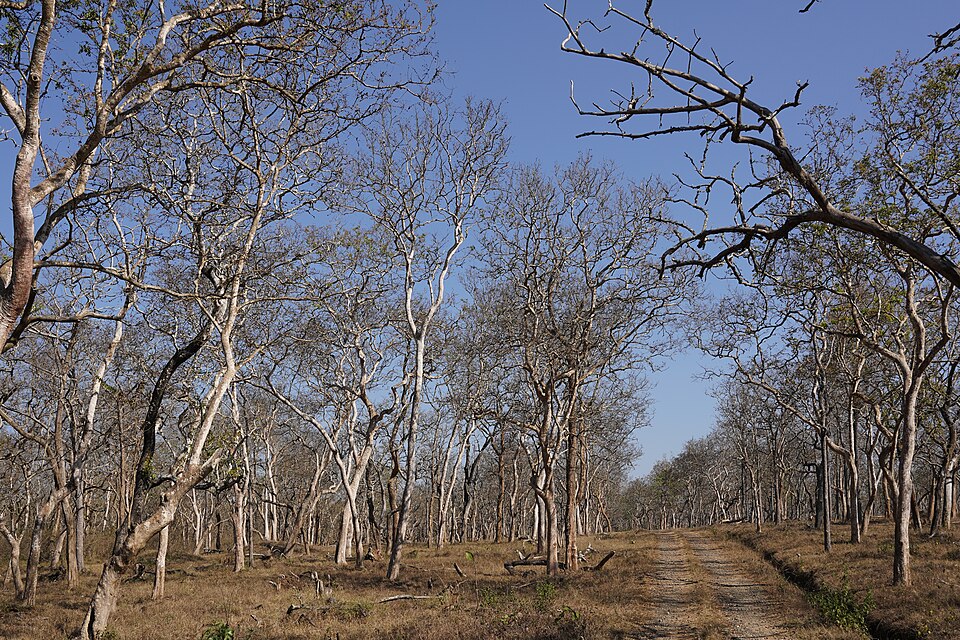
Correct — A, Tropical deciduous forests. Tropical deciduous (monsoon) forests — trees that shed their leaves in the dry season — are the most widespread natural vegetation in India. They occur over large stretches of the country in areas receiving roughly 70-200 cm of annual rainfall and include commercially valuable species such as teak and sal, covering more area than any of the other listed types.
Why the others are wrong
- (b)Tropical thorn forests — Tropical thorn and scrub forests are confined to the semi-arid north-west (much of Rajasthan and parts of Gujarat, Punjab and Haryana) with under 70 cm of rain — a smaller area than the deciduous forests.
- (c)Montane forests — Montane (mountain) forests are restricted to the higher Himalayas and other hill ranges, arranged in altitudinal belts; they cover far less of India's surface.
- (d)Tropical evergreen forests — Tropical evergreen (rain) forests grow only in the very high-rainfall pockets of the Western Ghats, the north-east and the Andaman & Nicobar Islands — a comparatively small area.
Concept
India's natural vegetation is classified largely by rainfall and temperature into tropical evergreen, tropical deciduous (monsoon), tropical thorn, montane (mountain) and littoral/mangrove forests. Because most of the country lies in the monsoon belt with moderate seasonal rainfall, the tropical deciduous type dominates the largest area.
Each option is a genuine Indian forest type, so the question is about relative extent. The clue is the monsoon climate: the type suited to the country's dominant rainfall regime (70-200 cm, with a dry season) is the tropical deciduous forest, which therefore covers the most ground.
Key facts
- Tropical deciduous (monsoon) forests are India's most widespread natural vegetation.
- They occur in areas with roughly 70-200 cm of annual rainfall and shed leaves in the dry season.
- Teak and sal are characteristic tropical deciduous species.
- Thorn forests (semi-arid NW), evergreen forests (very high rainfall) and montane forests (hills) each cover smaller areas.
Study next
Common traps
- Confusing 'maximum area' with the most luxuriant type — evergreen forests are dense but cover little area.
- Assuming thorn forests dominate because much of India is dry; the deciduous belt is larger.
Asked as 'which vegetation covers the largest area / occurs in rainfall zone X', or by matching forest types to their climatic regions.
Related PYQs
Open stunted forests with bushes and small trees having long roots and sharp thorns or spines are commonly found in
- (a) Eastern Orissa
- (b) North-eastern Tamil Nadu
- (c) Siwaliks in Terai region
- (d) Western Andhra Pradesh
Answer(d) Western Andhra Pradesh
Same concept — India's forest types and their rainfall-based distribution (here thorn forests), the classification used to rank tropical deciduous forests as the most extensive.
Which one of the following is the natural vegetation of South-east China?
- (a) Subtropical broadleaf evergreen forest
- (b) Tropical broadleaf evergreen forest
- (c) Tropical deciduous forest
- (d) Temperate evergreen forest
Answer(a) Subtropical broadleaf evergreen forest
Same concept — identifying natural-vegetation types by climate, the same reasoning used to match India's dominant rainfall belt to tropical deciduous forest.
Temperate forests of South India, known as 'Sholas' are found in which of the following hills? 1. Anaimalai; 2. Nilgiris; 3. Palani.
- (a) 1 only
- (b) 1 and 2 only
- (c) 2 and 3 only
- (d) 1, 2 and 3
Answer(d) 1, 2 and 3
Same theme — Indian forest/vegetation types and their locations (here montane Shola forests), the wider classification within which tropical deciduous forests are the most extensive.
Practice
- practice — not a real PYQ
Tropical evergreen forests in India are chiefly found in
- (a)the semi-arid north-west
- (b)the Western Ghats, north-east and Andaman & Nicobar Islands
- (c)the Deccan plateau interior
- (d)the higher Himalayas
Answer(b) the Western Ghats, north-east and Andaman & Nicobar Islands — the very high-rainfall regions. - practice — not a real PYQ
Teak and sal are characteristic species of which forest type in India?
- (a)Tropical thorn forests
- (b)Tropical deciduous forests
- (c)Montane forests
- (d)Mangrove forests
Answer(b) Tropical deciduous forests — India's most widespread vegetation type.