
Which of the following statements in respect of landslides are correct? 1. These occur only on gentle slopes during rain. 2. They generally occur in clay-rich soil. 3. Earthquakes trigger landslides. Select the correct answer using the code given below.
- (a)1 and 2 only
- (b)1 and 3 only
- (c)2 and 3 only
- (d)1, 2 and 3
Answer
Why
Correct — C, 2 and 3 only. Statement 1 is false: landslides occur mainly on steep, not gentle, slopes — the whole point is a steep gradient down which material can slide. Statement 2 is correct: clay-rich soils are especially landslide-prone because, when saturated, clay becomes slippery and loses shear strength, so the mass gives way. Statement 3 is correct: earthquakes are a major trigger, as ground shaking dislodges rock and soil on unstable slopes. Hence statements 2 and 3 are the right ones.
Why the others are wrong
- (a)1 and 2 only — Statement 1 is wrong — landslides need steep slopes, not gentle ones — so any option that includes 1 is incorrect.
- (b)1 and 3 only — It keeps the false statement 1 (gentle slopes) and, worse, drops the true statement 2 about clay-rich soils.
- (d)1, 2 and 3 — It wrongly treats statement 1 as correct; landslides are not confined to gentle slopes.
Concept
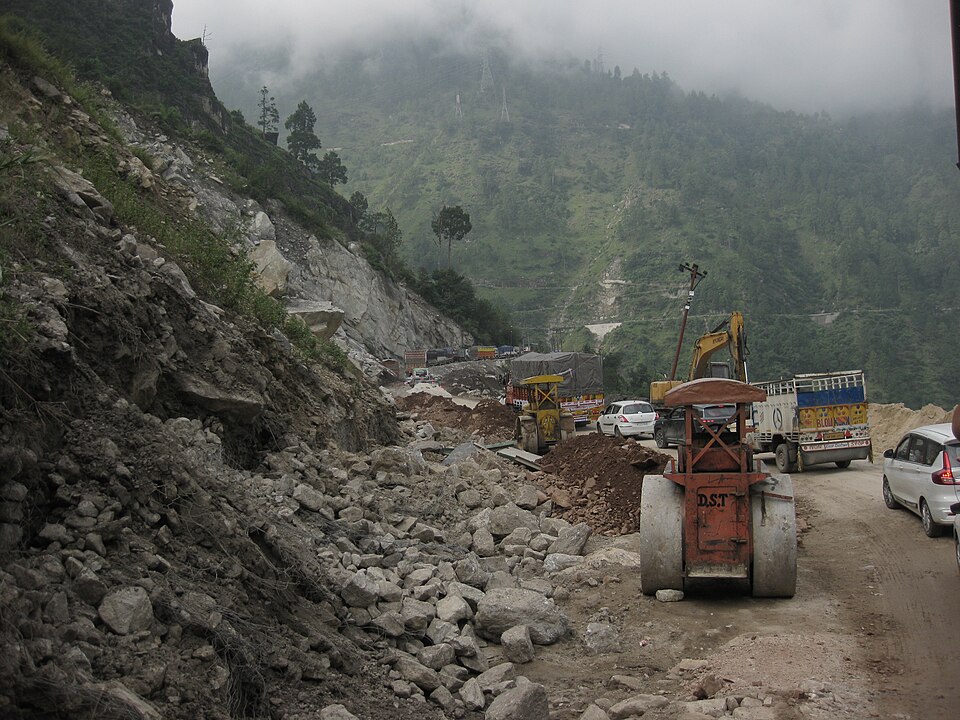
A landslide is a rapid downslope mass movement of rock, debris or soil. Its likelihood rises with steep gradients, water saturation, weak or clay-rich material, and triggering shocks. Common triggers are intense rainfall and earthquakes, which is why the Himalayas and the Western Ghats see them often.
The examiner plants an over-broad claim (statement 1) that landslides happen 'only on gentle slopes' — the reverse of reality — to catch hurried readers. Statements 2 (clay-rich, saturated soils) and 3 (earthquake triggers) are the sound ones.
Key facts
- Landslides occur predominantly on steep slopes, not gentle ones.
- Water-saturated clay-rich soils lose strength and are highly landslide-prone.
- Earthquakes and heavy/prolonged rainfall are the principal triggers of landslides.
- In India, the Himalayas and the Western Ghats are the most landslide-prone regions.
Study next
Common traps
- Accepting the over-broad 'only on gentle slopes' claim; landslides need steep slopes.
- Assuming rain is the sole cause and overlooking earthquakes as triggers.
As a statements-and-code item that mixes one clearly false over-generalisation with two correct facts on landslide causes.
Related PYQs
A great landslide caused by an earthquake killed hundreds of people in January 2001 near
- (a) San Salvador
- (b) San Jose
- (c) Managua
- (d) Guatemala City
Answer(a) San Salvador
Same concept — earthquakes triggering landslides. This UPSC item recalls the January 2001 El Salvador quake-triggered landslide, reinforcing statement 3 of this question.
Practice
- practice — not a real PYQ
Landslides in India are most frequent in which of the following regions?
- (a)The Himalayas and the Western Ghats
- (b)The Thar Desert
- (c)The Indo-Gangetic plain
- (d)The Deccan lava plateau interior
Answer(a) The Himalayas and the Western Ghats — steep, high-rainfall terrain. - practice — not a real PYQ
Which one of the following is the most common natural trigger of landslides on already unstable slopes?
- (a)Intense rainfall or an earthquake
- (b)Sea-level rise
- (c)A solar eclipse
- (d)A drop in atmospheric pressure only
Answer(a) Intense rainfall or an earthquake.