
Consider the following features about a geographical phenomenon: 1. Torrents of snow and ice roaring down a steep mountain side 2. It is hazardous to skiers and mountaineers 3. It involves a mix of falling, rolling, sliding and flowing of materials Which of the following phenomena can be identified with the above features?
- (a)Slump and earthflow
- (b)Avalanche
- (c)Landslide
- (d)Rockslide
Answer
Why
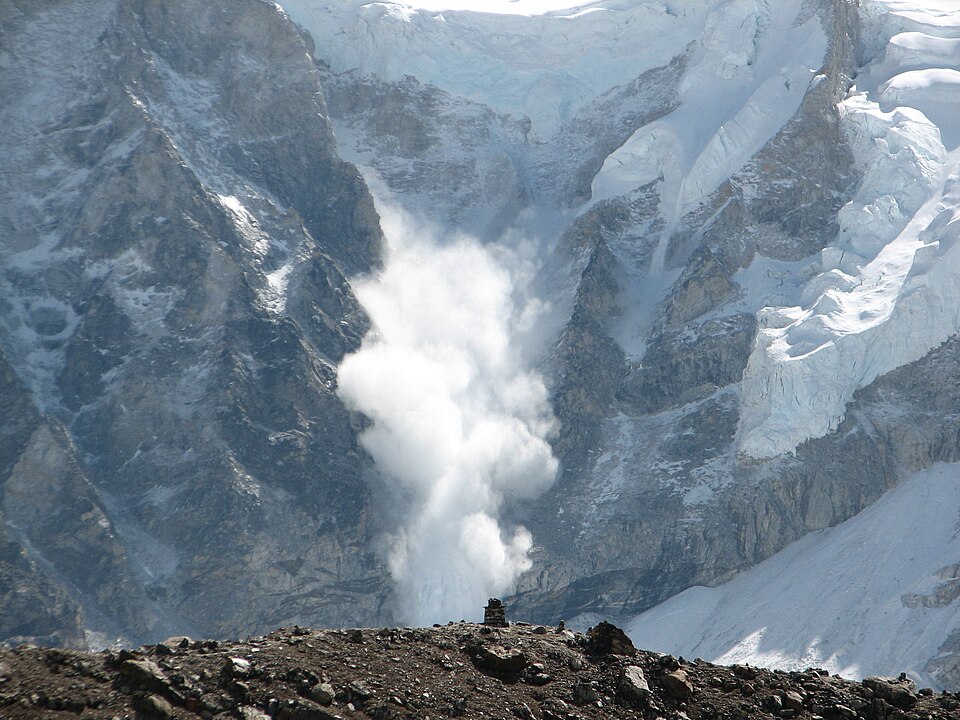
Correct — B, Avalanche. The three features name a mass of snow and ice: 'torrents of snow and ice' racing down a steep mountainside, the danger to skiers and mountaineers, and the mix of falling, rolling, sliding and flowing all describe a snow avalanche — the sudden rapid downslope movement of a large mass of snow and ice. The defining ingredient here is snow and ice, which sets it apart from the rock-and-soil movements in the other options.
Why the others are wrong
- (a)Slump and earthflow — A slump is a rotational slip of rock/soil and an earthflow is the flow of water-saturated soil; both involve earth material, not the snow and ice described.
- (c)Landslide — A landslide is the downslope movement of rock, debris and soil; it is a broader earth-material term and does not specifically mean the snow-and-ice mass roaring down described here.
- (d)Rockslide — A rockslide is the sliding of a rock mass along a slope; it is made of rock, not the snow and ice that define an avalanche.
Concept
An avalanche is a rapid mass movement in which a large volume of snow and ice, sometimes with rock and debris, rushes down a steep slope. It is one of the chief hazards of high, snow-clad mountains and is triggered by fresh snowfall, warming, or vibration. The other options are mass movements of rock and soil rather than snow.
Every feature in the question can be checked against the options: the phrase 'snow and ice' is decisive, since landslide, rockslide and slump/earthflow all involve earth material. Only the avalanche is a snow-and-ice phenomenon, so the described features are answerable without needing any accompanying picture.
Key facts
- An avalanche is the sudden downslope rush of a mass of snow and ice on a steep mountain slope.
- It is a major hazard for skiers, mountaineers and high-altitude settlements.
- Triggers include heavy fresh snowfall, rapid warming, slope steepness and vibrations.
- Landslides, rockslides and slumps involve rock and soil, not snow and ice.
Study next
Common traps
- Choosing 'landslide' as a catch-all and ignoring that the material named is snow and ice.
- Overlooking the phrase 'snow and ice', which is the single clue that fixes the answer.
As a feature-matching item where the 'snow and ice' clue must be separated from rock-and-soil mass movements.
Related PYQs
A great landslide caused by an earthquake killed hundreds of people in January 2001 near
- (a) San Salvador
- (b) San Jose
- (c) Managua
- (d) Guatemala City
Answer(a) San Salvador
Adjacent concept — rapid downslope mass movements as hazards. The avalanche (snow) and the landslide (rock and soil) are sister mass-movement hazards; this UPSC item tests the landslide side.
Practice
- practice — not a real PYQ
A sudden rapid flow of a large mass of snow down a mountain slope is called a/an
- (a)landslide
- (b)avalanche
- (c)mudflow
- (d)rockfall
Answer(b) avalanche — a rapid downslope movement of snow and ice. - practice — not a real PYQ
Which one of the following mass movements involves rock and soil rather than snow?
- (a)Snow avalanche
- (b)Landslide
- (c)Ice fall
- (d)Glacier surge
Answer(b) Landslide — movement of rock, debris and soil down a slope.