
While travelling to a hilly region, you notice a massive boulder, which was loosened by heavy rains and moved downhill. This has resulted due to which of the following processes? 1. Mass wasting 2. Erosion 3. Weathering Select the correct answer using the code given below.
- (a)1 only
- (b)1 and 2 only
- (c)2 and 3 only
- (d)1, 2 and 3
Answer
Why
Correct — D, 1, 2 and 3. A boulder loosened by rain and sliding downhill involves all three processes. Weathering (3) first broke and weakened the rock in place, detaching the boulder from the parent mass. Heavy rain then acted as an agent of erosion (2), prising the loosened block free and washing material around it. Finally the block moved down the slope under gravity, which is mass wasting (1) — the downslope movement of rock and soil under their own weight. So weathering prepares the material, erosion and rain loosen it, and mass wasting carries it downhill.
Why the others are wrong
- (a)1 only — Mass wasting describes the downhill movement, but the boulder was first broken loose by weathering and freed by rain-driven erosion, so those processes are also involved.
- (b)1 and 2 only — It leaves out weathering, which is what fragmented and loosened the rock in the first place before it could move.
- (c)2 and 3 only — It omits mass wasting, yet the boulder's downslope movement under gravity is exactly mass wasting.
Concept
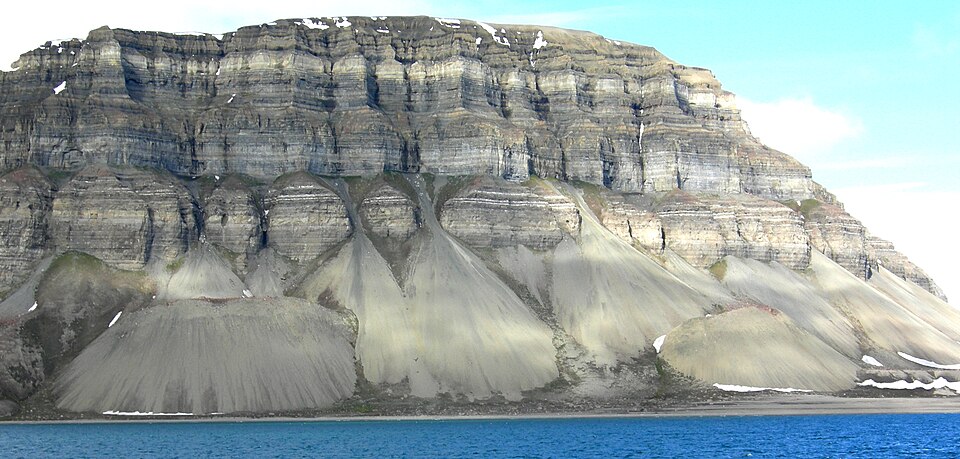
The wearing down of the land is denudation, which combines weathering (in-place breakdown of rock by physical, chemical or biological action), mass wasting (downslope movement of loosened material under gravity), and erosion (loosening, removal and transport of material by agents such as water, ice and wind). In hilly terrain, rain often triggers all three together.
The scenario is designed so that each clue maps to a process: 'loosened' points to weathering, 'heavy rains' points to rain-driven erosion, and 'moved downhill' points to mass wasting. Recognising that they act as a chain gives the all-three answer.
Key facts
- Weathering breaks rock in place; it does not by itself move the material away.
- Mass wasting is the downslope movement of rock, debris or soil under gravity, often aided by water.
- Erosion involves loosening plus removal and transport by an agent such as running water.
- Heavy rain is a common trigger that links weathering, erosion and mass wasting on steep slopes.
Study next
Common traps
- Treating mass wasting and erosion as the same thing (mass wasting is gravity-driven; erosion needs a transporting agent).
- Forgetting weathering, which prepares the loose material before any movement.
As a scenario-based 'which processes are involved' item, or a match/definition item distinguishing weathering, erosion and mass wasting.
Related PYQs
Consider the following statements: Statement-I: Rainfall is one of the reasons for weathering of rocks. Statement-II: Rain water contains carbon dioxide in solution. Statement-III: Rain water contains atmospheric oxygen. Which one of the following is correct in respect of the above statements?
- (a) Both Statement-II and Statement-III are correct and both of them explain Statement-I
- (b) Both Statement-II and Statement-III are correct, but only one of them explains Statement-I
- (c) Only one of the Statements II and III is correct and that explains Statement-I
- (d) Neither Statement-II nor Statement-III is correct
Answer(a) Both Statement-II and Statement-III are correct and both of them explain Statement-I
Same theme — rainfall and the weathering of rocks. This UPSC item explains how rain drives chemical weathering, the first link in the chain (weathering to mass wasting) tested here.
Which of the following is/are the applied forces in mechanical weathering process? 1. Gravitational force; 2. Expansion force; 3. Force due to water pressure.
- (a) 1 only
- (b) 1 and 2 only
- (c) 2 and 3 only
- (d) 1, 2 and 3
Answer(d) 1, 2 and 3
A later NDA item on the forces behind mechanical weathering — the same weathering process that loosens rock before mass wasting moves it downhill.
Practice
- practice — not a real PYQ
The downslope movement of rock and soil under the direct influence of gravity is called
- (a)weathering
- (b)mass wasting
- (c)deposition
- (d)leaching
Answer(b) mass wasting — gravity-driven movement of material down a slope. - practice — not a real PYQ
Which process refers to the in-place breakdown of rocks without their removal?
- (a)Erosion
- (b)Transportation
- (c)Weathering
- (d)Deposition
Answer(c) Weathering — disintegration and decomposition of rock in situ.