
In which one of the following countries is intensive subsistence agriculture not predominantly practised?
- (a)India
- (b)Japan
- (c)Canada
- (d)Indonesia
Answer
Why
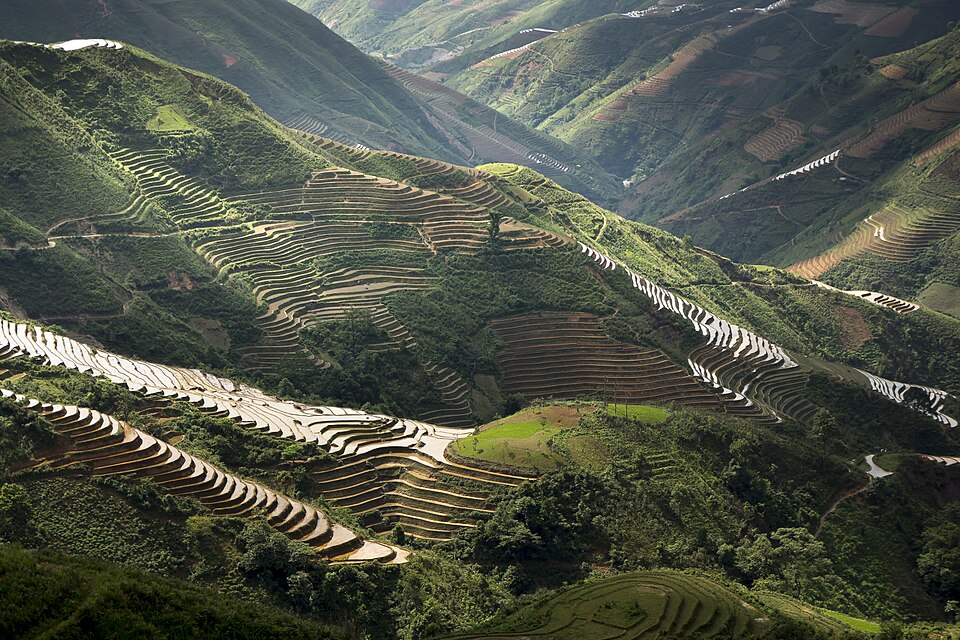
Correct — C, Canada. Intensive subsistence agriculture — small landholdings worked very intensively with abundant human labour, mainly to feed the cultivator's own family — dominates the densely populated monsoon lands of Asia such as India, Japan and Indonesia. Canada is sparsely populated and practises large-scale, mechanised, extensive commercial farming (chiefly wheat on the Prairies), so intensive subsistence agriculture is not predominant there.
Why the others are wrong
- (a)India — India is a classic land of intensive subsistence farming — small holdings, heavy labour input and food crops like rice and wheat — so it is a place where it IS practised.
- (b)Japan — Japan farms tiny, intensively cultivated holdings, especially wet-rice, with very high yields per hectare — a textbook example of intensive subsistence agriculture.
- (d)Indonesia — Indonesia (e.g. densely populated Java) is dominated by intensive wet-rice subsistence farming, so it too is a place where the practice predominates.
Concept
Intensive subsistence agriculture is farming on small plots with high inputs of human labour (and often manure/irrigation) to obtain maximum output per unit area, largely for the family's own consumption. It is characteristic of the densely peopled monsoon regions of South, South-East and East Asia. It contrasts with extensive commercial farming, where large farms are worked with machinery mainly for the market.
Three options are crowded Asian monsoon countries; the fourth, Canada, is a thinly populated country of the Americas. The discriminator is population density and farm type: the odd one out is the land of extensive commercial (not intensive subsistence) agriculture — Canada.
Key facts
- Intensive subsistence farming = small holdings, high labour input, mainly for self-consumption.
- It predominates in monsoon Asia — India, China, Japan, Indonesia and South-East Asia.
- Canada practises extensive commercial grain (wheat) farming on the Prairies, using machinery and large farms.
- The key variables are population density, farm size and whether output is for family use or the market.
Study next
Common traps
- Assuming a developed country like Japan must be commercial — Japan is intensively farmed subsistence-style.
- Overlooking population density, the key clue that separates Canada from the crowded Asian countries.
Asked as 'which country does/does not practise agriculture type X', or by matching a farming system to its typical region.
Related PYQs
Dry land farming in India is largely confined to areas with rainfall less than
- (a) 100 cm
- (b) 85 cm
- (c) 80 cm
- (d) 75 cm
Answer(d) 75 cm
Same domain — types and distribution of Indian/Asian farming systems; recognising farming types by environment is the reasoning used to separate intensive subsistence (monsoon Asia) from commercial farming (Canada).
Practice
- practice — not a real PYQ
Intensive subsistence agriculture is most characteristic of which of the following regions?
- (a)The Canadian Prairies
- (b)Monsoon Asia
- (c)The Argentine Pampas
- (d)The North American Great Plains
Answer(b) Monsoon Asia — densely populated regions farm small plots intensively for self-consumption. - practice — not a real PYQ
Large mechanised wheat farms worked mainly for the market are an example of
- (a)intensive subsistence farming
- (b)extensive commercial grain farming
- (c)shifting cultivation
- (d)plantation agriculture
Answer(b) extensive commercial grain farming — typical of thinly populated regions like the Canadian Prairies.