
Swami Dayanand Saraswati 1. was opposed to the worship of idols of Gods and Goddesses. 2. regarded the Vedas as infallible. 3. had met and had discussions with Ishwar Chandra Vidyasagar. Which of the statements given above are correct?
- (a)1, 2 and 3
- (b)2 and 3 only
- (c)1 and 3 only
- (d)1 and 2 only
Answer
Why
Correct — A, 1, 2 and 3. Swami Dayanand Saraswati, founder of the Arya Samaj (1875), condemned idol-worship (1) and held the Vedas to be infallible and the final authority — his rallying cry was 'Back to the Vedas' (2). During his tour of Bengal in 1872–73 he met and debated with reformers of the day, including Ishwar Chandra Vidyasagar (3). All three statements are therefore correct.
Why the others are wrong
- (b)2 and 3 only — It wrongly drops statement 1 — Dayanand was strongly opposed to idol-worship, so statement 1 is true.
- (c)1 and 3 only — It wrongly drops statement 2 — Dayanand explicitly regarded the Vedas as infallible, so statement 2 is true.
- (d)1 and 2 only — It wrongly drops statement 3 — Dayanand did meet and hold discussions with Vidyasagar during his Bengal visit.
Concept
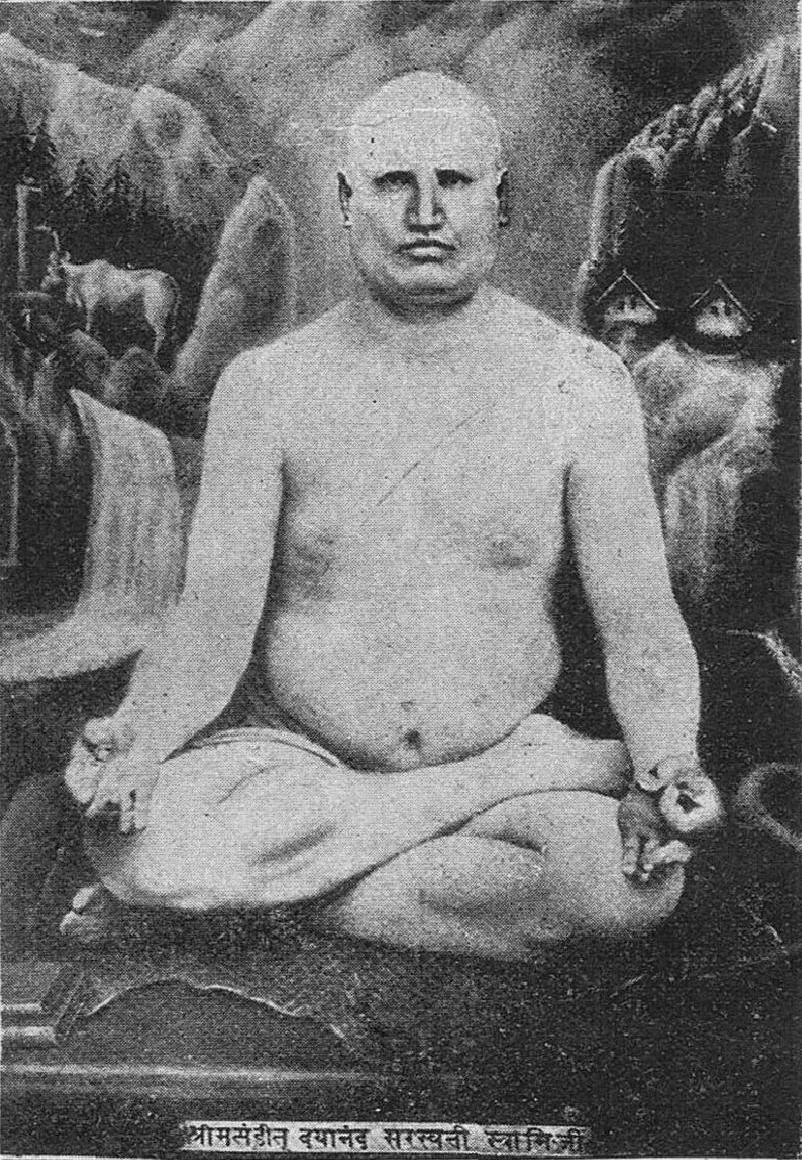
Swami Dayanand Saraswati (1824–1883) founded the Arya Samaj in Bombay in 1875. He rejected idolatry, hereditary priesthood, caste by birth and untouchability, and preached a return to the pure teachings of the Vedas, which he treated as infallible and self-sufficient revelation. His key text was Satyarth Prakash.
The uncertain statement for most students is (3) — the personal meeting with Vidyasagar. Dayanand toured Bengal in 1872–73 and interacted with leading reformers there, which makes all three statements true and rules out the 'only' options.
Key facts
- Dayanand Saraswati founded the Arya Samaj in 1875 (in Bombay).
- He opposed idol-worship and preached 'Back to the Vedas'.
- He regarded the Vedas as infallible and the ultimate authority.
- During his 1872–73 Bengal visit he met reformers including Ishwar Chandra Vidyasagar.
Study next
Common traps
- Dating the Arya Samaj to 1835 instead of 1875 (a classic UPSC trap).
- Assuming Dayanand had no contact with Bengal reformers such as Vidyasagar.
Asked through statement-based questions on Dayanand's ideas or by matching reformers to their organisations and beliefs.
Related PYQs
Consider the following statements: I. Arya Samaj was founded in 1835. II. Lala Lajpat Rai opposed the appeal of Arya Samaj to the authority of Vedas... (statements on Arya/Brahmo Samaj). Which are correct?
- (a) I and II
- (b) II and III
- (c) II and IV
- (d) III and IV
Answer(d) III and IV
Same topic — Dayanand's Arya Samaj (note the trap that it was founded in 1875, not 1835).
Consider the following statements related to Dayanand's idea of social reform: 1. Dayanand's reform envisaged a social order, where different castes performed functions suitable to their status determined by merit. 2. Dayanand's 'robust Vedic counterpart' challenged the masculine West that had enslaved the Aryavarta. Which of the statement/s given above is/are correct?
- (a) 1 only
- (b) 2 only
- (c) Both 1 and 2
- (d) Neither 1 nor 2
Answer(c) Both 1 and 2
Same figure — Swami Dayanand Saraswati and the ideology of his Arya Samaj reform programme.
Practice
- practice — not a real PYQ
The Arya Samaj was founded by Swami Dayanand Saraswati in the year
- (a)1828
- (b)1835
- (c)1875
- (d)1905
Answer(c) 1875 — founded in Bombay. - practice — not a real PYQ
Which text of Swami Dayanand Saraswati sets out his core teachings?
- (a)Satyarth Prakash
- (b)Gitanjali
- (c)Anandamath
- (d)Grammar of Politics
Answer(a) Satyarth Prakash — his principal doctrinal work.