
Consider the following statements related to Dayanand's idea of social reform: 1. Dayanand's reform envisaged a social order, where different castes performed functions suitable to their status determined by merit. 2. Dayanand's 'robust Vedic counterpart' challenged the masculine West that had enslaved the Aryavarta. Which of the statement/s given above is/are correct?
- (a)1 only
- (b)2 only
- (c)Both 1 and 2
- (d)Neither 1 nor 2
Answer
Why
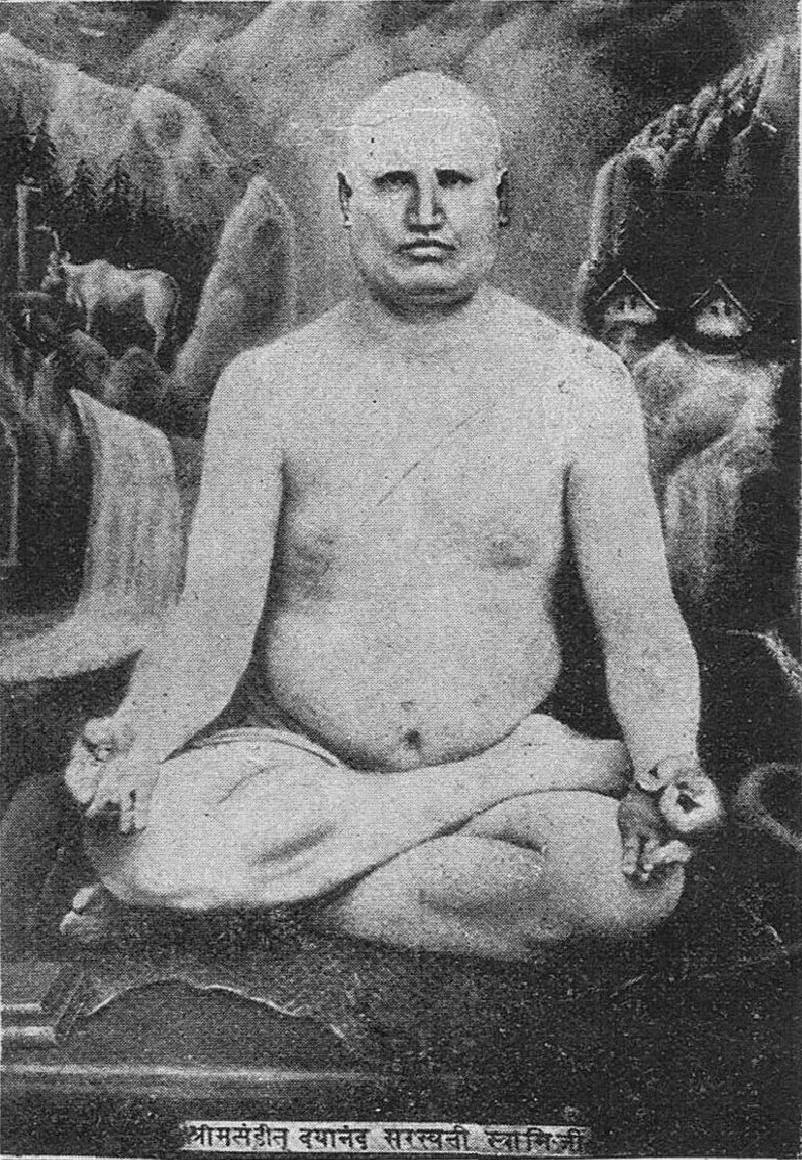
Correct — C, Both 1 and 2. Swami Dayanand Saraswati, founder of the Arya Samaj (1875), rethought the varna order: he held that a person's caste should follow individual merit, qualities and occupation (guna-karma) rather than birth, so statement 1 captures his reform faithfully. Statement 2 reflects the assertive, revivalist face of his movement — a confident 'back to the Vedas' nationalism that set a strong indigenous Vedic tradition against the culturally dominant, colonising West that had 'enslaved' Aryavarta (India). Both statements describe genuine strands of Dayanand's thought.
Why the others are wrong
- (a)1 only — The merit-based varna idea is his, but so is the assertive Vedic revivalism directed against Western cultural domination, so statement 2 is not false.
- (b)2 only — The cultural-nationalist strand is genuine, yet his rejection of birth-based caste in favour of merit (statement 1) is equally central to his reform.
- (d)Neither 1 nor 2 — Both statements express real features of Dayanand's reform agenda, so 'neither' is incorrect.
Concept
Dayanand Saraswati led a 19th-century Hindu reform and revival movement through the Arya Samaj. His slogan 'Back to the Vedas' rejected idolatry, priestly domination and hereditary caste, while asserting the Vedas as the source of a purified, self-confident Hindu social order.
The question blends his internal social reform (merit over birth in the caste order) with the movement's outward cultural nationalism (a robust Vedic Hinduism resisting Western dominance). Recognising both faces of the Arya Samaj is the key.
Key facts
- Dayanand Saraswati founded the Arya Samaj in Bombay in 1875.
- He preached 'Back to the Vedas' and opposed idol worship, untouchability and hereditary caste.
- He argued caste (varna) should follow merit and occupation, not birth.
- The Arya Samaj promoted shuddhi (reconversion) and a confident, revivalist Hindu nationalism.
Study next
Common traps
- Assuming Dayanand accepted birth-based caste — he tied varna to merit, not birth.
- Confusing the assertive, revivalist Arya Samaj with the more liberal, syncretic Brahmo Samaj.
Statement-based on a reformer's ideas, or matching reformers to their organisations and slogans.
Related PYQs
Which among the following events happened earliest? (a) Swami Dayanand established Arya Samaj. (b) Dinabandhu Mitra wrote Neeldarpan. (c) Bankim Chandra Chattopadhyay wrote Anandmath. (d) Satyendranath Tagore became the first Indian to succeed in the Indian Civil Services Examination.
- (a) Swami Dayanand established Arya Samaj.
- (b) Dinabandhu Mitra wrote Neeldarpan.
- (c) Bankim Chandra Chattopadhyay wrote Anandmath.
- (d) Satyendranath Tagore became the first Indian to succeed in the Indian Civil Services Examination.
Answer(b) Dinabandhu Mitra wrote Neeldarpan
Involves Dayanand's founding of the Arya Samaj (1875) as one of the events — the same reformer whose social ideas this NDA item probes.
Consider the following statements: I. Arya Samaj was founded in 1835. II. Lala Lajpat Rai opposed the appeal of Arya Samaj to the authority of Vedas in support of its social reform programmes. III. Under Keshab Chandra Sen, the Brahmo Samaj campaigned for women's education. IV. Vinoba Bhave founded the Sarvodaya Samaj to work among refugees. Which of these statements are correct?
- (a) I and II
- (b) II and III
- (c) II and IV
- (d) III and IV
Answer(d) III and IV
Tests the Arya Samaj's appeal to Vedic authority for social reform — the same reformist-revivalist agenda of Dayanand examined here.
Practice
- practice — not a real PYQ
The Arya Samaj was founded in 1875 by
- (a)Raja Ram Mohan Roy
- (b)Swami Vivekananda
- (c)Swami Dayanand Saraswati
- (d)Keshab Chandra Sen
Answer(c) Swami Dayanand Saraswati — who launched the 'Back to the Vedas' movement. - practice — not a real PYQ
Which reform practice, aimed at bringing converts back into the Hindu fold, was associated with the Arya Samaj?
- (a)Sati
- (b)Shuddhi
- (c)Satyagraha
- (d)Sarvodaya
Answer(b) Shuddhi — the Arya Samaj's reconversion or 'purification' movement.