
The ruins of Vijayanagara (Hampi) were brought to public light in the year 1800 by the following British surveyor and engineer:
- (a)James Prinsep
- (b)Colin Mackenzie
- (c)James Rennell
- (d)Charles Metcalfe
Answer
Why
Correct — B, Colin Mackenzie. A Scottish surveyor and engineer in the East India Company's service, Mackenzie made the first survey of the ruined city of Vijayanagara at Hampi in 1800 and later became the first Surveyor General of India (from 1815). His surveys, drawings and collected manuscripts opened the once-glorious capital of the Vijayanagara Empire to modern scholarship.
Why the others are wrong
- (a)James Prinsep — Prinsep is famous for deciphering the Brahmi and Kharosthi scripts (including Ashoka's edicts), not for surveying Hampi.
- (c)James Rennell — Rennell was the surveyor-geographer who mapped Bengal and is called the 'Father of Indian Geography', but he did not bring the Hampi ruins to light.
- (d)Charles Metcalfe — Metcalfe was a colonial administrator (and briefly acting Governor-General), not a surveyor of Vijayanagara.
Concept
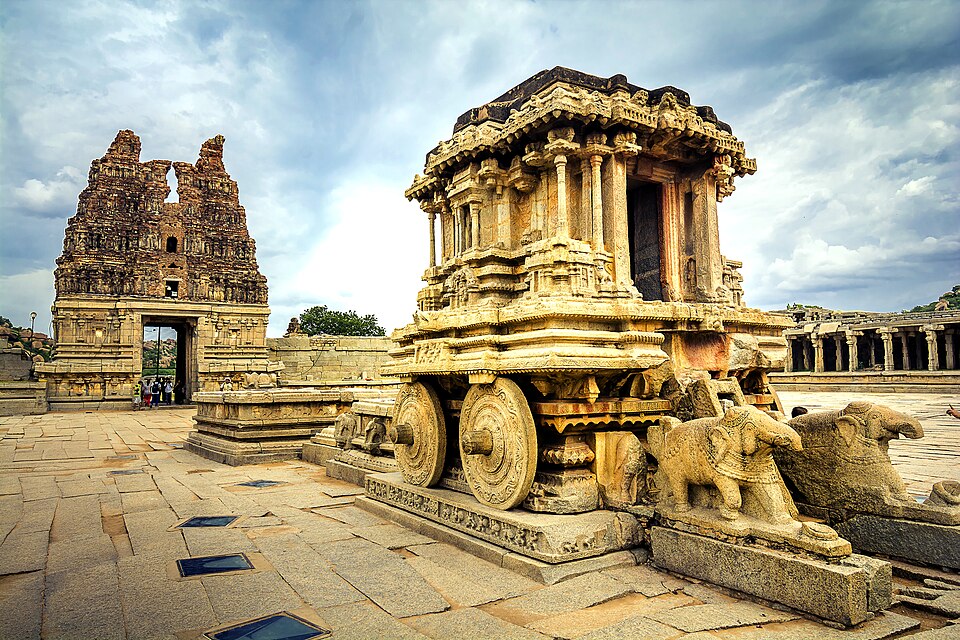
Hampi, on the Tungabhadra river in modern Karnataka, was the capital of the Vijayanagara Empire (founded 1336, sacked after the 1565 battle of Talikota). Its abandoned ruins were surveyed in 1800 by Colin Mackenzie, who went on to become India's first Surveyor General.
All four options are well-known British figures in Indian history, so the item tests who is specifically tied to the Hampi survey. Match 'surveyor and engineer, 1800' to Colin Mackenzie rather than the epigraphist Prinsep or the geographer Rennell.
Key facts
- Colin Mackenzie surveyed the ruins of Vijayanagara at Hampi in 1800.
- He became the first Surveyor General of India in 1815.
- Hampi was the capital of the Vijayanagara Empire, sacked after the 1565 battle of Talikota.
- The Hampi group of monuments is a UNESCO World Heritage Site.
Study next
Common traps
- Picking James Prinsep (script decipherment) or James Rennell (mapping of Bengal), who are surveyor/scholar names from other contexts.
- Confusing the first Surveyor General (Mackenzie) with later ASI figures like Alexander Cunningham.
Who 'discovered/surveyed' a specific site, or matching colonial officers to their archaeological/survey work.
Related PYQs
Consider the following events: I. Reign of Krishna Deva Raya of Vijayanagara. II. Construction of Qutab Minar. III. Arrival of Portuguese in India. IV. Death of Firoz Tughlaq. Which one of the following is the correct chronological sequence of the above events?
- (a) II, IV, III, I
- (b) II, IV, I, III
- (c) IV, II, I, III
- (d) IV, II, III, I
Answer(a) II, IV, III, I
Same empire — Vijayanagara. UPSC places the reign of Krishna Deva Raya in a chronology; this NDA item is about the later rediscovery of the empire's ruined capital at Hampi.
Which of the following statements about Vijayanagara king Krishnadevaraya's expeditions are correct? 1. In the early years of his reign he marched against the ruler of Orissa. 2. In 1520 CE, he captured the fort of Raichur from Ismail Adil Khan. 3. Krishnadevaraya restored Sultan Mahmud Shah to power and assumed the title of Yavana-rajya-sthapan-acharya. Select the answer using the code given below:
- (a) 1 and 3 only
- (b) 2 and 3 only
- (c) 1, 2 and 3
- (d) 1 and 2 only
Answer(c) 1, 2 and 3
Same empire at its height — Vijayanagara under Krishnadevaraya. That NDA item tests his military campaigns; this one tests how the empire's ruined capital was later surveyed by Colin Mackenzie.
Practice
- practice — not a real PYQ
Colin Mackenzie is best remembered as
- (a)the decipherer of the Brahmi script
- (b)the first Surveyor General of India who surveyed the Hampi ruins
- (c)the founder of the Asiatic Society
- (d)the first Director-General of the Archaeological Survey of India
Answer(b) the first Surveyor General of India who surveyed the Hampi ruins in 1800. - practice — not a real PYQ
Hampi, whose ruins were surveyed in 1800, was the capital of which empire?
- (a)The Bahmani Sultanate
- (b)The Vijayanagara Empire
- (c)The Chola Empire
- (d)The Kakatiya kingdom
Answer(b) the Vijayanagara Empire — sacked after the 1565 battle of Talikota.