
Which among the following materials was used in making the Harappan seals?
- (a)Sandstone
- (b)Lapis lazuli
- (c)Jasper
- (d)Steatite
Answer
Why
Correct — D, Steatite. The great majority of Harappan (Indus Valley) seals were carved from steatite, a soft soapstone that is easy to cut when freshly quarried and hardens after firing. The engraver incised the animal motif and Indus script into the soft stone and then heated the seal to make it durable — which is why steatite seals survive in large numbers at sites such as Mohenjo-daro and Harappa.
Why the others are wrong
- (a)Sandstone — Sandstone was used for larger sculpture and building blocks, but it is too coarse for the fine, small intaglio carving demanded by a seal.
- (b)Lapis lazuli — Lapis lazuli was a prized blue semi-precious stone traded from Afghanistan and used for beads and inlay, not for the mass production of seals.
- (c)Jasper — Jasper and other hard stones (carnelian, agate) were worked into beads by Harappan craftsmen, but the standard seal material was soft, fire-hardened steatite, not jasper.
Concept
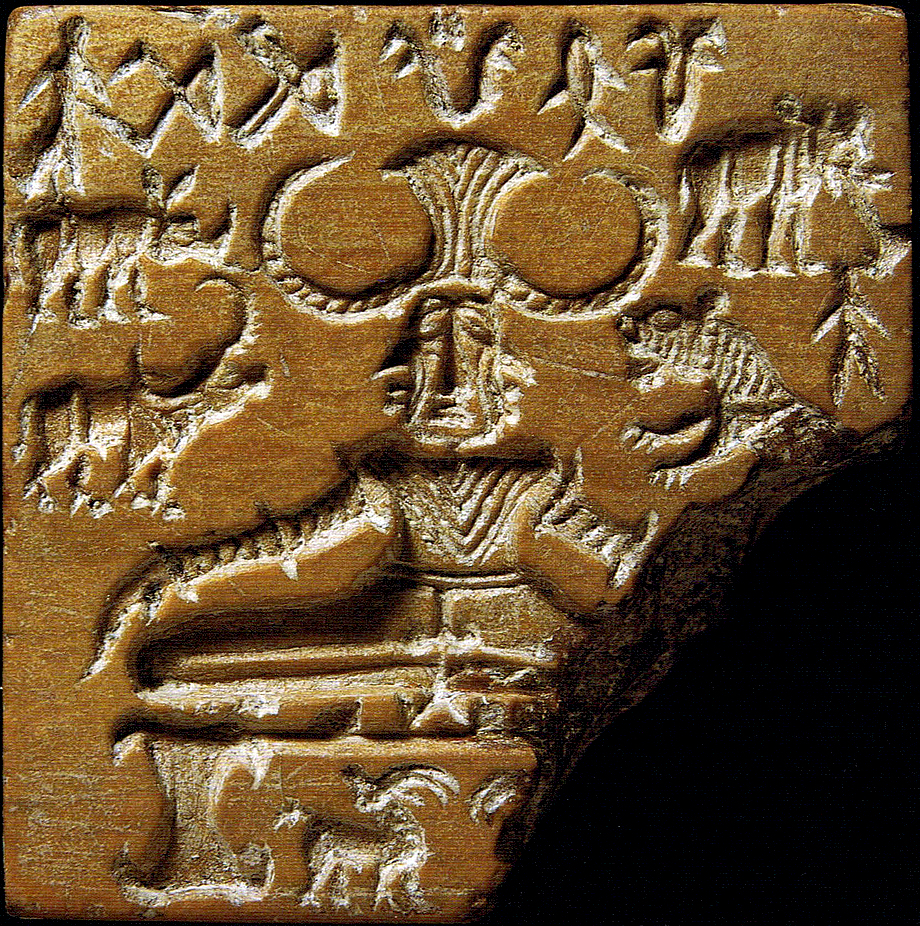
Indus (Harappan) seals are small, mostly square tablets — usually about 2-3 cm across — bearing an animal (very often the one-horned 'unicorn' bull), a short line of undeciphered Indus script, and a boss with a hole on the back for a cord. They were probably used to stamp goods and mark ownership in trade.
The material had to be soft enough to engrave finely yet hardenable for repeated stamping. Steatite (soapstone) fits: soft when carved, then kiln-fired to a hard, pale finish. That is why 'steatite' is the textbook answer, while the harder or more precious stones in the options were used for beads and inlay instead.
Key facts
- Most Harappan seals are steatite (soapstone), carved soft and then fired to harden.
- A typical seal shows an animal motif plus a line of the still-undeciphered Indus script.
- The one-horned 'unicorn' bull is the commonest animal on the seals; the cow is notably absent.
- Seals are found at Mohenjo-daro, Harappa, Lothal, Dholavira and beyond, and point to trade and administration.
Study next
Common traps
- Choosing lapis lazuli or jasper because they sound 'precious' — those were bead materials; seals were steatite.
- Confusing the seal material (steatite) with the bronze 'Dancing Girl' or the terracotta figurines.
Asked as 'material of Harappan seals', or by matching a Harappan site to its characteristic find or craft.
Related PYQs
Which one of the following animals was NOT represented on the seals and terracotta art of the Harappan culture?
- (a) Cow
- (b) Elephant
- (c) Rhinoceros
- (d) Tiger
Answer(a) Cow
Same concept — Harappan seals. UPSC tests the animals depicted on them (the cow is conspicuously absent); this NDA item tests the material they were carved from (steatite).
In the Harappan Civilization, traces of canals have been found at
- (a) Banawali
- (b) Lothal
- (c) Shortughai
- (d) Dholavira
Answer(c) Shortughai
Same civilization — the Indus/Harappan culture. That NDA item tests a distinctive site find (canals at Shortughai); this one tests the seal material (steatite).
Practice
- practice — not a real PYQ
The animal most frequently depicted on Harappan seals is
- (a)the cow
- (b)the one-horned 'unicorn' bull
- (c)the horse
- (d)the lion
Answer(b) the one-horned 'unicorn' bull — it dominates the seals, while the cow and the horse are absent. - practice — not a real PYQ
Harappan seals were most commonly made of
- (a)bronze
- (b)terracotta only
- (c)steatite (soapstone)
- (d)ivory
Answer(c) steatite (soapstone) — carved when soft, then fired hard.