
Match List–I with List–II and select the correct answer using the code given below the Lists : List–I (River Basin) A. Bhagirathi B. Alaknanda C. Nayar D. Ganga List–II (Town) 1. Lansdowne 2. Narendra Nagar 3. Uttarkashi 4. Pauri Code : A B C D
- (a)3 1 4 2
- (b)3 4 1 2
- (c)2 4 1 3
- (d)2 1 4 3
Answer
Why
Correct: B, the code 3 4 1 2. Every town in the list is in Garhwal, and each belongs to a different one of the four drainages. Uttarkashi, item 3, stands on the Bhagirathi, the headstream that rises at Gaumukh below the Gangotri glacier and runs down past Harsil and Uttarkashi to Tehri: hence A-3. Pauri, item 4, is the headquarters of the Garhwal Division, perched at about 1,765 m on the ridge above the Alaknanda valley in the district that the Alaknanda system drains along with Chamoli and Tehri: hence B-4. Lansdowne, item 1, the Garhwal Rifles cantonment in the southern part of that same Pauri Garhwal district, sits in the country of the Nayar, whose eastern and western branches rise in the Dudhatoli hills, meet at Satpuli and flow entirely within the district: hence C-1. Narendra Nagar, item 2, was built in 1919 by Maharaja Narendra Shah as the new capital of Tehri Garhwal on a spur that looks down over Rishikesh and Haridwar and the Ganga coming out of the mountains onto the plains: hence D-2.
Why the others are wrong
- (a)3 1 4 2: It gets Uttarkashi on the Bhagirathi and Narendra Nagar on the Ganga right, and then exchanges the middle two: putting Lansdowne in the Alaknanda basin and Pauri in the Nayar's. Pauri is the district and divisional headquarters overlooking the Alaknanda valley, while Lansdowne lies well to the south of it.
- (c)2 4 1 3: It hands the Bhagirathi to Narendra Nagar and the Ganga to Uttarkashi, which reverses the two ends of the river's course. Uttarkashi lies far up in the mountains on the headstream, while Narendra Nagar overlooks the point where the united Ganga leaves the hills.
- (d)2 1 4 3: Every pair is wrong. It moves Narendra Nagar up to the Bhagirathi, Lansdowne to the Alaknanda, Pauri to the Nayar and Uttarkashi down to the Ganga: a complete shuffle of the four.
Concept
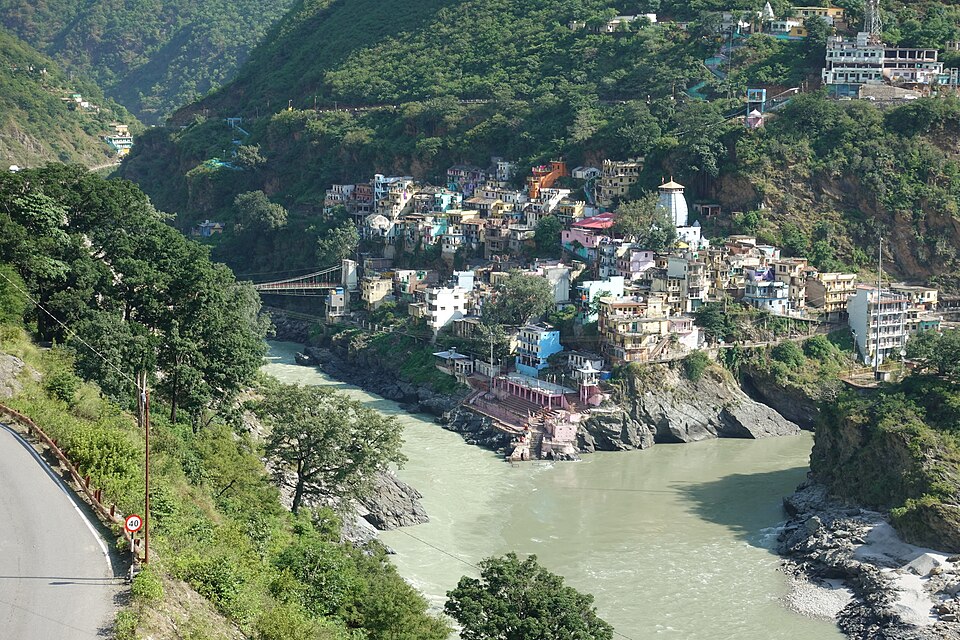
The Ganga is assembled in Garhwal from two headstreams. The Bhagirathi rises at Gaumukh at the snout of the Gangotri glacier and flows past Harsil, Uttarkashi and Tehri; the Alaknanda rises at the foot of the Satopanth and Bhagirath Kharak glaciers and flows past Badrinath, Joshimath and Srinagar, gathering the Dhauliganga, Nandakini, Pindar and Mandakini at the five prayags on the way. The two meet at Devprayag, and only below that confluence is the river called the Ganga. Further down, in Pauri Garhwal, the Nayar joins it from the south at Vyasghat before the river reaches Rishikesh and the plains.
Two anchors settle the code without any need to recall all four. Uttarkashi is a Bhagirathi town (its name means the Kashi of the north and it stands on the Gangotri pilgrim road, well above the confluence) so A must be 3, and options (c) and (d) both fall. Narendra Nagar is the old Tehri Garhwal capital on the hill above Rishikesh, which is Ganga country below Devprayag, so D must be 2, though both surviving options already agree on that. The tie-break is Pauri, which is the divisional headquarters looking out over the Alaknanda valley; put it against B and only option (b) survives. Lansdowne then falls into place against the Nayar, which is the one river in the list that lies wholly inside Pauri Garhwal district.
Key facts
- The Bhagirathi rises at Gaumukh below the Gangotri glacier and flows past Harsil, Uttarkashi and Tehri to Devprayag.
- The Bhagirathi and the Alaknanda unite at Devprayag, and the river takes the name Ganga only from that point.
- The Alaknanda system drains parts of Chamoli, Tehri and Pauri districts; Pauri town, at about 1,765 m, is the headquarters of the Garhwal Division.
- The Nayar, formed by an eastern and a western branch that meet at Satpuli, flows entirely within Pauri Garhwal and joins the Ganga at Vyasghat.
Study next
Common traps
- Assuming the mainstream is called the Ganga all the way from the glacier. It is the Bhagirathi until Devprayag.
- Placing Uttarkashi on the Alaknanda; it is on the Bhagirathi, on the road to Gangotri.
- Treating Pauri and Lansdowne as interchangeable because both are in Pauri Garhwal district: they sit in different valleys.
NDA asks which river a Himalayan town stands on, which tributaries meet at a named prayag, or, as here, for the whole basin-to-town match in code form.
Related PYQs
On which one of the following rivers is the Tehri Hydropower Complex located?
- (a) Alaknanda
- (b) Bhagirathi
- (c) Dhauliganga
- (d) Mandakini
Answer(b) Bhagirathi
Tests the same Bhagirathi–Alaknanda distinction with a dam instead of a town: Tehri lies on the Bhagirathi, downstream of the Uttarkashi that this card pairs with the same river.
Rudraprayag is situated at the confluence of rivers Alaknanda and
- (a) Bhagirathi
- (b) Mandakini
- (c) Nandakini
- (d) Dhauliganga
Answer(b) Mandakini
The same Garhwal drainage tested one year earlier, and its distractor list is the reason this card's Alaknanda pairing has to be settled by town rather than by guesswork.
Practice
- practice, not a real PYQ
The Bhagirathi and the Alaknanda unite to form the Ganga at
- (a)Rudraprayag
- (b)Karnaprayag
- (c)Devprayag
- (d)Haridwar
Answer(c) Devprayag: the river is called the Ganga only from this confluence downstream. - practice, not a real PYQ
The Bhagirathi river rises from which one of the following glaciers?
- (a)Satopanth glacier
- (b)Gangotri glacier
- (c)Milam glacier
- (d)Pindari glacier
Answer(b) Gangotri glacier: at its snout, Gaumukh, in Uttarkashi district.