
The full form of LED is
- (a)Light Emitting Diode
- (b)Light Emitting Device
- (c)Light Enhancing Device
- (d)Light Enhancing Diode
Answer
Why
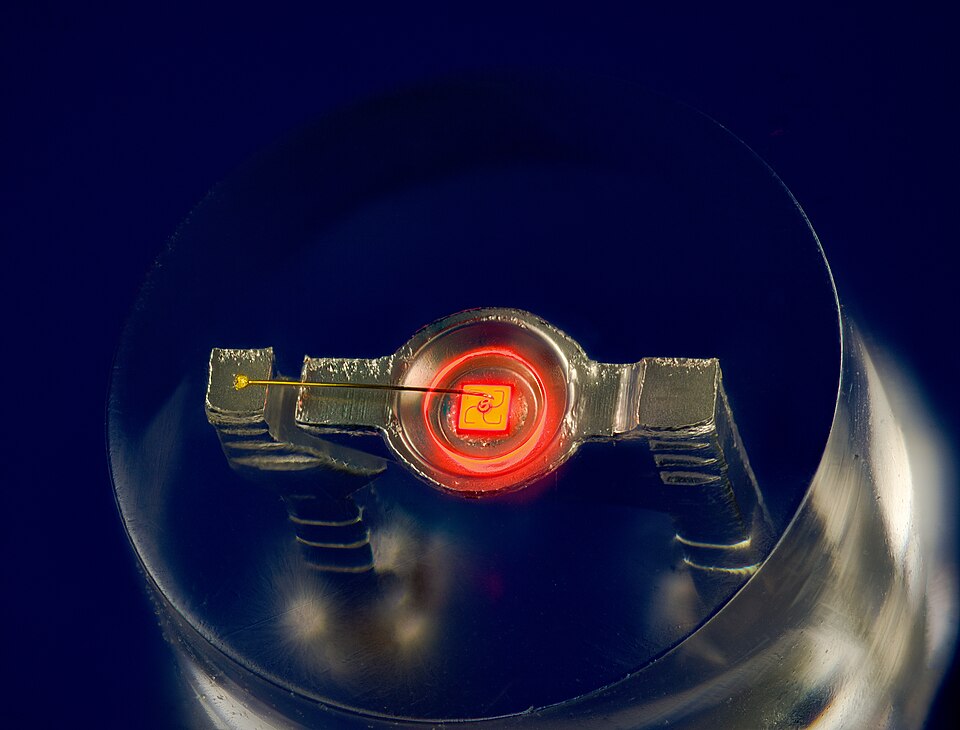
Correct: A, Light Emitting Diode. An LED is a p-n junction diode made from a semiconductor such as gallium arsenide phosphide or indium gallium nitride. Connect it in forward bias and electrons crossing the junction from the n-side recombine with holes on the p-side; each recombination releases a fixed packet of energy, and in these materials that energy comes out as a photon rather than as heat, so the junction glows. Both of the words the alternatives tamper with carry physics. 'Diode' records that the device is a p-n junction and conducts in one direction only. 'Emitting' records that it generates light from electrical energy rather than modifying light that is already there.
Why the others are wrong
- (b)Light Emitting Device: 'Device' throws away the specific fact that makes the component what it is, that it is a diode, a p-n junction with a one-way characteristic. A filament lamp is also a light-emitting device, and nobody calls it an LED.
- (c)Light Enhancing Device: Nothing is enhanced. The junction converts electrical energy directly into light; there is no incoming light for it to strengthen. This option gets both of the meaningful words wrong.
- (d)Light Enhancing Diode: Keeps the diode but replaces 'emitting' with 'enhancing', which describes nothing the junction does. Light amplification is what a laser does, and a laser works on stimulated emission, a different process altogether.
Concept
A diode is a junction between p-type and n-type semiconductor, and it passes current freely in forward bias while blocking it in reverse. In an ordinary silicon diode the energy released when electrons and holes recombine appears mostly as heat. In materials with a suitable band gap the same recombination gives out photons, and the device becomes a light-emitting diode. The colour is fixed by the size of the band gap, which is why different semiconductor compounds give red, green, blue or ultraviolet output, and why white LEDs are usually a blue emitter with a phosphor coating.
Full-form questions look like pure recall, and to a point they are, but the expansions the paper offers as wrong answers are always the ones a student could half-remember, so it pays to know why each word is there rather than to hold the phrase as a sound. 'Emitting' rather than 'enhancing' because the junction makes light; 'diode' rather than 'device' because it is a p-n junction. The same test came back in 2021 with a different set of decoys built the same way, and the reasoning that disposes of them is identical. Two facts worth attaching: the blue LED, which made white LED lighting practical, won the 2014 Nobel Prize in Physics for Isamu Akasaki, Hiroshi Amano and Shuji Nakamura, and India's UJALA programme, launched in 2015, distributed LED bulbs at scale on the strength of their efficiency.
Key facts
- An LED is a forward-biased p-n junction diode that converts electrical energy directly into light by electron-hole recombination.
- The colour of the light depends on the band gap of the semiconductor used.
- LEDs consume far less power and last far longer than incandescent lamps, which waste most of their energy as heat.
- The 2014 Nobel Prize in Physics was awarded for the invention of the efficient blue LED, which made white LED lighting possible.
- India's UJALA scheme, launched in 2015, distributed LED bulbs to households to cut lighting demand.
Study next
Common traps
- Expanding LED as 'light emitting device' and losing the diode.
- Confusing an LED with a laser diode; a laser works by stimulated emission and gives coherent light.
- Assuming an LED works in either direction; it emits only when forward biased.
NDA sets abbreviation questions in every paper (LED, LASER, SONAR, RADAR, LCD) and the wrong options are always near-miss expansions rather than random ones.
Related PYQs
LED (a semi-conductor device) is an abbreviation that stands for
- (a) Licence for Energy Detector.
- (b) Light Energy Device.
- (c) Light Emitting Diode.
- (d) Lost Energy Detector.
Answer(c) Light Emitting Diode.
The identical question three years later with the options reshuffled, which is about as clear a repeat signal as this paper gives.
Practice
- practice, not a real PYQ
An LED emits light when it is
- (a)reverse biased
- (b)forward biased
- (c)unbiased
- (d)heated above room temperature
Answer(b) forward biased: current flows across the junction and electron-hole recombination releases photons only in forward bias. - practice, not a real PYQ
The full form of LASER is
- (a)Light Amplification by Stimulated Emission of Radiation
- (b)Light Absorption by Stimulated Emission of Radiation
- (c)Linear Amplification of Standard Emitted Radiation
- (d)Light Amplification by Spontaneous Emission of Radiation
Answer(a) Light Amplification by Stimulated Emission of Radiation: the key word is stimulated, which distinguishes laser action from ordinary spontaneous emission.