
Which one of the following is a heterogeneous mixture?
- (a)Hydrochloric acid
- (b)Vinegar
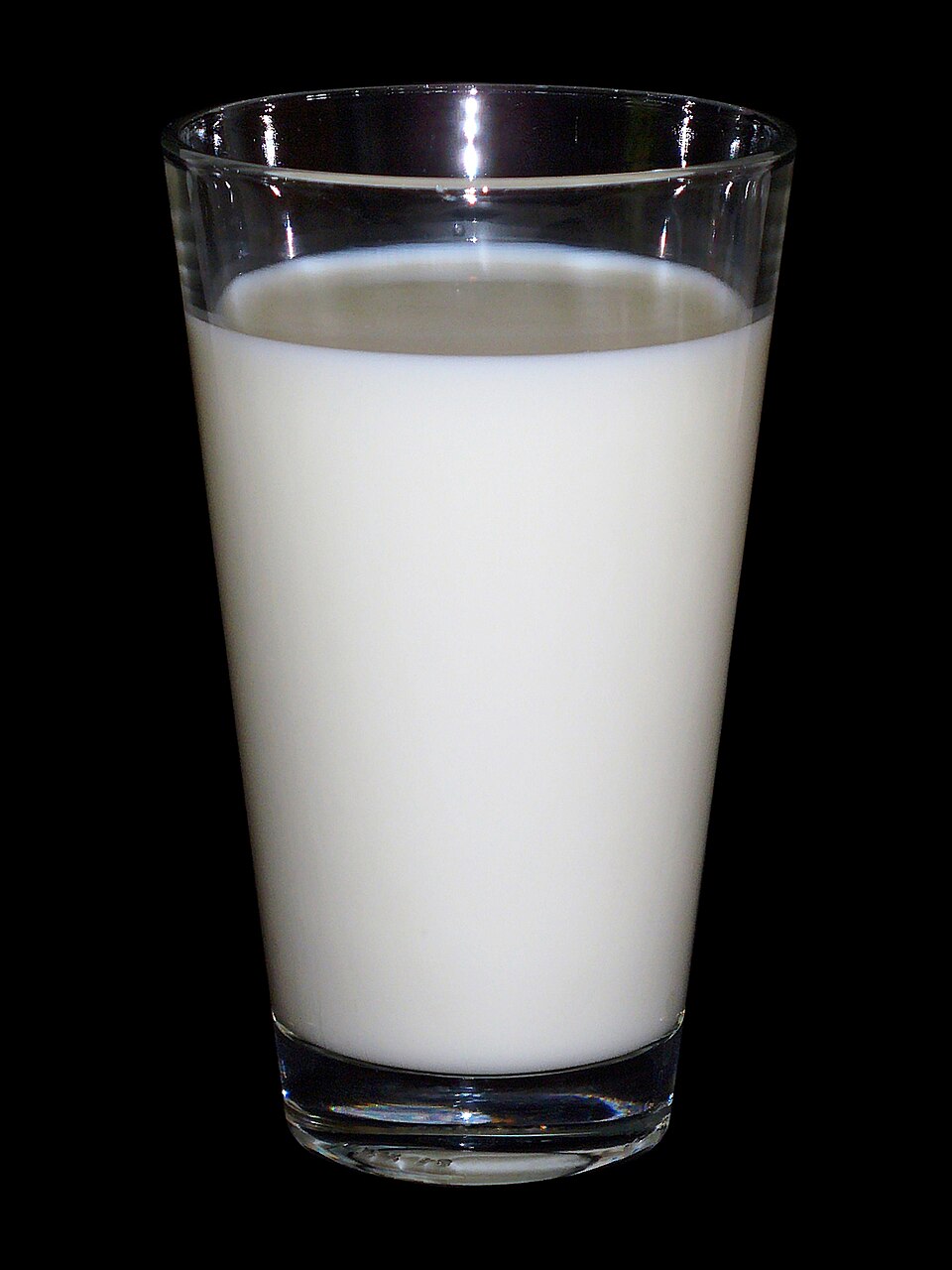
- (c)Milk
- (d)Soda water
Answer
Why
Correct: C, Milk. A mixture is homogeneous when its composition is the same throughout and its components cannot be told apart, and heterogeneous when they can. Milk is an emulsion: microscopic globules of butterfat, along with clusters of casein protein, dispersed through water. Those particles are far larger than dissolved molecules, which is why milk is opaque and white rather than clear, why it scatters a beam of light in the way a colloid does, and why a cream separator can spin the fat out of it. A colloid of this kind is classed as a heterogeneous mixture even though it looks perfectly uniform to the eye. The other three are all true solutions.
Why the others are wrong
- (a)Hydrochloric acid: Hydrogen chloride dissolved in water. The H⁺ and Cl⁻ ions are spread evenly at the molecular scale, the liquid is clear, and no filter or centrifuge will separate the components: a homogeneous solution.
- (b)Vinegar: A dilute solution of acetic acid in water, again a single uniform phase with the solute molecules distributed evenly. Nothing settles out on standing.
- (d)Soda water: Carbon dioxide dissolved in water under pressure, which makes a homogeneous solution. The bubbles you see are gas leaving the solution once the bottle is opened and the pressure drops, not a second phase suspended within the solution.
Concept
Mixtures are graded by the size of the dispersed particles. In a true solution the particles are smaller than about one nanometre, invisible, unable to be filtered out and unable to scatter light, and the mixture is homogeneous. In a colloid the particles run from roughly one to a thousand nanometres: too small to settle out under gravity, large enough to scatter a light beam, which is the Tyndall effect. In a suspension the particles are larger still and settle on standing. Colloids and suspensions are both heterogeneous.
The catch in this item is that the heterogeneous option is the one that looks most uniform. Students expect a heterogeneous mixture to look obviously mixed (sand in water, oil floating on water) and milk looks like a plain white liquid, so they reject it and hunt for something else. The test to apply is not appearance but particle size and whether a boundary between phases exists. Milk has fat droplets suspended in water with a real surface between the two, so it has two phases; hydrochloric acid, vinegar and soda water each have only one. Learning the standard colloids (milk, butter, cheese, smoke, fog, ink, blood, whipped cream, jelly) makes this recognisable at sight.
Key facts
- Solutions are homogeneous; colloids and suspensions are heterogeneous.
- Colloid particles are roughly 1 to 1000 nm across, small enough to stay dispersed but large enough to scatter light.
- The scattering of a light beam by a colloid is the Tyndall effect, the standard test for distinguishing a colloid from a true solution.
- Milk is an oil-in-water emulsion; butter is the reverse, water dispersed in fat.
- The particles of a suspension settle on standing and can be filtered out; those of a colloid cannot.
Study next
Common traps
- Judging by appearance and calling milk homogeneous because it looks uniform.
- Treating soda water as heterogeneous because of the bubbles, which are gas escaping rather than a suspended phase.
- Forgetting that a colloid, despite never settling out, is still classed as heterogeneous.
The examiner offers three true solutions and one colloid, or asks which mixture shows the Tyndall effect: both routes to the same distinction.
Related PYQs
A homogeneous mixture contains two liquids. How are they separated ?
- (a) By filtration
- (b) By evaporation
- (c) By distillation
- (d) By condensation
Answer(c) By distillation
Approaches the same classification from the practical side: how a mixture is separated depends on whether it is homogeneous or heterogeneous, which is the distinction this item tests directly.
Practice
- practice, not a real PYQ
A beam of light passed through a liquid becomes visible as a bright path. The liquid is most likely
- (a)a true solution
- (b)a colloid
- (c)a pure element
- (d)distilled water
Answer(b) a colloid: its particles are large enough to scatter light, which is the Tyndall effect; a true solution shows no such path. - practice, not a real PYQ
Which one of the following is a homogeneous mixture?
- (a)Muddy water
- (b)Smoke
- (c)Common salt dissolved in water
- (d)Milk
Answer(c) Common salt dissolved in water: a true solution with the solute spread evenly at the molecular level; the other three are heterogeneous.