
Directions : The following six (6) items consist of two statements, Statement I and Statement II. Examine these two statements carefully and select the correct answer using the code given below. Statement I : Phytoplankton produce most of the organic carbon in the ocean. Statement II : Algae are produced in the cold water biome.
- (a)Both the statements are individually true and Statement II is the correct explanation of Statement I
- (b)Both the statements are individually true but Statement II is not the correct explanation of Statement I
- (c)Statement I is true but Statement II is false
- (d)Statement I is false but Statement II is true
Answer
Why
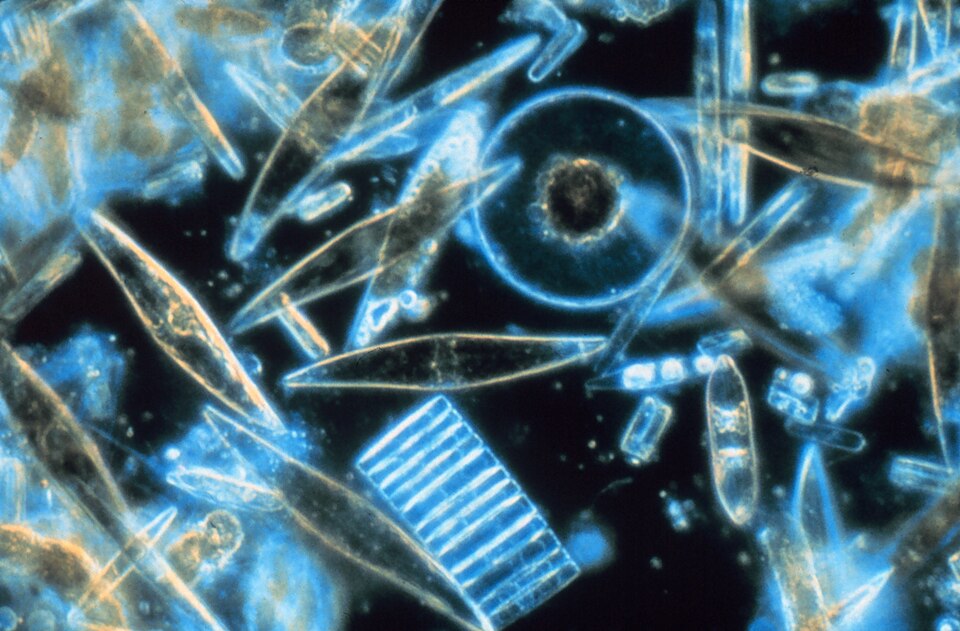
Correct: B, Both the statements are individually true but Statement II is not the correct explanation of Statement I. Statement I is true and is one of the best-established facts in marine science: phytoplankton, the drifting microscopic photosynthesisers of the sunlit surface layer (diatoms, dinoflagellates, coccolithophores, cyanobacteria) carry out the great bulk of photosynthesis in the sea and so fix most of the ocean's organic carbon, which is why they are called the base of the marine food web and why the loss of them would cripple the ocean as a carbon sink. Statement II, read as the booklet intends it, says that algae are produced in cold-water regions, and that too holds: the cold, well-mixed waters of high latitudes and the cold upwelling water off coasts such as Peru and Namibia are rich in nitrate and phosphate, and they carry the ocean's densest algal blooms. But that is a statement about where algae grow best. It does not explain why phytoplankton account for most of the ocean's organic carbon: they would do so whatever the temperature, simply because they are the sea's dominant photosynthesisers. Two true statements with no causal link between them gives (b).
Why the others are wrong
- (a)Both the statements are individually true and Statement II is the correct explanation of Statement I: This asks the cold-water fact to be the reason for the carbon fact. It is not. Phytoplankton dominate organic carbon production across the ocean, warm water included; the productivity of cold and upwelling water raises the total but is not the cause of their dominance.
- (c)Statement I is true but Statement II is false: The key does not treat Statement II as false. Cold, nutrient-rich water genuinely is where the ocean's heaviest algal growth occurs, so the statement stands on the reading the booklet intends.
- (d)Statement I is false but Statement II is true: Statement I is not false. It is the standard textbook description of phytoplankton's role, and UPSC has itself tested the consequence: destroy the ocean's phytoplankton and the ocean carbon sink and the marine food chains both fail.
Concept
Phytoplankton are the autotrophs of the open ocean. They live in the photic zone, the upper layer light can reach, and they need two things: light from above and dissolved nutrients from below. Where the water column is stratified, as in the warm tropics, nutrients sink out of the lit layer and are not replaced, so the water is clear, blue and poor in plankton. Where the water is cold and turns over, or where upwelling drags deep water to the surface, nitrate and phosphate return to the light and blooms follow, which is why the world's great fisheries sit over cold and upwelling waters.
Statement II is loosely worded, and it is worth being honest about that. Algae are certainly not confined to cold water; warm tropical seas carry their own phytoplankton, and reef-building corals depend on algae living inside their tissues. The key treats the statement as true in the sense that cold-water regions are notable algal producers, and the item's real work lies in the second test. That points to a general technique for this block: when Statement II is vague, run the explanation test first. If II plainly cannot be the reason for I, the choice collapses to (b) or (c) at once, and you only then have to decide whether II is true at all.
Key facts
- Marine phytoplankton and photosynthetic bacteria together produce roughly half of the world's oxygen and fix most of the ocean's organic carbon.
- Phytoplankton form the first trophic level of the marine food web, feeding zooplankton and everything above them.
- Cold, well-mixed high-latitude water and coastal upwelling zones are the ocean's most productive waters, because upwelling returns nitrate and phosphate to the sunlit layer.
- Warm tropical surface water is typically nutrient-poor and low in plankton, which is why it looks so clear and blue.
- Ocean acidification threatens calcifying plankton such as coccolithophores, whose shells are built of calcium carbonate.
Study next
Common traps
- Reading 'algae grow best in cold water' as an explanation of 'phytoplankton fix most of the ocean's carbon'.
- Assuming warm tropical seas must be the most productive because they are the warmest and sunniest; nutrient supply, not warmth, is the limit.
- Treating phytoplankton as plants of the sea floor; they drift in the sunlit surface layer, not on the bottom.
Geography and environment papers ask about phytoplankton through their consequences: the carbon sink, the food chain, and the productivity of upwelling coasts.
Related PYQs
Human activities in the recent past have caused the increased concentration of carbon dioxide in the atmosphere, but a lot of it does not remain in the lower atmosphere because of 1. Its escape into the outer stratosphere, 2. The photosynthesis by phytoplankton in the oceans, 3. The trapping of air in the polar ice caps. Which of the statements given above is/are correct?
- (a) 1 and 2
- (b) 2 only
- (c) 2 and 3
- (d) 3 only
Answer(b) 2 only
The consequence of Statement I: because phytoplankton fix most of the ocean's organic carbon, their photosynthesis is the main route by which the sea absorbs atmospheric carbon dioxide.
Practice
- practice, not a real PYQ
The exceptionally high biological productivity of the waters off the coast of Peru is mainly explained by
- (a)the high surface temperature of the water
- (b)upwelling of cold, nutrient-rich water
- (c)the low salinity of the water
- (d)the absence of ocean currents
Answer(b) upwelling of cold, nutrient-rich water: upwelling returns nitrate and phosphate to the sunlit layer, where phytoplankton can use them. - practice, not a real PYQ
Phytoplankton occupy which position in a marine food chain?
- (a)Primary producers
- (b)Primary consumers
- (c)Secondary consumers
- (d)Decomposers
Answer(a) Primary producers: they photosynthesise, and every other level of the marine food web ultimately depends on them.