
Which one of the following types of tissues will have contractile proteins ?
- (a)Nervous tissue
- (b)Muscle tissue
- (c)Bone tissue
- (d)Blood tissue
Answer
Why
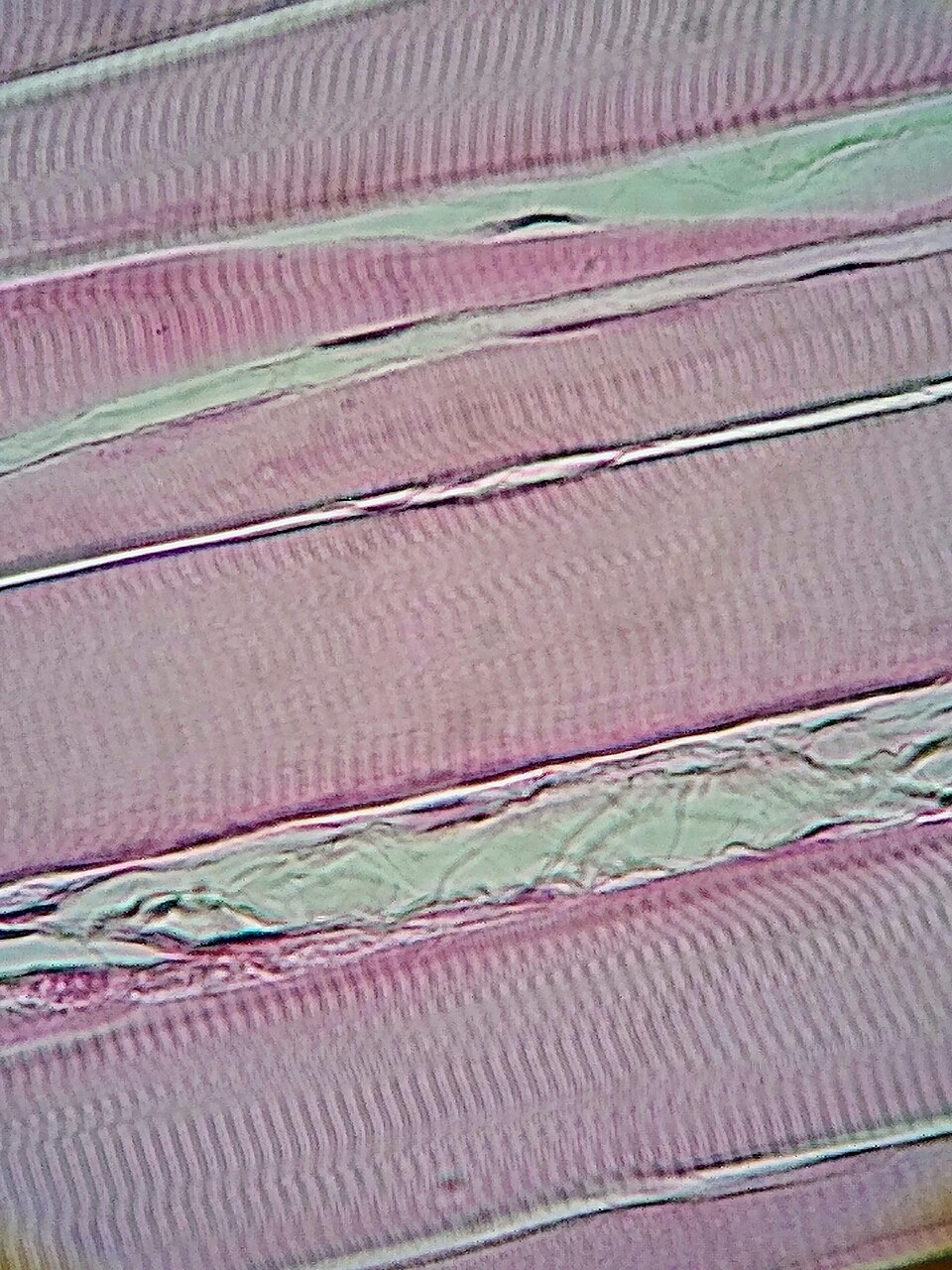
Correct: B, Muscle tissue. Muscle cells are packed with long protein filaments of two kinds, actin and myosin, arranged so that they overlap. When the cell is stimulated, the myosin filaments pull on the actin filaments and the two sets slide past one another; the cell shortens, and the shortening of millions of such cells together is what we experience as a muscle contracting. Actin and myosin are for this reason called the contractile proteins, and muscle is the only one of the four tissues built around them. That is also why the elongated muscle cells are called fibres.
Why the others are wrong
- (a)Nervous tissue: Nervous tissue conducts, it does not contract. A neuron carries an electrical signal along its length and passes it on chemically at a synapse; it may cause a muscle to shorten, but it does not shorten itself.
- (c)Bone tissue: Bone is a connective tissue built for rigidity and support. Its cells sit in a hard matrix of calcium phosphate salts laid down on collagen fibres: collagen is a structural protein, not a contractile one.
- (d)Blood tissue: Blood is a fluid connective tissue whose job is transport. Its important proteins are haemoglobin for carrying oxygen, and fibrinogen for clotting; neither contracts, and the plasma matrix has no fibres to contract against.
Concept
Animal tissues fall into four families. Epithelial tissue covers surfaces and lines cavities. Connective tissue binds and supports, and it includes bone, cartilage, tendon, ligament, adipose tissue and blood. Muscular tissue contracts. Nervous tissue receives and conducts impulses. Muscle itself comes in three forms: skeletal muscle, which is striated and under voluntary control; smooth muscle, unstriated and involuntary, found in the walls of the gut, blood vessels and other hollow organs; and cardiac muscle, striated but involuntary and tireless, found only in the heart.
This item is really a test of whether the candidate can attach a function to a tissue name, and the fastest route is to say what each of the four is FOR before looking at the options again: nerves conduct, bone supports, blood transports, muscle contracts. Two of the wrong options are also worth pinning down for their own sake, because NDA sets them directly: blood is classified as a connective tissue despite being liquid, which surprises candidates every year, and bone's hardness comes from a mineralised matrix rather than from anything the cells do. If the term 'contractile protein' itself is unfamiliar, the word contractile is the clue; the only tissue named after what it does is muscle.
Key facts
- Actin and myosin are the contractile proteins of muscle tissue.
- Contraction happens when myosin filaments pull actin filaments so the two slide past each other.
- Muscle occurs in three forms: skeletal, smooth and cardiac.
- Blood and bone are both classed as connective tissues, despite being liquid and solid respectively.
- Nervous tissue conducts impulses; it does not itself contract.
Study next
Common traps
- Assuming blood cannot be a connective tissue because it is a fluid.
- Crediting nervous tissue with contraction because nerves cause muscles to move.
- Confusing collagen, which gives strength, with actin and myosin, which produce movement.
NDA asks candidates to attach a named function or a named protein to one of the four tissue types, and has also asked for the classification of blood on its own.
Related PYQs
Blood is a type of
- (a) Epithelial tissue
- (b) Muscular tissue
- (c) Nervous tissue
- (d) Connective tissue
Answer(d) Connective tissue
The classification of one of the wrong options here, keyed by NDA a year later. Knowing blood is connective and not muscular is precisely what rules option (d) out of the 2018 item.
Squamous epithelial cells are found in the inner lining of
- (a) Oesophagus.
- (b) Small intestine.
- (c) Ducts of salivary gland.
- (d) Kidney.
Answer(a) Oesophagus.
The fourth tissue family from the same syllabus, tested on its function. NDA works through epithelial, connective, muscular and nervous tissue across papers, so learning the four together pays.
Practice
- practice, not a real PYQ
The two proteins directly responsible for muscle contraction are
- (a)collagen and elastin
- (b)actin and myosin
- (c)keratin and fibrin
- (d)albumin and globulin
Answer(b) actin and myosin: their filaments slide past one another and the fibre shortens. - practice, not a real PYQ
Which one of the following muscle types is striated but not under voluntary control?
- (a)Skeletal muscle
- (b)Smooth muscle
- (c)Cardiac muscle
- (d)None of them
Answer(c) Cardiac muscle: striated like skeletal muscle, yet involuntary, and found only in the heart.