
Squamous epithelial cells are found in the inner lining of
- (a)Oesophagus.
- (b)Small intestine.
- (c)Ducts of salivary gland.
- (d)Kidney.
Answer
Why
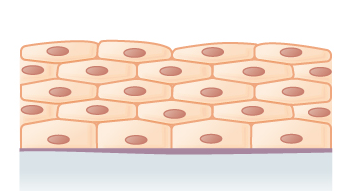
Correct — A, Oesophagus. Squamous epithelium is made of flat, thin, tile-like cells that suit surfaces needing a smooth, protective lining or easy diffusion. The oesophagus is lined by stratified squamous epithelium, which protects against abrasion from swallowed food. The other listed sites are lined by different epithelial types.
Why the others are wrong
- (b)Small intestine. — The small intestine is lined by columnar epithelium with microvilli, shaped for absorption of digested food — not squamous cells.
- (c)Ducts of salivary gland. — The ducts of glands such as salivary glands are lined by cuboidal epithelium, not flat squamous cells.
- (d)Kidney. — Kidney tubules are lined mainly by cuboidal epithelium suited to secretion and absorption; the tissue is not squamous.
Concept
Epithelial tissue covers body surfaces and lines cavities, and its cell shape matches its job. Squamous (flat, scale-like) cells form smooth linings and thin diffusion barriers; cuboidal cells line ducts and tubules for secretion/absorption; columnar cells line the gut for absorption and secretion. The oesophagus needs a tough, protective lining, so it has stratified squamous epithelium.
This is a shape-to-site matching question. Recall the pattern: squamous for protective/diffusion surfaces (oesophagus, mouth lining, alveoli, blood-vessel lining); cuboidal for ducts and kidney tubules; columnar for the intestine. Matching each option to its typical epithelium isolates the oesophagus as the squamous-lined organ.
Key facts
- Squamous epithelium = flat, thin cells forming smooth protective linings or diffusion surfaces.
- The oesophagus is lined by stratified squamous epithelium that resists abrasion.
- Cuboidal epithelium lines gland ducts and kidney tubules; columnar epithelium lines the small intestine.
- Simple squamous epithelium also lines the alveoli of the lungs and the inner walls of blood vessels.
Study next
Common traps
- Assuming all gut and gland linings are the same — the oesophagus is squamous but the intestine is columnar.
- Forgetting that kidney tubules and gland ducts are cuboidal, not squamous.
Asked by matching an epithelial type to the organ it lines, or by identifying the epithelium of a given site (oesophagus, intestine, kidney, alveoli).
Related PYQs
Blood is a type of
- (a) Epithelial tissue
- (b) Muscular tissue
- (c) Nervous tissue
- (d) Connective tissue
Answer(d) Connective tissue
Same topic — classifying animal tissues. Recognising blood as connective tissue (not epithelial) tests the same tissue-type knowledge as identifying the oesophagus lining as squamous epithelium.
Practice
- practice — not a real PYQ
The inner lining of the small intestine is made of
- (a)squamous epithelium
- (b)columnar epithelium
- (c)cuboidal epithelium
- (d)nervous tissue
Answer(b) columnar epithelium — with microvilli that increase the surface for absorption. - practice — not a real PYQ
Simple squamous epithelium is best suited for
- (a)secretion in glands
- (b)rapid diffusion across a thin surface
- (c)conducting impulses
- (d)contraction
Answer(b) rapid diffusion across a thin surface — as in the alveoli and blood-vessel walls.