
Which one of the following properties is NOT true for graphite ?
- (a)Hybridisation of each carbon atom is sp³
- (b)Hybridisation of each carbon atom is sp²
- (c)Electrons are delocalized over the whole sheet of atoms
- (d)Each layer is composed of hexagonal rings
Answer
Why
Correct: A, Hybridisation of each carbon atom is sp³. In graphite every carbon atom is bonded to three neighbours in the same plane, at 120° to one another, which is the signature of sp² hybridisation. That leaves one unhybridised p orbital on each atom, perpendicular to the sheet; these overlap sideways all the way across the layer to give a cloud of delocalised electrons. sp³ hybridisation, with four bonds pointing to the corners of a tetrahedron, is what diamond has, not graphite. The item asks which property is NOT true, so the sp³ claim is the answer.
Why the others are wrong
- (b)Hybridisation of each carbon atom is sp²: This is true of graphite, so it cannot be the odd one out. Three sigma bonds in a plane at 120° is exactly what sp² hybridisation produces, and options (a) and (b) are deliberately set against each other: only one can be right, and it is this one.
- (c)Electrons are delocalized over the whole sheet of atoms: Also true. The fourth electron on each carbon sits in a p orbital that overlaps across the layer, giving mobile electrons, which is precisely why graphite conducts electricity while diamond, with all four electrons locked into sigma bonds, does not.
- (d)Each layer is composed of hexagonal rings: True as well. A graphite sheet is a flat honeycomb of fused six-membered rings, and the sheets are stacked one above another and held only by weak forces, which lets them slide and makes graphite soft and slippery.
Concept
Diamond and graphite are both pure carbon, and every difference between them comes from how the atoms are joined. In diamond each carbon uses all four valence electrons in sigma bonds to four neighbours arranged tetrahedrally, giving a rigid three-dimensional network: extremely hard, an electrical insulator, transparent. In graphite each carbon bonds to only three neighbours in a flat hexagonal sheet, leaving one electron free to roam the layer; the sheets themselves are held to one another by weak van der Waals forces. So graphite is soft enough to leave a mark on paper, slippery enough to serve as a dry lubricant, and a good conductor of electricity along its layers.
A NOT question with two mutually exclusive options is a gift, because the answer must be one of that pair. Here options (a) and (b) assign contradictory hybridisations to the same atom, so one of them is the falsehood and the remaining options can be left unexamined if time is short. Deciding between them takes only the count of neighbours: three bonds in a plane means sp², four bonds in a tetrahedron means sp³. From that one fact everything else about graphite follows in order: a spare p electron per atom, delocalisation across the sheet, electrical conductivity, and hexagonal rings arranged in layers that slide over one another. NDA has come back to the diamond-and-graphite comparison in at least five sittings, usually in exactly this 'which statement is not correct' form.
Key facts
- In graphite each carbon is sp² hybridised and bonded to three others in a plane at 120°.
- The fourth valence electron occupies a p orbital and is delocalised across the layer.
- Graphite layers are flat sheets of fused hexagonal rings, stacked and held by weak van der Waals forces.
- In diamond each carbon is sp³ hybridised, bonded tetrahedrally to four others, with no free electrons.
- Hence graphite conducts electricity and is soft; diamond does not conduct and is the hardest natural substance.
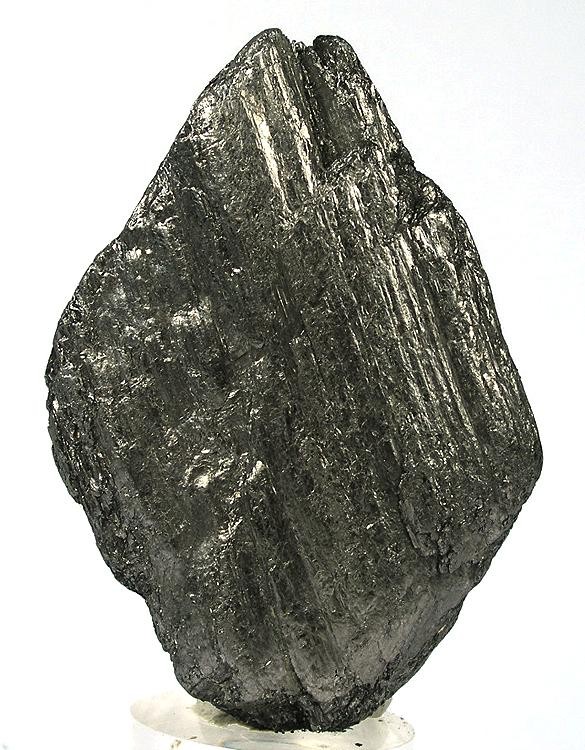
Study next
Common traps
- Swapping the hybridisations of diamond and graphite; count the bonded neighbours to fix them.
- Believing graphite's layers are held by covalent bonds: they are held by weak van der Waals forces.
- Answering with a true statement in a question that asks which statement is NOT true.
NDA sets the diamond-and-graphite comparison as a 'which is not correct' item almost every other year, planting the error in the hybridisation, the bonding between layers or the conductivity.
Related PYQs
Which one of the following statements is not correct?
- (a) All carbons in diamond are linked by carbon-carbon single bond.
- (b) Graphite is layered structure in which layers are held together by weak van der Waals forces.
- (c) Graphite layers are formed by hexagonal rings of carbon atoms.
- (d) Graphite layers are held together by carbon-carbon single bond.
Answer(d) Graphite layers are held together by carbon-carbon single bond.
The same comparison set six months later in the second sitting of the same year, and built the same way: the false option contradicts one of the true ones.
Which one of the following statements is NOT correct ?
- (a) Buckminsterfullerene is an allotrope of carbon
- (b) Diamond is a good conductor of electricity
- (c) Graphite is a good conductor of electricity
- (d) In graphite, each carbon atom is linked to three other carbon atoms
Answer(b) Diamond is a good conductor of electricity
Option (d) there states in words what sp² hybridisation means, and option (b) tests the consequence: the same chain of reasoning this 2018 item asks a candidate to run.
Practice
- practice, not a real PYQ
In diamond, each carbon atom is bonded to
- (a)two other carbon atoms in a chain
- (b)three other carbon atoms in a plane
- (c)four other carbon atoms tetrahedrally
- (d)six other carbon atoms in a ring
Answer(c) four other carbon atoms tetrahedrally: sp³ hybridisation, which uses up every valence electron and leaves none free to conduct. - practice, not a real PYQ
Graphite is used as a dry lubricant mainly because
- (a)it melts at a low temperature
- (b)its layers can slide over one another easily
- (c)it reacts with metal surfaces
- (d)it absorbs moisture from the air
Answer(b) its layers can slide over one another easily: the sheets are held together only by weak van der Waals forces.