
Which one of the following statements is NOT correct ?
- (a)Buckminsterfullerene is an allotrope of carbon
- (b)Diamond is a good conductor of electricity
- (c)Graphite is a good conductor of electricity
- (d)In graphite, each carbon atom is linked to three other carbon atoms
Answer
Why
Correct — B, 'Diamond is a good conductor of electricity.' The question asks for the statement that is NOT correct, and this is the false one. In diamond every carbon atom is covalently bonded to four others in a rigid three-dimensional tetrahedral network, leaving no free electrons, so diamond is an electrical insulator. Graphite, in contrast, bonds each carbon to only three others and leaves one delocalised electron per atom free to move - which is why graphite conducts.
Why the others are wrong
- (a)Buckminsterfullerene is an allotrope of carbon — This is true - buckminsterfullerene (C60) is a well-known allotrope of carbon alongside diamond and graphite - so it is not the incorrect statement.
- (c)Graphite is a good conductor of electricity — This is true; graphite's delocalised electrons make it a good conductor, which is precisely why the statement about diamond in (b) is the false one.
- (d)In graphite, each carbon atom is linked to three other carbon atoms — This is true - in graphite each carbon bonds to three others in flat hexagonal sheets, leaving the fourth electron free - so it is a correct statement, not the answer.
Concept
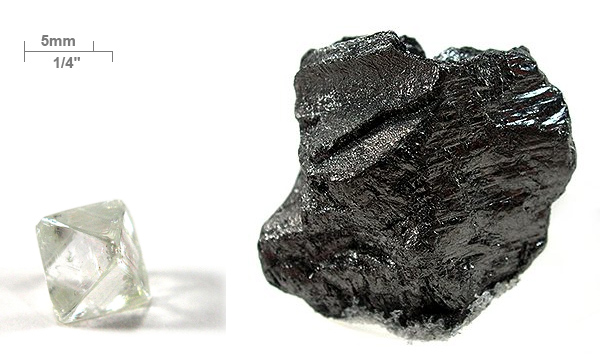
Diamond, graphite and buckminsterfullerene are allotropes of carbon - the same element in different structural forms. Their contrasting structures give contrasting properties: diamond is a hard insulator, while graphite is a soft conductor.
In a 'NOT correct' item, options (b) and (c) are opposites, so one must be false. Diamond is the insulator and graphite the conductor, which pins the false statement to (b).
Key facts
- Diamond, graphite and buckminsterfullerene (C60) are all allotropes of the same element, carbon.
- In diamond each carbon is bonded to four others in a 3-D tetrahedral lattice with no free electrons, making it a hard electrical insulator.
- In graphite each carbon bonds to three others in flat sheets; the fourth, delocalised electron lets graphite conduct electricity.
- Graphite is soft and slippery because its sheets slide, whereas diamond is the hardest natural substance.
Study next
Common traps
- Missing the word 'NOT' and picking a true statement.
- Assuming the hardest allotrope (diamond) must also conduct - hardness and conductivity are unrelated here.
- Swapping the coordination numbers: diamond is 4-coordinate, graphite 3-coordinate.
NDA asks 'which statement about diamond/graphite is NOT correct', turning on diamond = insulator, graphite = conductor.
Related PYQs
Which one of the following statements about diamond and graphite is not correct?
- (a) Diamond has a tetrahedral structure, whereas graphite has a hexagonal planar structure.
- (b) Both physical and chemical properties of diamond and graphite are different.
- (c) Graphite is soft but diamond is hard.
- (d) Graphite is a good conductor of electricity while diamond is not.
Answer(b) Both physical and chemical properties of diamond and graphite are different.
Same diamond-vs-graphite allotrope comparison, also a 'NOT correct' item - there the false claim is that their chemical properties differ, when both are simply pure carbon.
The elemental composition of diamond is
- (a) Carbon and Hydrogen
- (b) Carbon and Oxygen
- (c) Pure Carbon
- (d) Pure Silicon
Answer(c) Pure Carbon
Reinforces that diamond is an allotrope of pure carbon - the same carbon-allotropes theme.
Practice
- practice — not a real PYQ
Graphite is a good conductor of electricity because
- (a)it is very hard
- (b)each carbon atom has one delocalised (free) electron
- (c)it contains metal atoms
- (d)its carbons are bonded to four others
Answer(b) each carbon atom has one delocalised (free) electron - free to move and carry current. - practice — not a real PYQ
Which of the following is the hardest known naturally occurring allotrope of carbon?
- (a)Graphite
- (b)Fullerene
- (c)Diamond
- (d)Coal
Answer(c) Diamond - its 3-D tetrahedral covalent network makes it the hardest natural substance.