
Taklamakan Desert is situated in
- (a)Western Asia
- (b)Southern fringe of Sahara in Africa
- (c)South America
- (d)Central Asia
Answer
Why
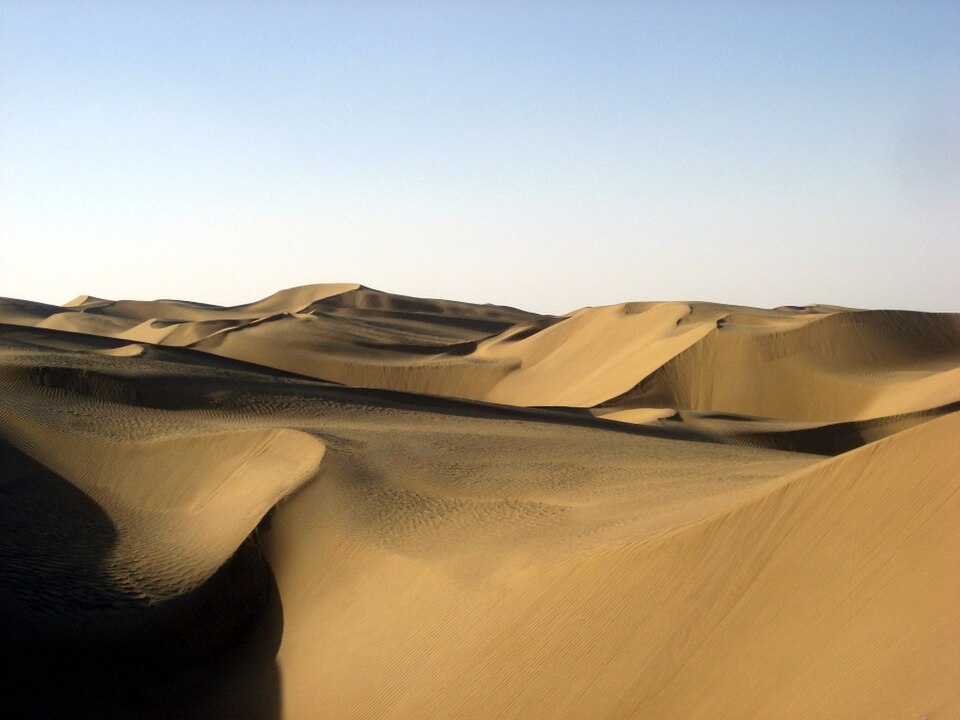
Correct: D, Central Asia. The Taklamakan fills the Tarim Basin in Xinjiang in the far west of China, ringed by the Tien Shan to the north, the Pamirs to the west and the Kunlun Shan to the south, with the Tibetan Plateau beyond. That is the heart of the Central Asian interior. It is a cold, continental, rain-shadow desert rather than a hot tropical one: every wind that could bring moisture has to cross a mountain wall first, so almost nothing arrives. Unlike the mostly stony Gobi to its east, the Taklamakan is a true sand sea of shifting dunes, and the oasis towns strung round its rim (Kashgar, Yarkand, Khotan) carried the northern and southern branches of the Silk Road around it because no caravan could cross the middle.
Why the others are wrong
- (a)Western Asia: Western Asia means the Arabian peninsula, Iran, Iraq and Anatolia, whose great deserts are the Arabian, the Rub' al Khali, the Dasht-e Kavir and the Dasht-e Lut. The Taklamakan lies far to their east, in China.
- (b)Southern fringe of Sahara in Africa: The southern fringe of the Sahara is the Sahel, the semi-arid belt running from Senegal to Sudan. It is a different continent and a hot desert margin, not a cold high-altitude basin.
- (c)South America: South America's deserts are the Atacama on the Pacific coast and the Patagonian desert in the Argentine rain shadow of the Andes. Neither has any connection with the Taklamakan.
Concept
Deserts form for several distinct reasons, and it helps to know which reason produced which desert. The Sahara and the Arabian sit under the subtropical high-pressure belt. The Atacama owes its dryness to a cold offshore current and the Andes. The Taklamakan and the Gobi are continental deserts of the deep interior, cut off from every ocean and shut in further by mountain rain shadows, and both are cold enough to see snow and hard frost in winter.
Anchor the Taklamakan to the Tarim Basin and Xinjiang and the question answers itself. Two further anchors are worth carrying: the Taklamakan lies wholly within China, and it is separated from the Gobi, which straddles southern Mongolia and northern China. Both are sometimes loosely described as Central Asian, but only the Taklamakan is a genuine sand sea. The Tarim river, fed by glacier melt from the surrounding ranges, skirts the northern edge of the desert and once ended in the wandering lake of Lop Nur.
Key facts
- The Taklamakan occupies the Tarim Basin in Xinjiang, in the far west of China.
- It is enclosed by the Tien Shan to the north, the Pamirs to the west and the Kunlun Shan to the south.
- It is a cold, continental rain-shadow desert with severe winters, not a hot tropical one.
- Unlike the largely stony Gobi, the Taklamakan is a sand sea of shifting dunes.
- Silk Road caravans skirted its rim through oases such as Kashgar, Yarkand and Khotan rather than crossing it.
Study next
Common traps
- Mixing the Taklamakan with the Gobi; they are neighbours but different in country, terrain and size.
- Assuming every desert is hot: the Taklamakan freezes hard in winter.
- Reading 'Central Asia' as only the five former Soviet republics and so ruling out western China.
NDA asks a bare place-to-region match, so a list of the world's deserts with the continent, country and cause of aridity for each is the preparation that pays.
Related PYQs
Consider the following statements : 1. In the world, the tropical deserts occur along the western margins of continents within the trade wind belt. 2. In India, the East Himalayan region gets high rainfall from north-east winds. Which of the statements given above is/are correct?
- (a) 1 only
- (b) 2 only
- (c) Both 1 and 2
- (d) Neither 1 nor 2
Answer(a) 1 only: tropical deserts do sit on western continental margins in the trade-wind belt, but the east Himalayan rain comes from the south-west monsoon.
States the rule that makes the Taklamakan interesting: it is not a tropical western-margin desert at all, but a continental one shut in by mountains, which is exactly why it sits in the middle of Asia.
‘Sahel’ region of Sahara desert is associated with
- (a) core area of Sahara desert
- (b) southern moving edge of Sahara desert
- (c) northern fringe of Sahara desert bordering Mediterranean sea
- (d) another name of Sahara desert
Answer(b) southern moving edge of Sahara desert
Defines the exact region offered as option (b) here, so the two together settle the one distractor a student is most likely to hesitate over.
Practice
- practice, not a real PYQ
The Taklamakan Desert lies within which basin?
- (a)The Tarim Basin
- (b)The Congo Basin
- (c)The Great Artesian Basin
- (d)The Amazon Basin
Answer(a) The Tarim Basin: the desert fills this enclosed basin in Xinjiang, western China. - practice, not a real PYQ
The Gobi Desert is spread over which two countries?
- (a)Mongolia and China
- (b)Russia and Kazakhstan
- (c)Iran and Afghanistan
- (d)China and Pakistan
Answer(a) Mongolia and China: it covers southern Mongolia and the northern fringe of China, and does not reach Russia.