
Step-up transformers are used for
- (a)increasing electrical power
- (b)decreasing electrical power
- (c)decreasing voltage
- (d)increasing voltage
Answer
Why
Correct: D, increasing voltage. A transformer works by mutual induction between two coils wound on a common iron core, and the voltage across each coil is proportional to its number of turns. In a step-up transformer the secondary has more turns than the primary, so the output voltage is higher than the input. The name says what it does to voltage and nothing else. Because an ideal transformer neither creates nor destroys energy, the current in the secondary falls in the same proportion as the voltage rises, so the product of voltage and current (the power) stays essentially the same.
Why the others are wrong
- (a)increasing electrical power: No transformer can increase power; that would make it a source of energy. A real transformer delivers slightly less power than it draws, the difference lost as heat in the core and windings.
- (b)decreasing electrical power: Reducing power is not the purpose of a transformer either. A good transformer is over 95 per cent efficient, and the small loss is a defect to be minimised, not a function to be advertised.
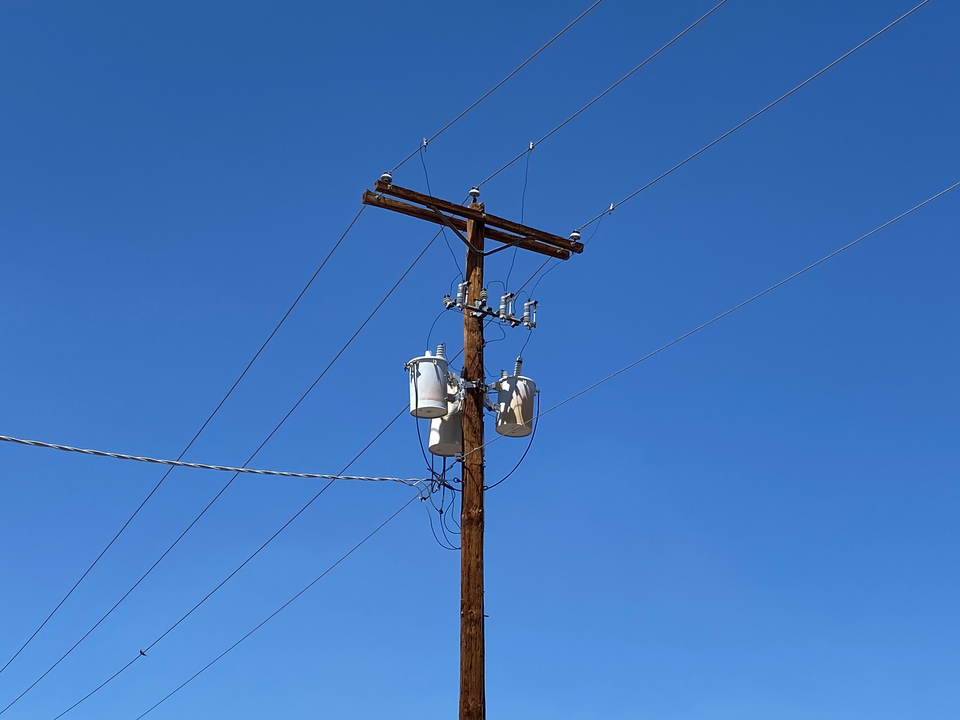
- (c)decreasing voltage: That is a step-down transformer, with fewer turns on the secondary than on the primary. It is the device on a distribution pole that brings the line voltage down for household supply.
Concept
An alternating current in the primary coil sets up a changing magnetic flux, the iron core carries that flux to the secondary, and the changing flux induces an alternating voltage there. The turns ratio fixes the voltage ratio, and energy conservation fixes the current ratio inversely. This is also why a transformer works only with alternating current: with steady direct current the flux does not change, nothing is induced in the secondary, and the core would simply saturate.
The reason the grid needs both kinds is the heating loss in a transmission line, which is proportional to the square of the current. Sending the same power at a much higher voltage means a much smaller current, and the loss falls as the square of the reduction. So power stations step the voltage up for long-distance transmission and a chain of step-down transformers brings it back to a few hundred volts at the consumer's end. Both devices are the same object; whether it is called step-up or step-down simply depends on which coil you feed.
Key facts
- In a transformer the ratio of secondary to primary voltage equals the ratio of their numbers of turns.
- A step-up transformer has more turns on the secondary and raises voltage while lowering current in the same proportion.
- Power is very nearly conserved; real transformers lose a little as heat in the core and the windings and are typically over 95 per cent efficient.
- A transformer works on alternating current only, because it needs a changing magnetic flux to induce a voltage.
- Transmission lines run at high voltage because the heating loss in a line is proportional to the square of the current.
Study next
Common traps
- Reading step-up as increasing power rather than voltage.
- Forgetting that current falls when voltage rises, so nothing is gained for free.
- Assuming a transformer will work on a battery; direct current produces no changing flux.
NDA asks what a step-up or step-down transformer does, or which device changes AC voltage, or why transmission runs at high voltage.
Related PYQs
Assertion (A): Transformer is useful for stepping up or stepping down voltages. Reason (R): Transformer is a device used in D.C. circuits. In the context of the above two statements, which one of the following is correct?
- (a) Both A and R are true and R is the correct explanation of A.
- (b) Both A and R are true but R is not a correct explanation of A.
- (c) A is true but R is false.
- (d) A is false but R is true.
Answer(c) A is true but R is false.
Affirms exactly what the NDA key affirms (a transformer changes voltage) and adds the point that it needs alternating current to do it.
Which one of the following devices changes low voltage alternating current to high voltage alternating current and vice versa ?
- (a) Generator
- (b) Motor
- (c) Transformer
- (d) Vibrator
Answer(c) Transformer
The companion item from the first session of the same year, naming the device that this question describes by function.
Practice
- practice, not a real PYQ
In an ideal step-up transformer, as the output voltage rises the output current
- (a)rises in the same proportion
- (b)falls in the same proportion
- (c)stays unchanged
- (d)becomes zero
Answer(b) falls in the same proportion: the product of voltage and current, that is the power, is essentially unchanged. - practice, not a real PYQ
Electric power is transmitted over long distances at high voltage mainly because
- (a)high voltage travels faster along the wire
- (b)the current is smaller, so the heating loss in the line falls
- (c)high voltage cannot cause a shock
- (d)the resistance of the line becomes zero
Answer(b) the current is smaller, so the heating loss in the line falls: the loss goes as the square of the current.