
Who among the following shared the Nobel Prize in 1962 along with Francis Crick and James Watson for their discoveries concerning the molecular structure of nucleic acids ?
- (a)Erwin Chargaff
- (b)Maurice Hugh Frederick Wilkins
- (c)Rosalind Franklin
- (d)Phoebus Levene
Answer
Why
Correct: B, Maurice Hugh Frederick Wilkins. The 1962 Nobel Prize in Physiology or Medicine was divided three ways between Francis Crick, James Watson and Maurice Wilkins, with the citation reading 'for their discoveries concerning the molecular structure of nucleic acids and its significance for information transfer in living material'. Wilkins led the X-ray diffraction work on DNA at King's College London, and the diffraction images produced in his laboratory supplied the physical evidence that the Cambridge model had to fit.
Why the others are wrong
- (a)Erwin Chargaff: Chargaff established the base-composition rules that any correct model of DNA had to satisfy: adenine matching thymine and guanine matching cytosine in amount. His rules were essential to the double helix, but he never received a Nobel Prize.
- (c)Rosalind Franklin: Franklin's diffraction work at King's College London was central to the structure, but she died in 1958 and Nobel Prizes are not awarded posthumously, so she could not be named in 1962. Wilkins himself insisted that her name stand first on the King's building later called the Franklin-Wilkins Building.
- (d)Phoebus Levene: Levene identified the sugar and base components of nucleic acids in the early twentieth century, but he also proposed the tetranucleotide hypothesis, a wrong picture of DNA that the double helix displaced. He died in 1940.
Concept
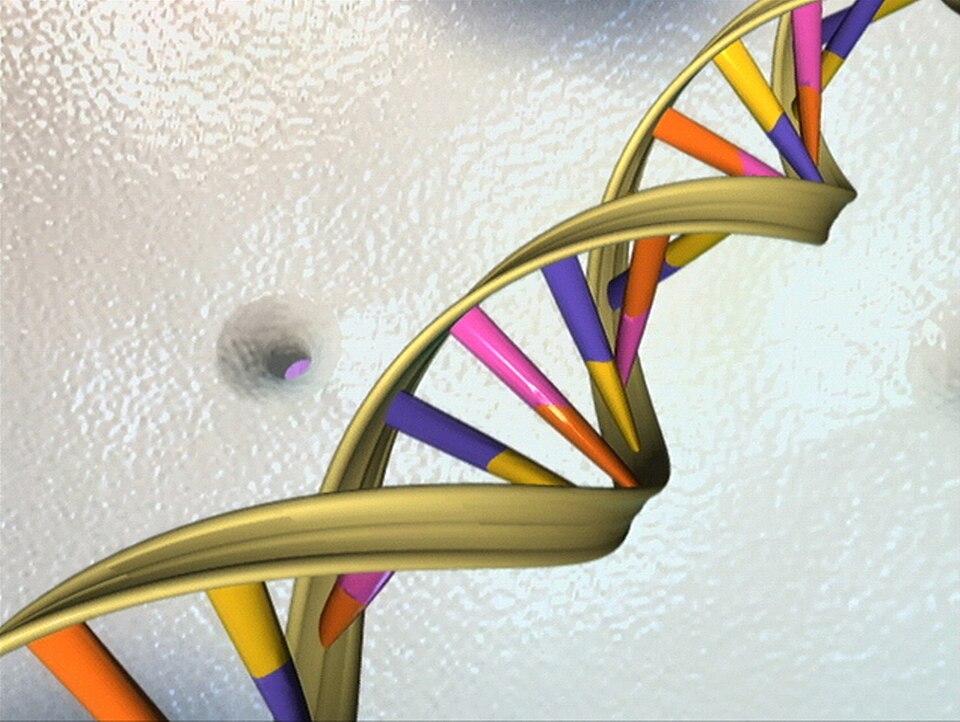
DNA is a double helix of two sugar-phosphate strands running in opposite directions, held together by hydrogen bonds between paired bases, with adenine always facing thymine and guanine always facing cytosine. The model was published in 1953 and rested on two separate lines of evidence: Chargaff's measurements of base ratios, and X-ray diffraction photographs of DNA fibres taken at King's College London. Because the two strands are complementary, each can serve as the template for rebuilding the other, which is what makes faithful copying possible.
The examiner's real question here is which of four names attached to DNA was actually on the 1962 prize, and the deciding rule is a Nobel rule rather than a scientific one. A prize goes to at most three living people. Franklin had died four years earlier, Levene two decades earlier, and Chargaff, though alive, was never awarded one. That leaves Wilkins as the third laureate beside Crick and Watson. Worth carrying forward: the argument over the credit due to Franklin has continued long after the exam, and a modern card should name her contribution honestly while stating why she was not a laureate.
Key facts
- The 1962 Nobel Prize in Physiology or Medicine went jointly to Francis Crick, James Watson and Maurice Wilkins.
- The citation was 'for their discoveries concerning the molecular structure of nucleic acids and its significance for information transfer in living material'.
- Rosalind Franklin died in 1958; Nobel Prizes are not awarded posthumously, which is why she could not share the 1962 award.
- Chargaff's rules (adenine equal to thymine, guanine equal to cytosine) were a key constraint on the double-helix model, but Chargaff received no Nobel Prize.
- The double-helix paper appeared in 1953, nine years before the prize.
Study next
Common traps
- Choosing Franklin because her diffraction image is the best-known part of the story; the prize could not name her after 1958.
- Assuming a scientist whose work was indispensable must have been a laureate: Chargaff was not.
- Mixing the 1962 Physiology or Medicine prize with a chemistry prize; DNA structure was awarded in medicine.
NDA asks who shared a named prize, or which listed person is not a recipient of a particular Nobel award.
Related PYQs
Which of the following features of DNA makes it uniquely suited to store and transmit genetic information from generation to generation?
- (a) Complementarity of the two strands
- (b) Double helix
- (c) Number of base pairs per turn
- (d) Sugar phosphate backbone
Answer(a) Complementarity of the two strands
Asks what the 1962 discovery actually explained: the complementary strands that let DNA copy itself, which is the 'significance for information transfer' in the Nobel citation.
Who among the following is not a recipient of Nobel Prize in Chemistry in 2022 ?
- (a) Carolyn R. Bertozzi
- (b) Benjamin List
- (c) Morten Meldal
- (d) K. Barry Sharpless
Answer(b) Benjamin List
The same shape of question a few years on: four plausible names, only three of whom actually shared the prize in the year named.
Practice
- practice, not a real PYQ
Chargaff's rules state that in a DNA molecule the amount of
- (a)adenine equals that of guanine
- (b)adenine equals that of thymine, and guanine that of cytosine
- (c)purines is twice that of pyrimidines
- (d)cytosine equals that of thymine
Answer(b) adenine equals that of thymine, and guanine that of cytosine: the base-pairing constraint the double helix had to satisfy. - practice, not a real PYQ
The technique that produced the crucial experimental evidence for the double-helical structure of DNA was
- (a)electron microscopy
- (b)X-ray diffraction of DNA fibres
- (c)paper chromatography
- (d)gel electrophoresis
Answer(b) X-ray diffraction of DNA fibres: the King's College London work for which Wilkins shared the 1962 prize.