
Which of the following statements about magnetite ore of iron is/are correct ? 1. It is known as black ore. 2. It contains 60% to 70% of pure iron. 3. It possesses magnetic properties. Select the correct answer using the codes given below :
- (a)1 only
- (b)2 and 3 only
- (c)1 and 3 only
- (d)1, 2 and 3
Answer
Why
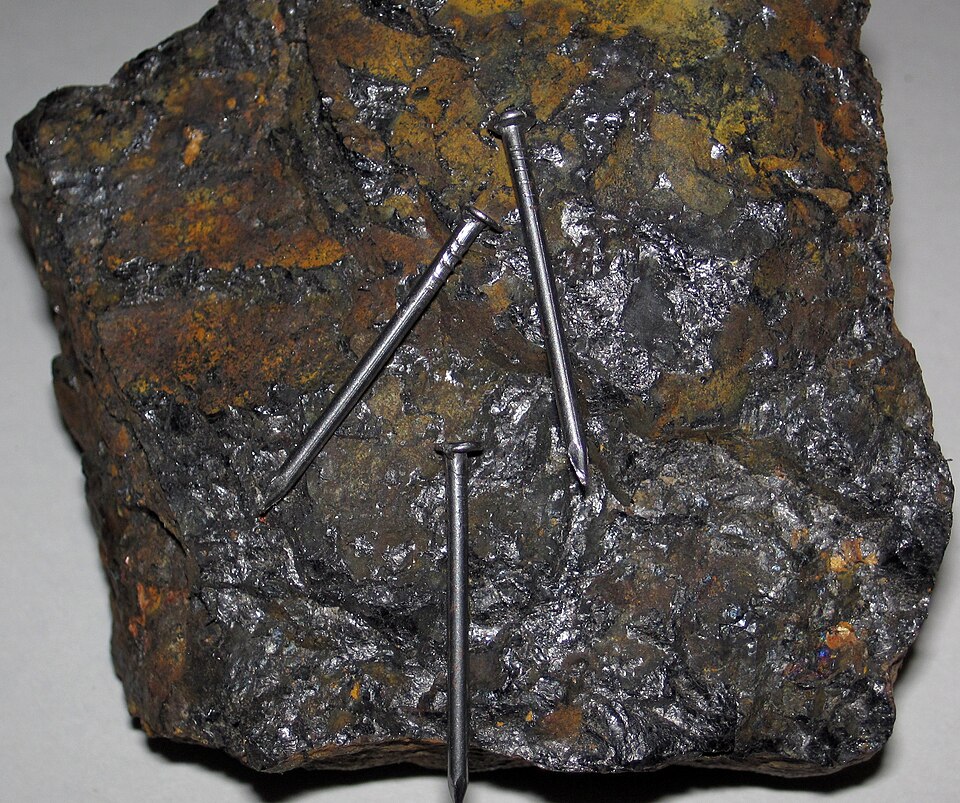
Correct: D, 1, 2 and 3. Statement 1 holds because magnetite is black to brownish-black with a metallic lustre and leaves a black streak, which is exactly why Indian textbooks call it the black ore. Statement 2 holds in the sense the school syllabus intends: magnetite is the richest of the iron ores, quoted at up to about 70 per cent metallic iron against haematite's 50 to 60 per cent, so a 60 to 70 per cent band describes it fairly. Statement 3 holds because magnetite is ferrimagnetic: apart from vanishingly rare native iron, it is the most magnetic mineral occurring naturally on Earth, and a naturally magnetised piece of it is the lodestone that served as the first compass.
Why the others are wrong
- (a)1 only: It keeps the colour and throws away the two properties that actually matter industrially: the high iron content that makes magnetite worth mining, and the magnetism that lets a magnetic separator concentrate it.
- (b)2 and 3 only: It drops the one statement that is simply a description of the specimen in your hand. Magnetite is black and gives a black streak; the name black ore comes straight from that.
- (c)1 and 3 only: This is the near miss for a candidate who remembers that haematite, not magnetite, is the ore India actually exports and so doubts the iron figure. Commercial importance is not the same as richness: magnetite is the higher-grade ore of the two.
Concept
Iron occurs in nature chiefly as oxides. Magnetite is iron(II,III) oxide, written Fe3O4, and haematite is Fe2O3. On paper magnetite is the richer mineral, working out to 72.4 per cent iron by mass against haematite's 69.9 per cent, and it is also strongly magnetic, whereas haematite is not. Haematite nevertheless dominates Indian mining and export because its deposits are found at a directly shippable grade, while magnetite deposits usually need grinding and magnetic separation before they are worth smelting.
Statement-based mineral questions reward you for separating the mineral's properties from the industry's economics. Every property listed here is a property of the mineral itself, and all three are true. The doubt most candidates feel is over the iron percentage, because they have learnt that India's iron-ore exports are haematite. That is a fact about deposits and costs, not about the chemistry. Be honest about one nuance the printed figure glosses over: 60 to 70 per cent is the textbook band for magnetite ore, whereas pure Fe3O4 computes to 72.4 per cent, and a beneficiated magnetite concentrate is usually above 70 per cent. The statement is right in the sense the syllabus means it, and there is no option that quibbles with the number.
Key facts
- Magnetite is Fe3O4, black with a black streak, and pure Fe3O4 is 72.4 per cent iron by mass; haematite is Fe2O3 at 69.9 per cent.
- Indian school texts put magnetite ore at up to about 70 per cent metallic iron and haematite at 50 to 60 per cent, which is why magnetite is called the finest iron ore.
- Magnetite is ferrimagnetic and can itself be magnetised; naturally magnetised pieces are called lodestone and gave the world its first compass.
- Most of India's mined and exported iron ore is haematite, from belts such as Bailadila in Chhattisgarh and Noamundi in Jharkhand; magnetite is commoner in Karnataka, Andhra Pradesh and Tamil Nadu.
- Odisha is by far the largest iron-ore producing state, followed by Chhattisgarh, Karnataka and Jharkhand.
Study next
Common traps
- Assuming the ore India exports most must also be the richest ore: haematite is the commercial mainstay, magnetite the higher grade.
- Reading magnetic property as a feature of all iron ores; haematite is not appreciably magnetic.
- Mixing up magnetite the mineral with magnesite, which is magnesium carbonate and has nothing to do with iron.
NDA asks for the properties or the iron content of a named ore, or pairs a mine with the mineral worked there.
Related PYQs
Consider the following statements: Coke is one of the materials of the charge added to blast furnace for the production of steel/iron. Its function is to I. Act as a reducing agent. II. Remove silica associated with the iron ore. III. Function as fuel, to supply heat. IV. Act as an oxidizing agent. Of these statements:
- (a) I and II are correct
- (b) II and IV are correct
- (c) I and III are correct
- (d) III and IV are correct
Answer(c) I and III are correct
Takes the same ore one stage further: carbon monoxide from coke reduces Fe2O3 and Fe3O4 to metallic iron, which is why the ore's iron content matters.
Which one among the following pairs of mine and mineral is NOT correctly matched ?
- (a) Bailadila : Iron Ore
- (b) Zawar : Zinc
- (c) Ghatsila : Copper
- (d) Kudremukh : Bauxite
Answer(d) Kudremukh : Bauxite
Tests the same mineral on the map instead of in the hand, and its answer turns on Kudremukh being iron country.
Practice
- practice, not a real PYQ
Which one of the following is the chemical formula of magnetite ?
- (a)Fe2O3
- (b)Fe3O4
- (c)FeCO3
- (d)FeS2
Answer(b) Fe3O4: Fe2O3 is haematite, FeCO3 is siderite and FeS2 is iron pyrites. - practice, not a real PYQ
A naturally magnetised piece of magnetite, used in early compasses, is called
- (a)Lodestone
- (b)Limonite
- (c)Bauxite
- (d)Gypsum
Answer(a) Lodestone: a naturally magnetised magnetite that attracts iron and aligns itself north-south.