
Dengue virus causes high fever, rashes and reduces the number of a particular type of blood cells. Those blood cells are
- (a)Monocytes
- (b)Platelets
- (c)Eosinophils
- (d)Neutrophils
Answer
Why
Correct — B, Platelets. Dengue infection characteristically drives down the platelet count, a state called thrombocytopenia. Two things act together — early in the illness the virus suppresses the bone marrow so fewer platelets are made, and the platelets already in circulation are then destroyed by immune complexes, complement activation and direct viral damage. Because platelets are what plug small vessel injuries, their loss shows up as the skin rash, bleeding gums and nosebleeds of dengue, and a falling platelet count alongside a rising haematocrit is the standard warning pattern that a patient may be slipping towards dengue shock.
Why the others are wrong
- (a)Monocytes — Monocytes are the large phagocytic white cells that mature into macrophages. Dengue does push the total white-cell count down, but the fall that defines the disease clinically, and the one doctors chart daily, is in platelets.
- (c)Eosinophils — Eosinophils rise in worm infestations and allergic conditions; they are not the cell line that collapses in dengue, and an eosinophil count is not part of dengue monitoring.
- (d)Neutrophils — Neutrophils are the first-responder white cells of bacterial infection. A viral illness such as dengue lowers white cells generally, but the diagnostic and dangerous drop asked about here is the platelet drop.
Concept
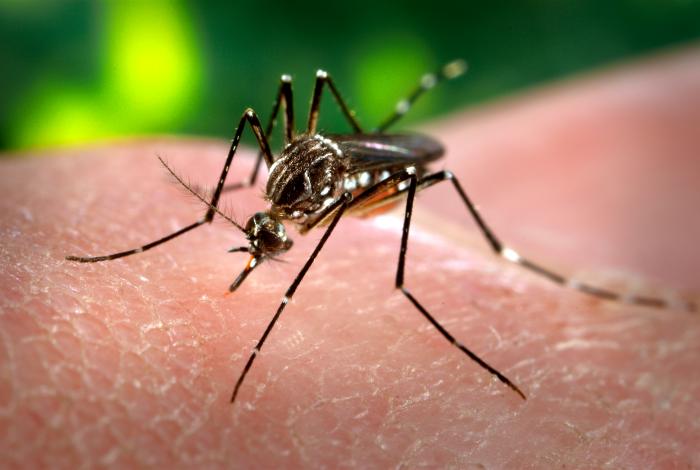
Platelets, also called thrombocytes, are small cell fragments shed by giant bone-marrow cells called megakaryocytes. They circulate at roughly 1.5 to 4 lakh per microlitre of blood and are the first element to stick to a damaged vessel wall and start the clotting cascade. Dengue is caused by a flavivirus spread mainly by the day-biting mosquito Aedes aegypti, and its hallmark laboratory findings are a low white-cell count together with a low platelet count.
The stem gives two clues that both point the same way — fever with rashes, and a fall in one blood-cell type. Rash plus bleeding tendency is a clotting problem, and clotting is the platelet's job, so the answer follows without any recall of numbers. The three white-cell options are placed there to catch a student who remembers only that dengue lowers something in a blood report.
Key facts
- Dengue's typical blood picture is leukopenia plus thrombocytopenia, with coagulopathy in severe cases.
- The low platelet count comes from bone-marrow suppression early on and destruction of circulating platelets later.
- A rising haematocrit with a falling platelet count is the warning pattern that precedes dengue shock.
- The dengue virus is carried chiefly by the female Aedes aegypti mosquito, which also spreads chikungunya and Zika.
Study next
Common traps
- Assuming any disease that lowers a blood count must be lowering white cells — dengue's signature fall is in platelets.
- Calling dengue a bacterial or protozoan disease; it is viral, which is why UPSC and NDA both like the pathogen-matching version of this question.
NDA asks either which cell type a named disease affects, or which pathogen class a named disease belongs to — so learn each disease with both its vector and its pathogen.
Related PYQs
Consider the following statements: 1. Dengue is a protozoan disease transmitted by mosquitoes. 2. Retro-orbital pain is not a symptom of Dengue. 3. Skin rash and bleeding from nose and gums are some of the symptoms of Dengue. Which one of the following statements is/are correct?
- (a) 1 and 2
- (b) 3 only
- (c) 2 only
- (d) 1 and 3
Answer(b) 3 only
The same disease from the symptom side. UPSC tested that dengue is viral rather than protozoan and that bleeding from nose and gums is genuinely a dengue sign — the very bleeding the platelet fall in this NDA question produces.
With reference to the blood in a normal person, which one of the following statements is correct?
- (a) Compared to arteries, veins are less numerous and hold less of the body’s blood at any given time
- (b) Blood cells constitute about 70 % of the total volume of the blood
- (c) White Blood Cells (WBC) are made by lymph nodes only
- (d) The blood has more platelets than WBC
Answer(d) The blood has more platelets than WBC
Platelets again, this time by numbers — a normal count runs to lakhs per microlitre against a few thousand white cells. Knowing that baseline is what makes a dengue platelet crash meaningful.
Which one of the following is caused by a bacterial pathogen?
- (a) AIDS
- (b) Dengue fever
- (c) COVID-19
- (d) Typhoid fever
Answer(d) Typhoid fever
Dengue turns up again five years later, this time as the wrong option in a pathogen-class question. NDA recycles the same short disease list, so tabulate each disease with its pathogen and vector once and it pays twice.
Practice
- practice — not a real PYQ
Which one of the following blood components is chiefly responsible for clotting at the site of an injury?
- (a)Red blood cells
- (b)Platelets
- (c)Lymphocytes
- (d)Plasma proteins alone
Answer(b) Platelets — they adhere to the damaged vessel wall and trigger the clotting cascade. - practice — not a real PYQ
Dengue virus is transmitted to human beings chiefly by which one of the following?
- (a)Female Anopheles mosquito
- (b)Female Aedes aegypti mosquito
- (c)Culex mosquito
- (d)Sandfly
Answer(b) Female Aedes aegypti mosquito — Anopheles carries malaria and the sandfly carries kala-azar.