
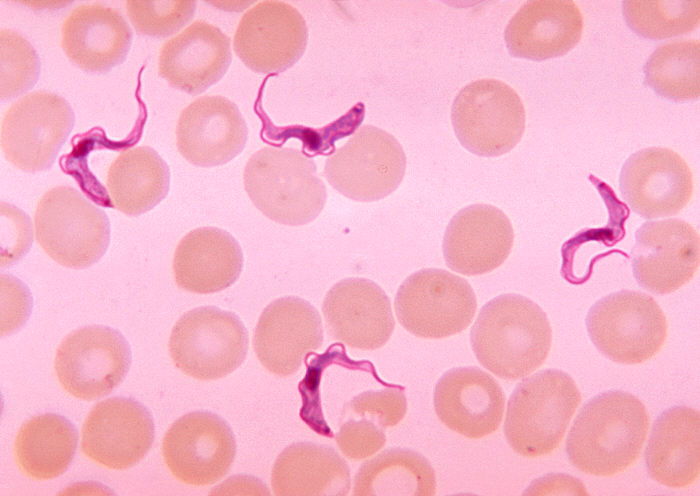
Sleeping sickness is a parasitic disease of humans and other animals. It is caused by
- (a)Histomonas
- (b)Trypanosoma
- (c)Angomonae
- (d)Naegleria
Answer
Why
Correct — B, Trypanosoma. Sleeping sickness, known formally as human African trypanosomiasis, is caused by protozoan parasites of the genus Trypanosoma and is passed to people through the bite of the tsetse fly. Two subspecies are responsible, and they behave differently — Trypanosoma brucei gambiense in west and central Africa accounts for the great majority of reported cases and produces a slow, chronic illness, while Trypanosoma brucei rhodesiense in east and southern Africa causes a small share of cases but a rapid, acute disease. The parasites multiply in the blood and lymph, and in the later stage they cross into the central nervous system, where they disturb the sleep cycle so severely that the disease takes its popular name. The same genus causes nagana in cattle, which is why the tsetse belt has long limited livestock keeping in Africa.
Why the others are wrong
- (a)Histomonas — Histomonas is a protozoan of poultry, known for causing histomoniasis or blackhead disease in turkeys. It is not a cause of human sleeping sickness and it is not carried by the tsetse fly.
- (c)Angomonae — No genus of that name causes sleeping sickness. The closest real name is Angomonas, a genus of protists of the same order as Trypanosoma whose species are associated with flies rather than with people; it is not a human parasite and not the answer here.
- (d)Naegleria — Naegleria is a free-living amoeba of warm fresh water. One species can cause a rare and severe infection of the brain when water is forced up the nose, but that disease is quite distinct from sleeping sickness and has nothing to do with the tsetse fly.
Concept
Protozoan parasites cause a family of diseases that examiners return to repeatedly, each with its own vector. Trypanosoma causes sleeping sickness through the tsetse fly, Plasmodium causes malaria through the female Anopheles mosquito, Leishmania causes kala-azar through the sandfly, and Entamoeba causes amoebic dysentery through contaminated food and water. Knowing the pathogen, the vector and the organ affected answers most questions in this area.
The trap in this item is that all four options look like genus names, so the safe route is to work from what you positively know rather than by elimination. Anchor Trypanosoma to the tsetse fly and to Africa and the answer follows at once. Two notes are worth adding. The printed option (c) reads 'Angomonae', which is not a standard genus name — the booklet was checked at high resolution and the spelling is genuinely what the paper carries, so treat it as a slip in the paper that does not affect the answer. And the disease has moved a long way since this paper was set — the World Health Organization records that reported cases fell below two thousand a year in 2017, the year of this exam, and below one thousand from 2018 onward, having dropped by about ninety-seven per cent over twenty years; elimination as a public health problem and then interruption of transmission are its stated goals.
Key facts
- The World Health Organization describes sleeping sickness as caused by protozoans of the genus Trypanosoma, transmitted to humans by bites of tsetse flies.
- Trypanosoma brucei gambiense accounts for about ninety-two per cent of reported cases and causes a chronic illness; Trypanosoma brucei rhodesiense accounts for about eight per cent and causes an acute disease.
- In the later stage the parasites invade the central nervous system, which disturbs the sleep cycle and gives the disease its name.
- Reported cases fell below two thousand in 2017 and below one thousand from 2018 onward, a fall of about ninety-seven per cent over twenty years.
- Plasmodium and the Anopheles mosquito, and Leishmania and the sandfly, are the other standard protozoan pairings to remember.
Study next
Common traps
- Guessing from the look of a genus name; learn the pathogen with its vector instead.
- Confusing sleeping sickness with encephalitis or with narcolepsy — the cause here is a protozoan spread by a fly.
- Assuming every fly-borne disease is malaria; malaria comes from a mosquito and a different genus of parasite.
NDA asks which organism causes a named disease, or the reverse, and often mixes bacteria, viruses and protozoa in the same option list.
Related PYQs
Consider the following statements: 1. Dengue is a protozoan disease transmitted by mosquitoes. 2. Retro-orbital pain is not a symptom of Dengue. 3. Skin rash and bleeding from nose and gums are some of the symptoms of Dengue. Which one of the following statements is/are correct?
- (a) 1 and 2
- (b) 3 only
- (c) 2 only
- (d) 1 and 3
Answer(b) 3 only
Turns on the same skill of matching a disease to the right class of pathogen — its first statement fails precisely because dengue is viral and not protozoan.
Which one of the following is a bacterium that causes disease in the human body?
- (a) Varicella zoster
- (b) Trypanosoma gambiense
- (c) Salmonella typhi
- (d) Plasmodium falciparum
Answer(c) Salmonella typhi
Puts the sleeping-sickness parasite in an option list of its own and asks you to recognise that it is a protozoan and not a bacterium.
Practice
- practice — not a real PYQ
Sleeping sickness in humans is transmitted by
- (a)the female Anopheles mosquito
- (b)the tsetse fly
- (c)the sandfly
- (d)the housefly
Answer(b) the tsetse fly — the tsetse carries the Trypanosoma parasites that cause African sleeping sickness. - practice — not a real PYQ
Kala-azar is caused by a protozoan of the genus
- (a)Plasmodium
- (b)Trypanosoma
- (c)Leishmania
- (d)Entamoeba
Answer(c) Leishmania — kala-azar is a leishmaniasis spread by the bite of the sandfly.