
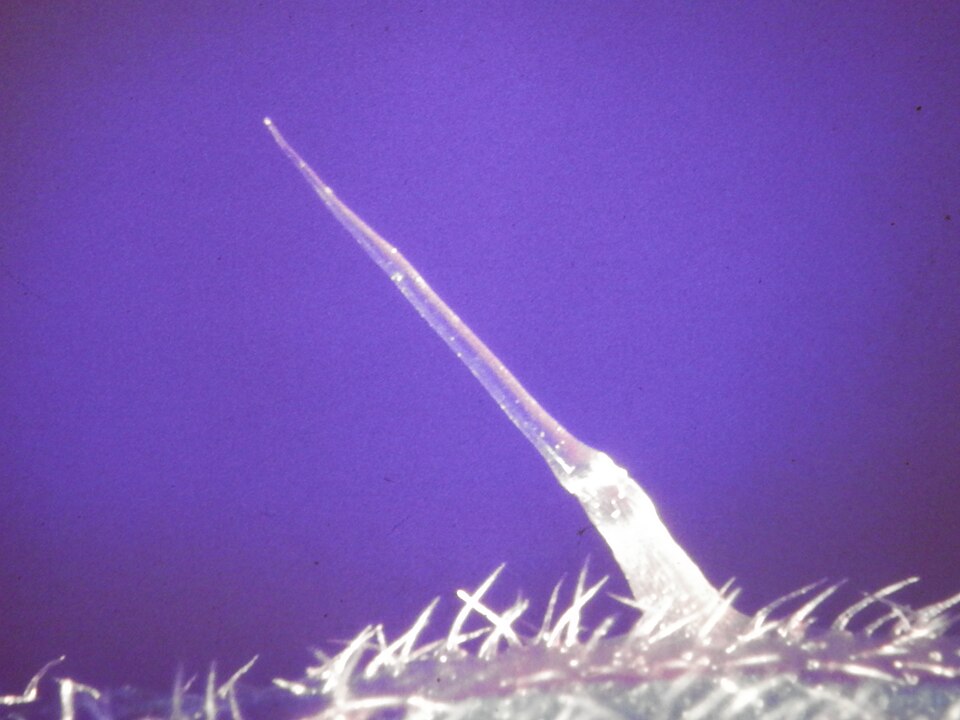
Stung by hairs of nettle leaves causes burning pain. This is due to the injection of
- (a)Acetic acid
- (b)Methanoic acid
- (c)Sulphuric acid
- (d)Hydrochloric acid
Answer
Why
Correct — B, Methanoic acid. The nettle is a wild herb whose leaves carry fine stinging hairs, and each hair works like a tiny hypodermic needle — brushing against it breaks the tip and drives an irritant fluid into the skin, which is why the pain begins the moment you touch the plant. NCERT Class 10 Science states it plainly in the chapter on acids, bases and salts, saying that the stinging hair of nettle leaves inject methanoic acid causing burning pain. Methanoic acid is the common name formic acid's systematic name, the simplest carboxylic acid, and the same acid the textbook lists for an ant sting. Because the irritant is an acid, the traditional relief is a mild base rubbed over the area, either baking soda or the leaf of the dock plant that grows beside the nettle in the wild.
Why the others are wrong
- (a)Acetic acid — Acetic acid, systematically ethanoic acid, is the acid of vinegar. It is a common laboratory and kitchen acid but it is not the compound the stinging hairs of the nettle deliver; NCERT names methanoic acid for both the nettle and the ant.
- (c)Sulphuric acid — Sulphuric acid is a strong mineral acid manufactured industrially. Plants do not synthesise it, and an injection of it would burn tissue far more severely than a nettle sting does.
- (d)Hydrochloric acid — Hydrochloric acid is another strong mineral acid. The human stomach makes it for digestion, but no plant hair secretes it, so it cannot be the irritant behind a nettle sting.
Concept
Several plants and animals defend themselves chemically, and school chemistry pairs a few standard sources with the acids they contain. Methanoic acid, better known as formic acid, is the simplest carboxylic acid and is associated with both ant stings and nettle stings. Since the injected substance is an acid, a mild base neutralises the irritation, which is the everyday chemistry the chapter is really teaching.
Learn this as a table rather than as a story, because that is how the examiner uses it — nettle sting and ant sting go with methanoic acid, vinegar with acetic acid, tomato with oxalic acid, citrus fruits with citric acid, curd with lactic acid, tamarind with tartaric acid. One honest caution is worth adding for the present day. Modern chemical work on stings does not always match the textbook line — the venom of the honey bee, for instance, is dominated by the peptide melittin rather than by formic acid — but for NDA and for the school syllabus the pairing in NCERT is the one that is being examined, and it is the one this key marks.
Key facts
- NCERT Class 10 Science, in the chapter on acids, bases and salts, states that the stinging hair of nettle leaves inject methanoic acid causing burning pain.
- The same NCERT table pairs an ant sting with methanoic acid and a tomato with oxalic acid.
- Methanoic acid is the systematic name for formic acid, the simplest carboxylic acid.
- NCERT suggests relief by rubbing the stung area with a mild base such as baking soda, or with the leaf of the dock plant that grows beside the nettle.
- The nettle is a herbaceous plant of the wild whose leaves carry stinging hairs that break on contact.
Study next
Common traps
- Choosing acetic acid because it is the acid students meet most often; the textbook pairing for both nettle and ant is methanoic acid.
- Picking a strong mineral acid because the pain is severe — living tissue does not manufacture sulphuric or hydrochloric acid for defence.
- Forgetting that the remedy must be a base, which is the point of the neutralisation lesson.
NDA asks which acid a named sting or a named food contains, so keep the source-and-acid table ready.
Related PYQs
When ants bite, they inject
- (a) glacial acetic acid
- (b) methanol
- (c) formic acid
- (d) stearic acid
Answer(c) formic acid
The same acid under its common name, injected by the other creature NCERT pairs with it — formic acid and methanoic acid are two names for one compound.
Bee sting leaves an acid which causes pain and irritation. The acid released is
- (a) tartaric acid
- (b) citric acid
- (c) ethanoic acid
- (d) methanoic acid
Answer(d) methanoic acid
Comes from the very paragraph of NCERT that this question is drawn from, and shows the examiner reusing the sting-and-acid pairing across sessions.
Practice
- practice — not a real PYQ
Rubbing baking soda on an ant sting gives relief because baking soda
- (a)is an acid stronger than the injected one
- (b)is a mild base that neutralises the injected acid
- (c)absorbs the injected acid without reacting
- (d)dries the skin around the sting
Answer(b) is a mild base that neutralises the injected acid — the sting injects methanoic acid, and a mild base cancels its effect. - practice — not a real PYQ
Oxalic acid is the acid naturally present in
- (a)curd
- (b)vinegar
- (c)tomato
- (d)lemon
Answer(c) tomato — NCERT's table of naturally occurring acids pairs the tomato with oxalic acid, curd with lactic acid, vinegar with acetic acid and lemon with citric acid.