
Which of the following are the major coral reef areas of India ? 1. Gulf of Kachchh 2. Gulf of Mannar 3. Lakshadweep 4. Andaman and Nicobar Islands Select the correct answer using the code given below :
- (a)1 and 3 only
- (b)2 and 4 only
- (c)1, 2 and 3 only
- (d)1, 2, 3 and 4
Answer
Why
Correct — D, 1, 2, 3 and 4. All four are genuine reef areas, and together they make up the standard list of India's major coral regions. The Gulf of Kachchh off Jamnagar in Gujarat carries fringing reefs and holds India's first marine protected area. The Gulf of Mannar, between Rameswaram and Thoothukudi, has fringing reefs around a chain of twenty-one small islands. Lakshadweep is built of coral atolls, the only atolls in Indian waters. The Andaman and Nicobar Islands carry the richest and most extensive fringing reefs of all, spread around hundreds of islands. Since every listed area qualifies, the answer must be the option that includes them all.
Why the others are wrong
- (a)1 and 3 only — It keeps the Gulf of Kachchh and Lakshadweep but drops the Gulf of Mannar and the Andaman and Nicobar Islands, which are the two richest reef areas India has.
- (b)2 and 4 only — It keeps the Gulf of Mannar and the Andamans but leaves out the Gulf of Kachchh and Lakshadweep. The Gulf of Kachchh reefs are the ones protected in India's earliest marine sanctuary, and Lakshadweep is coral in its very construction.
- (c)1, 2 and 3 only — This is the near miss. It admits three of the four and drops the Andaman and Nicobar Islands, which in fact carry the largest reef spread in the country. It is offered because a candidate who has memorised a three-item list will reach for it without checking what is missing.
Concept
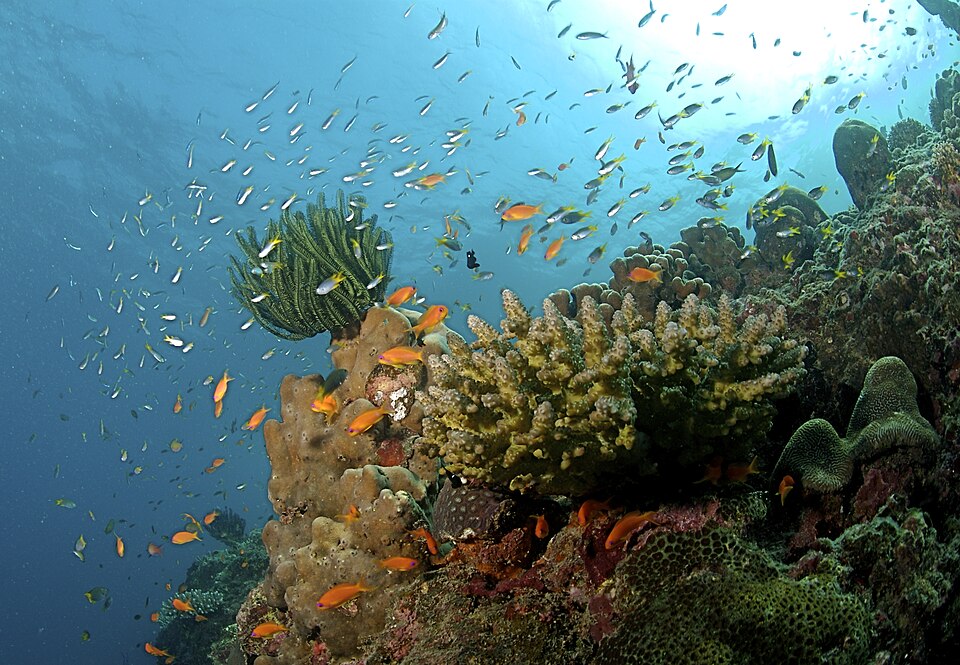
Reef-building corals are colonial animals that live in partnership with tiny algae inside their tissues, so they need warm, shallow, clear and salty water with plenty of sunlight — roughly twenty to thirty-five degrees Celsius, within about fifty metres of the surface, and away from silt and fresh water. That set of conditions explains India's reef map exactly. Reefs occur in the two enclosed gulfs, around the coral islands of Lakshadweep and among the Andaman and Nicobar Islands, with patchy growth in Palk Bay and at a few spots along the coasts. They are absent from the Sundarbans and the other great delta coasts, where river water is muddy and only half salty.
The question is a counting exercise rather than a memory test, and the way to lose it is to stop at three. Work through each name and ask what kind of reef it carries — fringing in the two gulfs and the Andamans, atolls in Lakshadweep — and once all four pass, the all-inclusive option is forced. Compare it with the way UPSC framed the same list in 2014, where the Sundarbans was slipped in as a fifth name and the answer was three of four. The two papers together teach the real rule: it is the absence of silt and fresh water, not the presence of a coastline, that decides where corals grow.
Key facts
- India's reefs are found mainly in the Gulf of Kachchh, the Gulf of Mannar, Lakshadweep and the Andaman and Nicobar Islands, with patches in Palk Bay and off Malvan and Netrani.
- Lakshadweep is made of coral atolls; the other three regions carry fringing reefs.
- The Gulf of Kachchh Marine Sanctuary, notified in 1980 with a National Park declared in 1982, was India's first marine protected area.
- Reef-building corals need warm, shallow, clear and saline water, which is why deltaic coasts such as the Sundarbans have no reefs.
Study next
Common traps
- Stopping at three names when all four in the list qualify.
- Adding the Sundarbans or another delta to a reef list; muddy, brackish water rules corals out.
- Confusing Gulf of Kachchh with Gulf of Khambhat — only the first has reefs.
NDA asks which areas have coral reefs, what damages them, or which body protects a named reef region.
Related PYQs
Which of the following have coral reefs? 1. Andaman and Nicobar Islands 2. Gulf of Kachchh 3. Gulf of Mannar 4. Sunderbans Select the correct answer using the code given below.
- (a) 1, 2 and 3 only
- (b) 2 and 4 only
- (c) 1 and 3 only
- (d) 1, 2, 3 and 4
Answer(a) 1, 2 and 3 only
The same list three years earlier with the Sundarbans planted as a fourth name — the perfect companion, because there the all-inclusive option is the trap and here it is the answer.
The first marine sanctuary in India, having within its bounds coral reefs, Mollusca, dolphins, tortoises and various kinds of sea birds, has been established in
- (a) Sundarbans
- (b) Chilka Lake
- (c) Gulf of Kachchh
- (d) Lakshadweep
Answer(c) Gulf of Kachchh
One of the four areas in its protected-area avatar, and the fact that fixes the Gulf of Kachchh firmly on any reef list.
Keppel Island is completely bleached mainly due to the expansion of
- (a) Starfish
- (b) Blue whale
- (c) Octopus
- (d) Sea horse
Answer(a) Starfish
The threat side of the same topic; NDA asks where reefs are in one year and what destroys them in another.
Practice
- practice — not a real PYQ
The only coral atolls among India's reef areas are found in
- (a)the Gulf of Kachchh
- (b)the Gulf of Mannar
- (c)Lakshadweep
- (d)the Andaman and Nicobar Islands
Answer(c) Lakshadweep — its islands are atolls, while the other three regions carry fringing reefs. - practice — not a real PYQ
Coral bleaching occurs mainly because
- (a)corals are covered by sand during storms
- (b)corals expel the symbiotic algae living in their tissues under thermal stress
- (c)sea water becomes too salty for corals to survive
- (d)corals are eaten by fish in large numbers
Answer(b) corals expel the symbiotic algae living in their tissues under thermal stress — losing the algae takes away both the colour and the main food supply.