
Keppel Island is completely bleached mainly due to the expansion of
- (a)Starfish
- (b)Blue whale
- (c)Octopus
- (d)Sea horse
Answer
Why
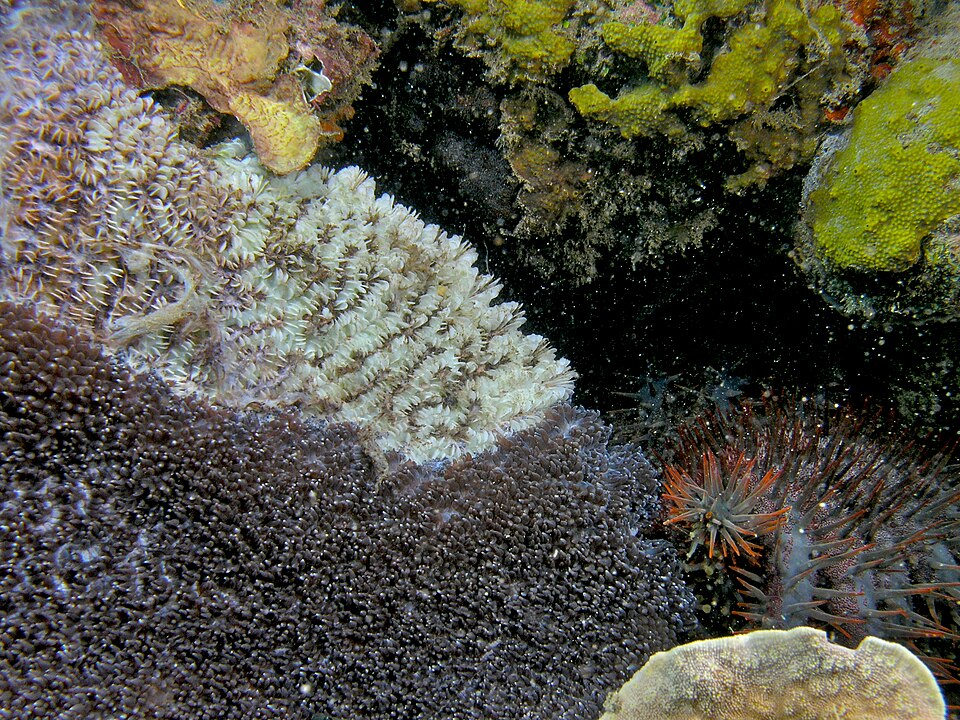
Correct — A, Starfish. The starfish meant here is the crown-of-thorns starfish (Acanthaster planci), a large coral-eating sea star. When its population explodes in an outbreak, it strips the reef of living coral tissue, leaving behind bare white skeletons — the effect seen at Keppel Island in the southern Great Barrier Reef. Of the four animals listed, only the starfish preys on and destroys coral.
Why the others are wrong
- (b)Blue whale — The blue whale is a filter feeder that eats krill in open oceans; it does not feed on or damage coral reefs, so its 'expansion' could not bleach a reef.
- (c)Octopus — Octopuses shelter and hunt small prey around reefs but do not consume coral polyps or cause reef-wide coral loss.
- (d)Sea horse — Sea horses are small fish that feed on tiny plankton and crustaceans; they are harmless to coral and cannot cause bleaching.
Concept
Coral reefs are built by tiny coral polyps living in symbiosis with algae (zooxanthellae). Reefs lose their living colour and turn white ('bleaching' in the broad sense) when the coral tissue is lost or the algae are expelled. One biological driver of coral destruction is the crown-of-thorns starfish, which feeds directly on coral; during outbreaks it can wipe out large stretches of reef such as those around the Keppel Islands off Queensland, Australia.
The question is really an elimination exercise: only one of the four listed marine animals eats coral. Blue whales, octopuses and sea horses do not, so the crown-of-thorns starfish (option a) is the only creature whose 'expansion' could denude a reef.
Key facts
- The crown-of-thorns starfish (Acanthaster planci) preys on live hard-coral polyps.
- It feeds by everting its stomach over the coral, leaving bare white skeletons that algae then colonise.
- Population outbreaks of this starfish are a major cause of coral-cover loss on Australia's Great Barrier Reef.
- The Keppel Islands lie in the southern Great Barrier Reef off the Queensland coast.
Study next
Common traps
- Assuming 'bleaching' is only about temperature — here the driver is a coral-eating starfish.
- Being distracted by large or exotic marine animals (blue whale) that have nothing to do with reefs.
Asked as the cause of reef/coral damage, or by pairing coral-reef locations (GBR, Gulf of Mannar) with the reefs they host.
Related PYQs
The largest coral reef in the world is found near the coast of which one of the following countries?
- (a) Australia
- (b) Cuba
- (c) Ghana
- (d) Philippines
Answer(a) Australia — the Great Barrier Reef off north-east Australia is the world's largest coral reef.
Same setting — the Great Barrier Reef (which includes the Keppel Islands), tying reef geography to the crown-of-thorns starfish damage in this question.
Practice
- practice — not a real PYQ
The crown-of-thorns starfish is a threat to coral reefs because it
- (a)raises sea-water temperature
- (b)feeds on live coral polyps
- (c)blocks sunlight to the reef
- (d)increases ocean salinity
Answer(b) feeds on live coral polyps — its outbreaks strip reefs of living coral. - practice — not a real PYQ
Which one of the following is essential for the healthy growth of coral reefs?
- (a)Cold, deep, muddy water
- (b)Warm, shallow, clear and clean saline water
- (c)Fresh water with high sediment
- (d)Water below 15 °C
Answer(b) Warm, shallow, clear and clean saline water — the conditions coral polyps and their algae need.