
The LPG cooking gas contains propane and butane as the constituents. A sulfur containing compound is added to the LPG, because
- (a)it lowers the cost of production
- (b)it enhances the efficiency of LPG
- (c)it facilitates easy detection of leakage of the gas
- (d)it assists in liquefying hydrocarbons
Answer
Why
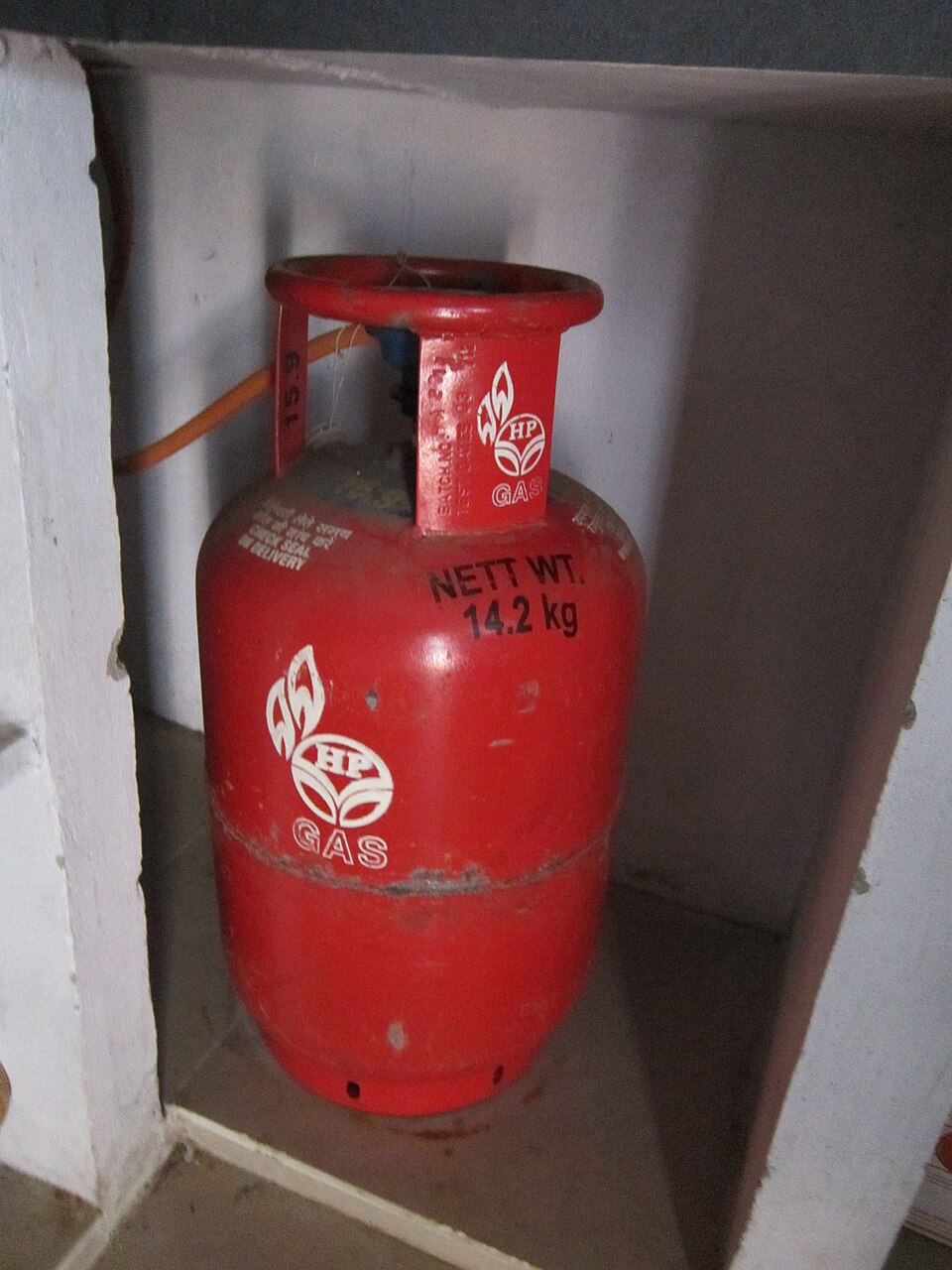
Correct: C, it makes a leak easy to detect. Propane and butane are both colourless and, in their pure state, effectively odourless, so a cylinder could empty itself into a closed kitchen without anyone noticing until the mixture reached the point of exploding. The remedy is to add a trace of a strong-smelling sulfur compound, usually ethyl mercaptan, which the nose picks up at concentrations far below anything dangerous. The characteristic smell of a leaking cylinder is therefore not the smell of the fuel at all; it is the smell of the warning agent deliberately blended into it.
Why the others are wrong
- (a)it lowers the cost of production: Backwards. The odourant is an extra ingredient that has to be manufactured, stored and dosed accurately into the gas, so it adds a small cost rather than removing one. Its value is measured in accidents prevented, not in rupees saved.
- (b)it enhances the efficiency of LPG: The amount added is minute (parts per million) so it makes no measurable difference to the calorific value or the combustion of the fuel. If anything, burning any sulfur compound produces a trace of sulfur dioxide, which is undesirable, so the quantity is kept as small as the nose will allow.
- (d)it assists in liquefying hydrocarbons: Liquefaction has nothing to do with any additive. Propane and butane turn liquid simply because they are compressed, which is why an LPG cylinder holds liquid under moderate pressure and delivers gas as the pressure is released. That is exactly what the L in LPG stands for.
Concept
Liquefied petroleum gas is a mixture of propane and butane obtained during the refining of crude oil and from natural gas processing. Both gases liquefy under moderate pressure at ordinary temperatures, which is what lets a large amount of fuel be carried in a small steel cylinder. Because the constituents give no warning of their own, safety regulations require an odourant, and ethyl mercaptan (chemically ethanethiol, containing a sulfur-hydrogen group) is the standard choice. The nose detects mercaptans at extraordinarily low concentrations, which is precisely the property being exploited.
The item is really a question about why anything is ever added to a fuel, and the odourant is one of a family of deliberate additives whose purpose is safety or handling rather than performance. It pays to keep three facts about LPG apart, because examiners rotate among them: the composition is propane and butane, not methane, which is the constituent of piped natural gas and of CNG; liquefaction is achieved by pressure alone; and the smell is added, not intrinsic. The everyday relevance was high when this paper was set: the Pradhan Mantri Ujjwala Yojana, which took LPG connections to households that had been cooking on biomass, was launched in May 2016, only months before the exam, and the safety-by-smell arrangement is what makes a cylinder usable in a kitchen with no gas-detection equipment. A useful cross-link is that the pungency of garlic comes from sulfur compounds too; sulfur-containing molecules are among the most powerfully odorous substances known, which is exactly why one of them is chosen for this job.
Key facts
- LPG is a mixture chiefly of propane and butane and is liquefied by pressure, not by any additive.
- Ethyl mercaptan, or ethanethiol, is the sulfur compound normally added as an odourant, in trace quantities.
- Pure propane and butane are colourless and odourless, so the familiar smell of a leak comes entirely from the added compound.
- Methane is the main constituent of natural gas and CNG, not of LPG.
Study next
Common traps
- Believing LPG smells of itself; the odour is added, and a candidate who has never questioned it will look for a chemical reason instead of a safety one.
- Confusing LPG with CNG: the first is propane and butane liquefied by pressure, the second is compressed methane.
Everyday chemistry with a why in it is standard NDA fare, and the wrong options are usually plausible-sounding technical benefits, so ask yourself whether the additive is there for performance or for safety.
Related PYQs
Assertion (A): The main constituent of the Liquefied Petroleum Gas is methane. Reason (R): Methane can be used directly for burning in homes and factories where it can be supplied through pipelines.
- (a) Both A and R are individually true and R is the correct explanation of A
- (b) Both A and R are individually true but R is not the correct explanation of A
- (c) A is true but R is false
- (d) A is false but R is true
Answer(d) A is false but R is true
Fixes the composition fact this stem states outright: LPG is propane and butane, and methane belongs to piped natural gas instead.
The characteristic odour of garlic is due to
- (a) a chloro compound
- (b) a sulphur compound
- (c) a fluorine compound
- (d) acetic acid
Answer(b) a sulphur compound
The same chemistry behind the answer: sulfur compounds are among the most powerfully smelling substances known, which is precisely why one of them is chosen as the warning agent in LPG.
Which of the hydrocarbons are arranged as per the increasing order of their boiling points ?
- (a) Methane, Butane, Propane, Heptane
- (b) Propane, Butane, Pentane, Octane
- (c) Propane, Butane, Heptane, Methane
- (d) Octane, Ethane, Methane, Propane
Answer(b) Propane, Butane, Pentane, Octane
Explains why LPG is propane and butane rather than methane: these two lie at the point on the boiling-point scale where moderate pressure is enough to keep them liquid in a cylinder.
Practice
- practice, not a real PYQ
The compound usually added to LPG to give it a warning smell is
- (a)ethyl mercaptan
- (b)ethyl alcohol
- (c)ethylene glycol
- (d)ethyl acetate
Answer(a) ethyl mercaptan: a sulfur compound detectable by the nose at extremely low concentrations. - practice, not a real PYQ
The main constituent of compressed natural gas (CNG) is
- (a)butane
- (b)propane
- (c)methane
- (d)ethylene
Answer(c) methane: LPG, by contrast, is a mixture of propane and butane.