
When one strikes a safety match, the first step is
- (a)burning of sulfur
- (b)decomposition of potassium chlorate into potassium chloride and oxygen
- (c)conversion of a small amount of red phosphorus into white phosphorus
- (d)burning of glue and starch
Answer
Why
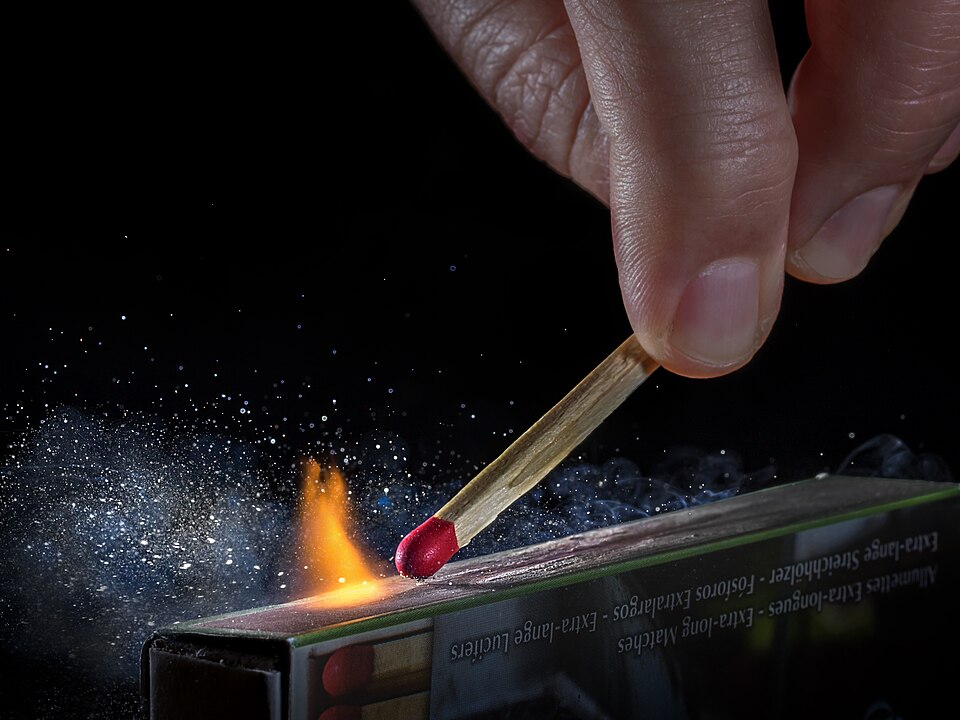
Correct: C, the conversion of a small amount of red phosphorus into white phosphorus. A safety match is deliberately built so that neither half can catch fire on its own. The head carries potassium chlorate as the oxidising agent, with antimony trisulphide or sulfur as fuel and glue and filler to bind them; the rough strip on the side of the box carries red phosphorus mixed with powdered glass. Striking the head against that strip generates heat by friction at the point of contact, and in the school-textbook account this heat converts a trace of the red phosphorus into the far more reactive white form. White phosphorus catches fire in air at once, and that tiny flame supplies the heat that starts everything else. Since the question asks for the first step, the conversion of the allotrope is the answer; the reactions in the other three options all come after it.
Why the others are wrong
- (a)burning of sulfur: The sulfur, or the antimony trisulphide used in its place, is the fuel in the match head, and it does burn, but only after the oxygen released from the potassium chlorate has become available. It is a later link in the chain, not the trigger.
- (b)decomposition of potassium chlorate into potassium chloride and oxygen: The most tempting wrong answer, because this decomposition really does happen and really is essential: it is the source of the oxygen that lets the head burn without air. But potassium chlorate does not decompose spontaneously; it needs heat, and the heat has to come from somewhere first. That somewhere is the phosphorus flash, so this is the second step and not the first.
- (d)burning of glue and starch: Glue and starch are the binders that hold the head together and, with the wax on the splint, help carry the flame down into the wood. They burn last of all, once the head is already alight.
Concept
Phosphorus exists in more than one allotropic form, and the two that matter here behave very differently. Red phosphorus is a polymeric solid, stable in air and safe to handle, which is why it can sit exposed on the side of a matchbox. White phosphorus is made of discrete tetrahedral molecules, is far more reactive, and ignites spontaneously in air at a very low temperature, so low that it has to be stored under water. Converting a trace of the first into the second is what turns a mechanical rub into a chemical fire.
The safety match earns its name from this division of labour: the oxidiser is on the head and the phosphorus is on the box, so the head will not light against an arbitrary rough surface the way the older strike-anywhere match would. Once started, the sequence runs phosphorus flash, then decomposition of potassium chlorate to give oxygen, then combustion of the antimony trisulphide or sulfur, then the glue and the wax-treated splint. One honest note on the chemistry: the red-to-white conversion is the mechanism given in Indian school textbooks and is what this key rewards, while some technical accounts describe the initiation differently, as friction simply bringing red phosphorus and chlorate into intimate contact so that the mixture ignites directly. Either way the first event is at the phosphorus on the striking surface, which is what the option says. A point of printing worth noticing: this option spells 'phosphorus' correctly, whereas the element is printed as 'Phosphorous' in the valency questions elsewhere in this same booklet: the correct spelling of the element is the one used here.
Key facts
- The head of a safety match carries potassium chlorate as oxidiser with antimony trisulphide or sulfur as fuel, plus glue and powdered filler.
- The striking surface on the box carries red phosphorus mixed with powdered glass as an abrasive.
- White phosphorus ignites spontaneously in air and is stored under water; red phosphorus is stable in air and needs no such protection.
- Potassium chlorate on heating gives potassium chloride and oxygen, and that oxygen sustains the burning of the match head.
Study next
Common traps
- Choosing the decomposition of potassium chlorate because it is the reaction you were taught by name; the question asks for the first step, and that reaction needs heat supplied to it.
- Assuming the match head contains phosphorus; in a safety match the phosphorus is on the box, which is the whole point of the design.
NDA likes everyday chemistry with a sequence in it (the match, the fire extinguisher, the candle flame) and the discriminator is nearly always which event comes first, so learn these processes as ordered chains.
Related PYQs
Buckminster fullerene, which looks like a football, is an allotropic form of
- (a) Phosphorus
- (b) Sulfur
- (c) Carbon
- (d) Tin
Answer(c) Carbon
The same idea of allotropy tested directly: different forms of one element with sharply different properties, which is exactly what makes the red-to-white change on a matchbox chemically significant.
Practice
- practice, not a real PYQ
Red phosphorus in a safety match is present on
- (a)the match head
- (b)the rubbing surface on the side of the box
- (c)the wooden splint
- (d)both the head and the splint
Answer(b) the rubbing surface on the side of the box: separating it from the oxidiser on the head is what makes the match a safety match. - practice, not a real PYQ
Which allotrope of phosphorus catches fire spontaneously in air and is therefore stored under water?
- (a)Red phosphorus
- (b)White phosphorus
- (c)Black phosphorus
- (d)Violet phosphorus
Answer(b) White phosphorus: its ignition temperature is so low that contact with air is enough to set it alight.