
Which of the following items is used in the household wirings to prevent accidental fire in case of short circuit ?
- (a)Insulated wire
- (b)Plastic switches
- (c)Non-metallic coatings on conducting wires
- (d)Electric fuse
Answer
Why
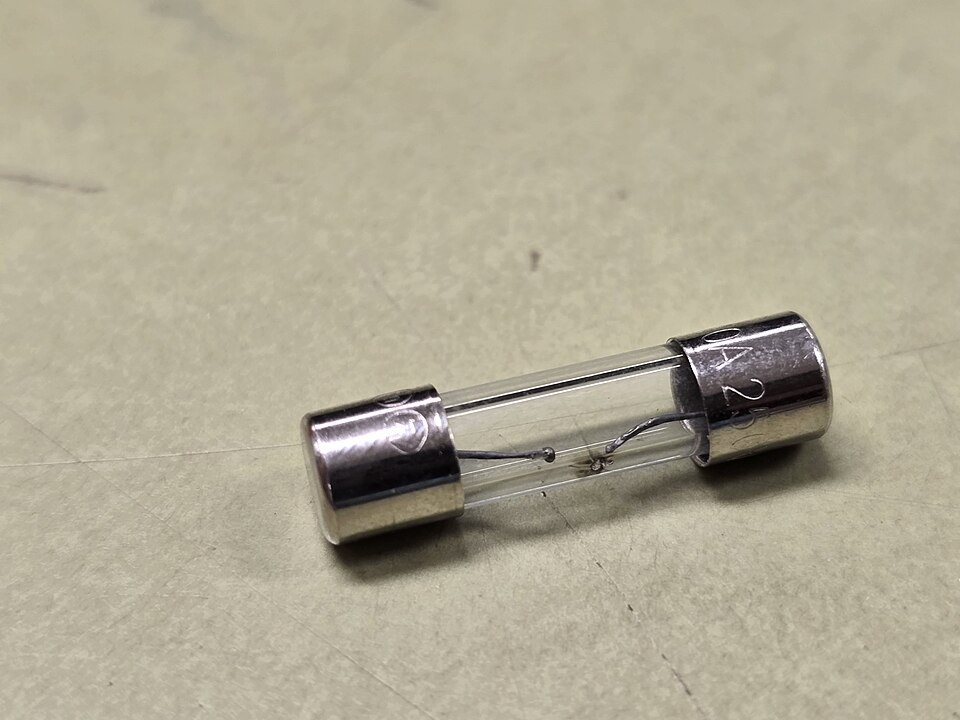
Correct: D, the electric fuse. A short circuit happens when the live and neutral wires touch directly, so the current bypasses the appliance and meets almost no resistance. The current then shoots up to many times its normal value, and because the heat produced in a wire grows as the square of the current, ordinary house wiring can get hot enough to set fire to its own insulation within seconds. A fuse is a short length of thin wire made of an alloy with a low melting point, connected in series with the circuit. The same surge of current melts the fuse wire first, the circuit breaks, and the current stops before the rest of the wiring has time to overheat. That is the only item in the list whose job is to intervene once a fault has already occurred.
Why the others are wrong
- (a)Insulated wire: Insulation is preventive rather than protective. It stops the live and neutral conductors from touching in the first place and stops a person from touching them, but once a short circuit has actually formed, insulation does nothing to limit the current: indeed it is the insulation that ends up burning.
- (b)Plastic switches: A plastic switch body keeps the user safely away from live parts and lets a circuit be opened deliberately. It cannot detect a fault or open itself, so it plays no part in cutting off the huge current of an accidental short circuit.
- (c)Non-metallic coatings on conducting wires: This is only another way of describing insulation, so it fails for the same reason as option (a). It is a barrier against a fault developing, not a device that acts after one has developed.
Concept
A fuse works on the heating effect of electric current. The heat generated in a conductor is proportional to the square of the current, to the resistance and to the time, so a large fault current heats a thin wire very quickly. The fuse wire is deliberately chosen to be the weakest link in the circuit (thin, and made of an alloy such as tin and lead with a melting point far below that of copper) so that it fails and opens the circuit before anything more valuable or more dangerous does. It is always connected in series and always in the live wire.
Three of the four options describe insulation in different words, which is the clue that the examiner wants the one item that is a protective device rather than a barrier. It is worth separating three safety measures that students often blur together. Insulation prevents contact. Earthing gives leakage current a safe path to the ground so that a metal appliance body never becomes live. The fuse, or its modern equivalent the miniature circuit breaker, disconnects the supply when the current exceeds a set limit. A fuse of the wrong rating defeats the whole arrangement, which is why replacing a blown fuse with a thick copper wire is dangerous. In today's Indian homes the same function is usually performed by a miniature circuit breaker in the distribution board, which trips instead of melting and can be reset, but the physics and the purpose are unchanged.
Key facts
- A fuse is connected in series with the circuit and is placed in the live wire, so that melting it isolates the supply.
- Fuse wire is made of an alloy of low melting point and is thinner than the circuit conductors, so it melts first.
- The heat produced in a conductor is proportional to the square of the current, which is why a short circuit heats wiring so rapidly.
- A miniature circuit breaker performs the same protective role in modern wiring but trips a switch instead of melting, and can be reset.
Study next
Common traps
- Treating insulation as protection against a short circuit: it prevents one from forming but does nothing once one exists.
- Confusing overloading, which is too many appliances drawing current through one circuit, with a short circuit, which is a direct live-to-neutral contact.
Household electrical safety is a reliable NDA topic, usually as an identify-the-device item like this one or as a property question about the fuse wire's melting point and its series connection.
Related PYQs
A fuse is used in main electric supply as a safety device. Which one of the following statements about the fuse is correct?
- (a) It is connected in parallel with the main switch
- (b) It is made mainly from silver alloys
- (c) It must have a low melting point
- (d) It must have a very high resistance
Answer(c) It must have a low melting point
The same device asked one level deeper: having identified the fuse as the protection, this item makes you justify why its wire is chosen for a low melting point and a series connection.
When the short circuit condition occurs, the current in the circuit
- (a) becomes zero
- (b) remains constant
- (c) increases substantially
- (d) keeps on changing randomly
Answer(c) increases substantially
Supplies the fact this item rests on: a short circuit sends the current up sharply, and it is that surge that the fuse is designed to interrupt.
Practice
- practice, not a real PYQ
An electric fuse is always connected in a household circuit
- (a)in parallel with the appliance
- (b)in series in the live wire
- (c)in series in the earth wire
- (d)in parallel with the main switch
Answer(b) in series in the live wire: only a series connection lets the melting fuse break the circuit and isolate the supply. - practice, not a real PYQ
The material used for a fuse wire must have
- (a)a high melting point and high resistance
- (b)a low melting point and suitable resistance
- (c)a high melting point and low resistance
- (d)the same melting point as copper
Answer(b) a low melting point and suitable resistance: the fuse must melt before the rest of the wiring is damaged.