
When the short circuit condition occurs, the current in the circuit
- (a)becomes zero
- (b)remains constant
- (c)increases substantially
- (d)keeps on changing randomly
Answer
Why
Correct — C, increases substantially. A short circuit is an unintended low-resistance path that lets current bypass the normal load and flow almost directly across the supply. By Ohm's law, I = V/R: when the resistance R in the path drops to a very small value while the voltage V stays the same, the current I becomes very large. This sudden surge is what overheats wires and blows fuses or trips circuit breakers, which are fitted precisely to interrupt it.
Why the others are wrong
- (a)becomes zero — Zero current describes an open circuit (a break in the path, R → infinity), which is the opposite situation to a short circuit.
- (b)remains constant — The whole point of a short is that resistance collapses, so by I = V/R the current changes sharply — it cannot stay constant.
- (d)keeps on changing randomly — The current follows Ohm's law deterministically; it jumps to a large value, it does not fluctuate randomly.
Concept
In a normal circuit, current is limited by the resistance of the load (a bulb, heater, appliance, etc.). A short circuit creates a path of nearly zero resistance across the source, so almost all the voltage drives current through this path. With R very small in I = V/R, the current spikes to a dangerously high value.
The reasoning hinges on Ohm's law and the difference between a short circuit (resistance falls, current rises) and an open circuit (resistance rises, current falls to zero). Safety devices — fuses and miniature circuit breakers (MCBs) — exist to detect and cut off this surge before wires overheat and cause a fire.
Key facts
- A short circuit is a low-resistance path bypassing the load.
- Ohm's law I = V/R: as R → very small, I becomes very large.
- The surge current can overheat wiring and start fires.
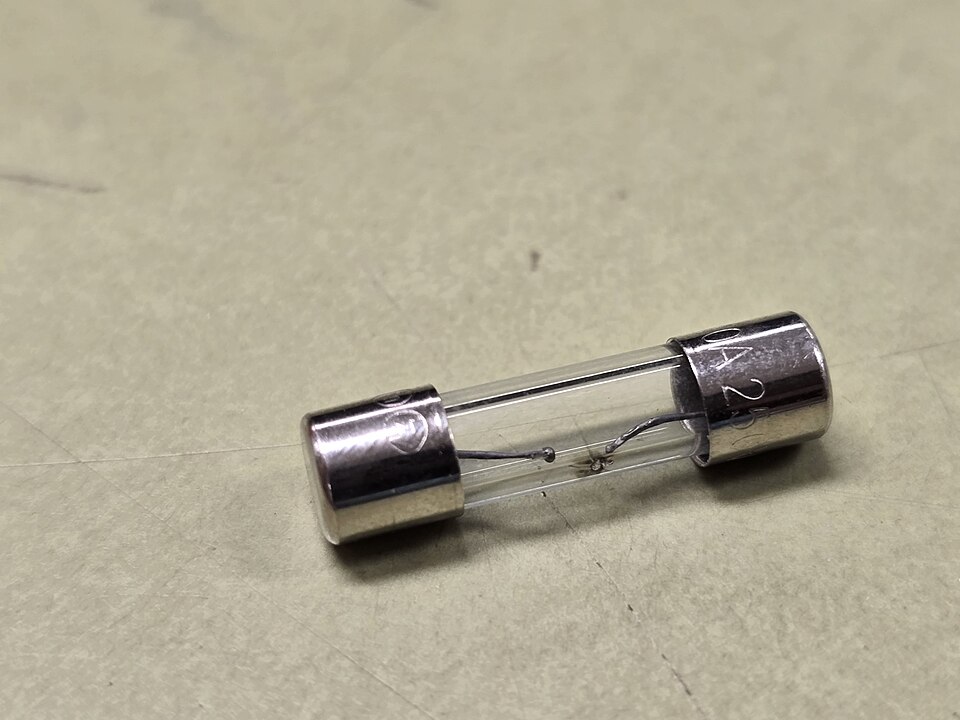
- Fuses and MCBs are designed to break the circuit during this surge.
Study next
Common traps
- Confusing a short circuit (very low resistance, very high current) with an open circuit (broken path, zero current).
- Thinking 'short' implies less current — it actually means a shortcut for the current, causing a surge.
Asked as a conceptual recall — apply I = V/R to a collapsing resistance and recognise the resulting current surge.
Related PYQs
A fuse is used in main electric supply as a safety device. Which one of the following statements about the fuse is correct?
- (a) It is connected in parallel with the main switch
- (b) It is made mainly from silver alloys
- (c) It must have a low melting point
- (d) It must have a very high resistance
Answer(c) It must have a low melting point
Two sides of the same idea. This NDA item establishes that a short circuit produces a surge of current; the UPSC item tests the safety device that responds to it — a low-melting-point fuse that melts and breaks the circuit when that surge flows.
Practice
- practice — not a real PYQ
A fuse wire used for protection against short circuits should have a
- (a)high melting point and high resistance
- (b)low melting point and low resistance
- (c)high melting point and low resistance
- (d)low melting point and high resistance
Answer(b) low melting point and low resistance — so it melts quickly when a surge current flows but does not waste energy in normal use. - practice — not a real PYQ
In a domestic circuit, the fuse is connected
- (a)in series with the live wire
- (b)in parallel with the live wire
- (c)in series with the neutral wire
- (d)in parallel with the appliance
Answer(a) in series with the live wire — so it can break the circuit when excessive current flows.