
Match List I with List II and select the correct answer using the code given below the Lists : List I (Process) A. Heating Camphor B. Cooling of water vapour up to room temperature C. Cooking an egg D. Formation of water vapour at room temperature List II (Type of change) 1. Chemical 2. Evaporation 3. Condensation 4. Sublimation Code : A B C D
- (a)4 3 1 2
- (b)4 1 3 2
- (c)2 1 3 4
- (d)2 3 1 4
Answer
Why
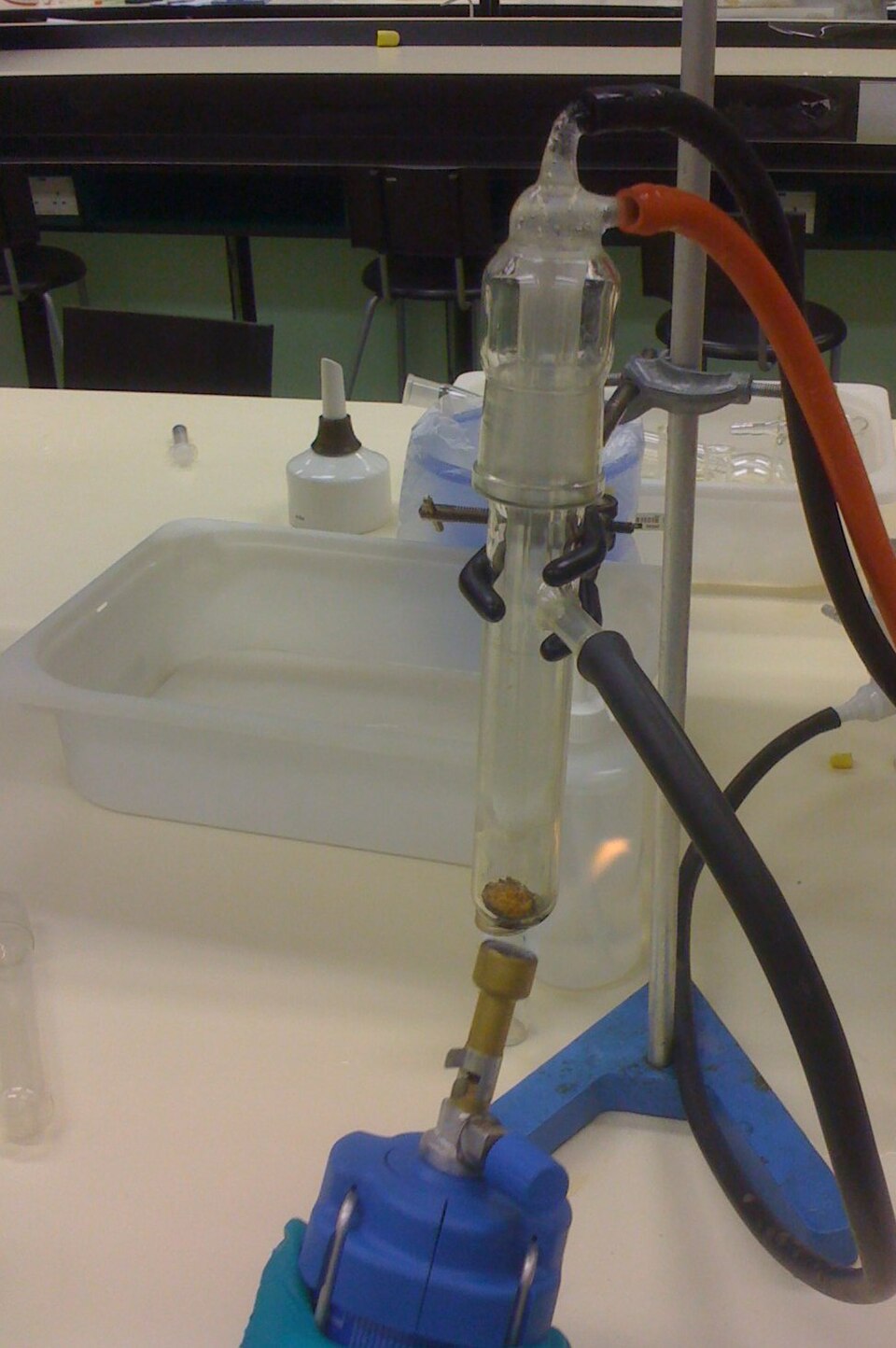
Correct: A, the code 4 3 1 2, that is camphor–sublimation, cooling water vapour–condensation, cooking an egg–chemical, and water vapour forming at room temperature–evaporation. Camphor is one of the small set of solids that turns straight into vapour on warming without ever melting into a liquid, which is sublimation, so A goes to 4. Water vapour cooled to room temperature gives up its latent heat and returns to the liquid state, which is condensation, so B goes to 3. Cooking an egg is the odd one out on the list because it is not a change of state at all: the heat unravels and permanently sets the proteins of the white and yolk, and no amount of cooling will bring the raw egg back, so it is classed as a chemical change and C goes to 1. Water becoming vapour at room temperature, far below its boiling point, is escape from the liquid surface alone, which is evaporation, so D goes to 2.
Why the others are wrong
- (b)4 1 3 2: Starts correctly with sublimation for camphor but then calls the cooling of water vapour a chemical change and the cooking of an egg condensation: the two middle entries have simply been swapped.
- (c)2 1 3 4: Calls the heating of camphor evaporation. Evaporation acts on a liquid; camphor is a solid that never passes through a liquid stage, so the first entry is wrong and the option can be dropped at once.
- (d)2 3 1 4: Right for the middle two entries but wrong at both ends. It labels camphor evaporation and the room-temperature formation of water vapour sublimation, which reverses the two words: sublimation starts from a solid, evaporation from a liquid.
Concept
A physical change alters the state or form of a substance without producing anything new, and it can normally be reversed. Melting, freezing, evaporation, condensation and sublimation are all physical. A chemical change rearranges atoms into different substances and is usually hard to reverse. The three vapour-related terms are told apart by where they start and end: evaporation is liquid to vapour below the boiling point and only at the surface, condensation is vapour to liquid, and sublimation is solid straight to vapour with no liquid in between.
Attack a four-way match by finding the entry that splits the options fastest. Here it is A, because two options call the heating of camphor evaporation, and evaporation is by definition a change in a liquid. That eliminates options (c) and (d) at a stroke, leaving only the middle two entries to separate options (a) and (b). Cooling water vapour is plainly condensation, so option (a) wins. It is also worth noticing that the setter has put exactly one chemical change on the list among three physical ones, which is a common design: spot the odd one out first and the rest becomes a two-way choice.
Key facts
- Camphor, naphthalene, iodine, ammonium chloride and solid carbon dioxide are the standard examples of substances that sublime.
- Evaporation occurs only at the surface of a liquid and at any temperature below the boiling point, whereas boiling occurs throughout the liquid at a fixed temperature.
- Condensation releases the latent heat that evaporation absorbed, which is why steam scalds more severely than water at the same temperature.
- Cooking an egg irreversibly denatures and coagulates its proteins, so it is treated as a chemical change rather than a change of state.
Study next
Common traps
- Calling the heating of camphor evaporation; evaporation needs a liquid, and camphor never becomes one.
- Assuming every process in a chemistry list must be a change of state: one entry here is deliberately a chemical change.
NDA GAT returns to sublimation almost every session, sometimes through camphor, sometimes through dry ice or naphthalene balls, so fix the definition rather than a single example.
Related PYQs
Consider the following statements: 1. Steam at 100 °C and boiling water at 100 °C contain the same amount of heat. 2. Latent heat of fusion of ice is equal to the latent heat of vaporization of water. 3. In an air-conditioner, heat is extracted from the room air at the evaporator coils and is rejected out at the condenser coils. Which of these statements is/are correct?
- (a) 1 and 2
- (b) 2 and 3
- (c) Only 2
- (d) Only 3
Answer(d) Only 3
Takes the same two changes of state further: evaporation and condensation as the working pair inside an air conditioner, and the latent heat each one carries.
Dry ice is used on a performing stage to produce mist in air. The process involved is an example of
- (a) sublimation
- (b) evaporation
- (c) condensation
- (d) precipitation
Answer(a) sublimation
The same concept with a different substance: solid carbon dioxide going straight to vapour is the other example NDA reaches for when it wants to test sublimation.
Practice
- practice, not a real PYQ
Which one of the following changes is a chemical change?
- (a)Melting of ice
- (b)Dissolving sugar in water
- (c)Rusting of iron
- (d)Sublimation of iodine
Answer(c) Rusting of iron: a new substance, hydrated iron oxide, is formed and the change cannot simply be reversed. - practice, not a real PYQ
The direct change of a solid into vapour without passing through the liquid state is called
- (a)evaporation
- (b)condensation
- (c)sublimation
- (d)distillation
Answer(c) sublimation: shown by camphor, naphthalene, iodine and solid carbon dioxide.