
The following 6 (Six) items consist of two statements, Statement I and Statement II. Examine these two statements carefully and select the correct answer using the code given below : Statement I : The laterite soils develop in areas with high temperature and high rainfall. Statement II : Laterite soils are the result of intense leaching process.
- (a)Both the statements are individually true and Statement II is the correct explanation of Statement I
- (b)Both the statements are individually true but Statement II is not the correct explanation of Statement I
- (c)Statement I is true but Statement II is false
- (d)Statement I is false but Statement II is true
Answer
Why
Correct: A, both statements are individually true and Statement II is the correct explanation of Statement I. Laterite is a humid-tropical soil: it develops where the year is hot and the rain heavy and seasonal, so Statement I is true. It is also, by definition, the residue left by intense leaching, so Statement II is true. Here the second statement is not a companion fact but the actual mechanism behind the first. Heavy rain percolating through a warm soil dissolves and carries away silica and the soluble bases (calcium, magnesium, potassium, sodium) while the far less soluble oxides of iron and aluminium stay put and accumulate. That washing-out process is leaching, and it needs exactly the two conditions Statement I names: enough water to do the washing and enough warmth to keep the chemical weathering rapid. Take away the high rainfall and the leaching stops, and no laterite forms. Statement II therefore explains Statement I, which is what option (a) records.
Why the others are wrong
- (b)Both the statements are individually true but Statement II is not the correct explanation of Statement I: This is the option to pick when two true facts merely sit side by side. Here they do not: leaching is the very process by which heat and rain produce laterite, so the second statement supplies the causal link rather than an unrelated observation.
- (c)Statement I is true but Statement II is false: Leaching is the defining process of laterite formation: the word laterisation is used for it. Denying Statement II would leave no account of how the soil forms at all.
- (d)Statement I is false but Statement II is true: The classic error, and one UPSC has tested directly by offering 'well-developed in Rajasthan and Uttar Pradesh' as a laterite statement. Laterite belongs to the wet tropics, not to arid or alluvial plains, so Statement I stands.
Concept
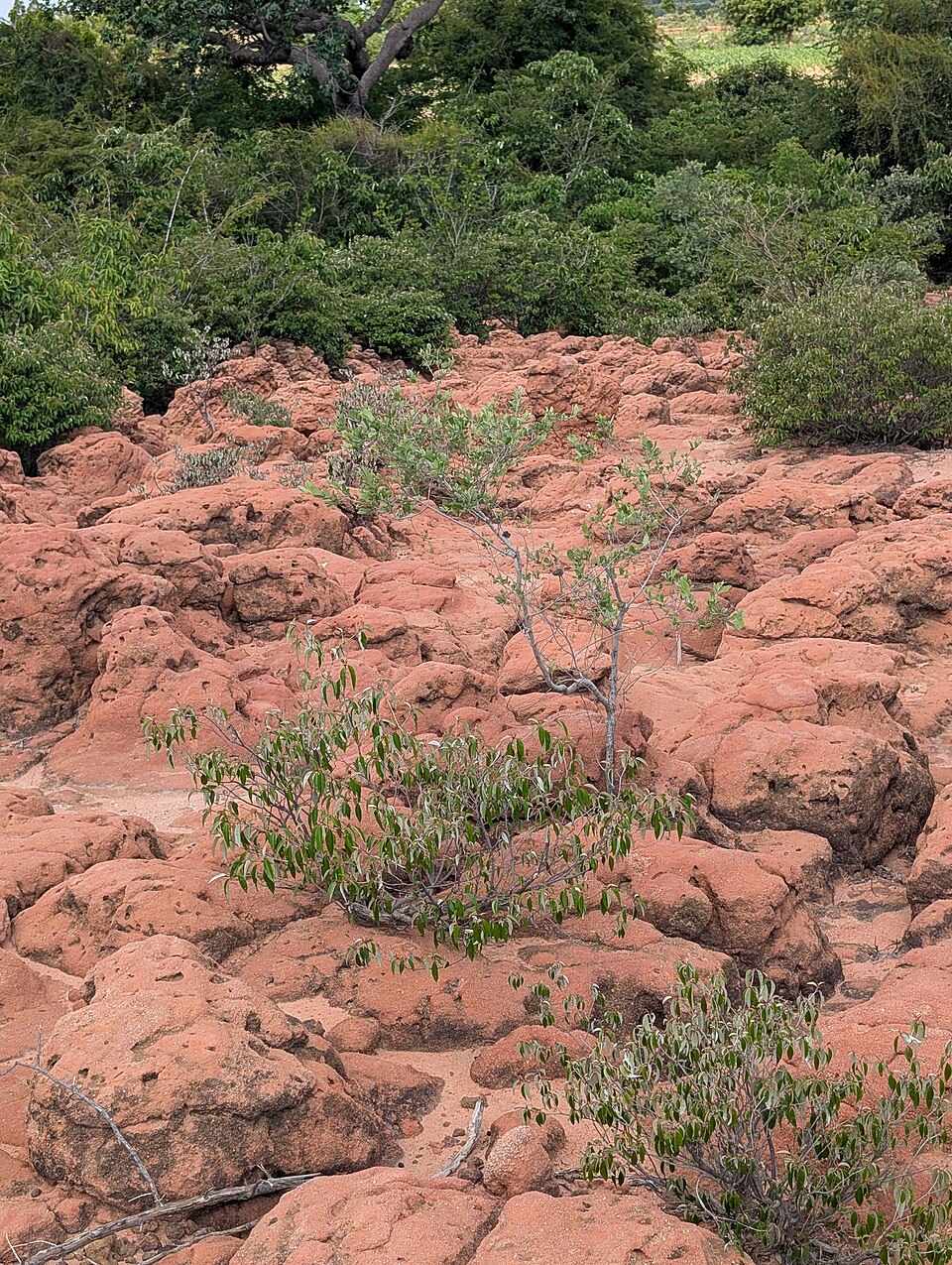
Laterite is the soil left behind when intense leaching strips a tropical soil of its silica and soluble bases, concentrating the residual oxides of iron and aluminium. The conditions it needs are a high mean temperature, which speeds chemical weathering, and heavy seasonal rain with a marked wet and dry alternation, which drives water down through the profile and then lets the iron compounds harden. The name comes from the Latin later, a brick, because the material sets hard on exposure to air and can be cut into building blocks.
The item rewards a candidate who knows that laterite is named for a process, not merely for a place. Work the code in two stages: both statements are clearly true, so the answer lies between options (a) and (b), and the whole question becomes whether leaching is the reason for the climatic requirement or just another fact about laterite. Because leaching is precisely what high temperature and high rainfall do to a soil, the two statements are cause and consequence. A useful sanity check is the soil's chemistry: laterite is poor in nitrogen, phosphate, lime and humus, all of which the same leaching carried away, and rich only in the oxides that leaching could not move.
Key facts
- Laterite forms in the humid tropics where high temperature and heavy seasonal rain together drive intense leaching.
- Leaching removes silica and the soluble bases and leaves residual oxides of iron and aluminium, which give laterite its brick-red cast and its low fertility.
- The name derives from the Latin later, meaning a brick, because laterite hardens in air and has long been quarried for building blocks.
- In India laterite occurs on the crests of the Western Ghats, in parts of the Eastern Ghats and the Chhotanagpur plateau, and in the Meghalaya hills, supporting plantation crops such as tea, coffee, cashew and tapioca rather than cereals.
Study next
Common traps
- Placing laterite in dry regions such as Rajasthan, when it is strictly a wet-tropical soil.
- Calling laterite fertile because it is deep and widespread: the same leaching that makes it also strips its nutrients.
Indian soils are a near-certain NDA topic, usually as a soil-to-region or soil-to-crop match, so learn each soil with one process, one region and one crop attached.
Related PYQs
Which of the following statements regarding laterite soils of India are correct? 1. They are generally red in colour. 2. They are rich in nitrogen and potash. 3. They are well-developed in Rajasthan and UP. 4. Tapioca and cashew nuts grow well on these soils. Select the correct answer using the codes given below.
- (a) 1, 2 and 3
- (b) 2, 3 and 4
- (c) 1 and 4
- (d) 2 and 3 only
Answer(c) 1 and 4
The same soil examined from the other side: it confirms both the wet-tropical location and the nutrient poverty that intense leaching leaves behind.
Which one of the following soils is ideal for growing cotton ?
- (a) Regur soil
- (b) Laterite soil
- (c) Desert soil
- (d) Mountainous soil
Answer(a) Regur soil
Sets laterite against the black regur soil in a soil-to-crop item, the commonest way NDA tests Indian soils.
Practice
- practice, not a real PYQ
Which soil-forming process is chiefly responsible for the formation of laterite soil?
- (a)Calcification
- (b)Leaching
- (c)Salinisation
- (d)Podzolisation
Answer(b) Leaching: percolating rainwater removes silica and bases and leaves iron and aluminium oxides behind. - practice, not a real PYQ
Laterite soils in India are best developed in
- (a)the arid west of Rajasthan
- (b)the alluvial plains of Uttar Pradesh
- (c)the summits of the Western Ghats and parts of the Eastern Ghats
- (d)the cold deserts of Ladakh
Answer(c) the summits of the Western Ghats and parts of the Eastern Ghats: the hot, heavily rained-on uplands where leaching is most intense.