
Match List I with List II List-I List-II Building Built by a) Kabuli Bagh Mosque 1) Qutb ud-Din Aibak b) Adhai Din Ka Jhopra 2) Nur Jahan c) Allahabad Fort 3) Akbar d) Itmad-ud-Daulah Mausoleum 4) Babar Select the correct answer using the codes given below : a b c d
- (a)4 1 3 2
- (b)2 1 4 3
- (c)4 1 2 3
- (d)1 4 3 2
Answer
Why
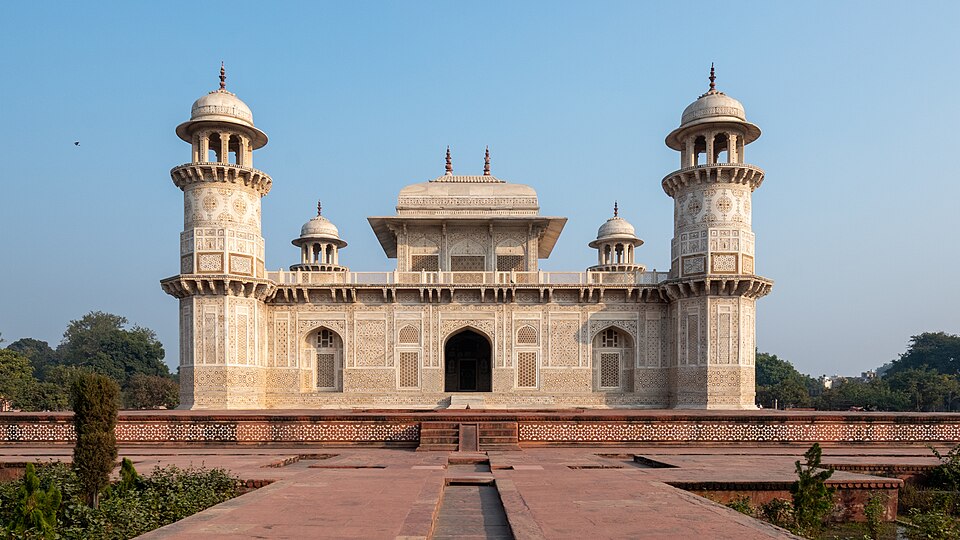
Correct — A, 4 1 3 2. Take the four pairings one at a time. (a) Kabuli Bagh Mosque — 4, Babar. It stands at Panipat in Haryana and was built in 1527 by Babur to mark his victory over Sultan Ibrahim Lodi at the First Battle of Panipat the previous year; it is named after Kabuli Begum, Babur's wife, and the mosque with its enclosure wall is a Monument of National Importance. (b) Adhai Din Ka Jhopra — 1, Qutb ud-Din Aibak. The Ajmer mosque, the oldest surviving monument in that city, was commissioned by Qutb ud-Din Aibak in 1192, designed by Abu Bakr of Herat, completed in 1199, and later enhanced by Iltutmish in 1213. (c) Allahabad Fort — 3, Akbar. Akbar raised it in 1583 at Prayag on the bank of the Yamuna near its confluence with the Ganga; Abu'l-Fazl records in the Akbarnama that the emperor had long wished to found a great city at Piyag, and the Archaeological Survey classes the fort a monument of national importance. (d) Itmad-ud-Daulah Mausoleum — 2, Nur Jahan. Built at Agra between 1622 and 1628, it was commissioned by Nur Jahan for her father Mirza Ghiyas Beg, the Persian noble who was made vazir after her marriage to Jahangir in 1611 and who carried the title I'timad-ud-Daulah, 'pillar of the state'. That gives a-4, b-1, c-3, d-2, which is the code 4 1 3 2 and only option A carries it. Note also that the same four pairings, sorted by date — Ajmer 1192-1199, Panipat 1527, Allahabad 1583, Agra 1622-1628 — line up in exactly the order Aibak, Babur, Akbar, Nur Jahan, so the mapping is forced by chronology alone. Two spellings in the printed list are worth fixing in your notes, because they are what you will search under later. The booklet's 'Adhai Din Ka Jhopra' is the monument catalogued as the Adhai Din Ka Jhonpra, the 'shed of two and a half days', at Ajmer; its 'Itmad-ud-Daulah Mausoleum' is catalogued as the Tomb of I'timad-ud-Daulah at Agra. Neither variant changes the attribution, and neither was the point of the question — but a student who revises from the booklet spelling alone will not find the standard entry.
Why the others are wrong
- (b)2 1 4 3 — Gets only b-1 right and breaks the other three. It hands the Kabuli Bagh Mosque to Nur Jahan, who became Jahangir's consort in 1611 — eighty-four years after that mosque was finished in 1527. It hands the Allahabad Fort to Babar, who died in 1530, fifty-three years before the fort was built in 1583. And it hands the Itmad-ud-Daulah Mausoleum to Akbar, who died in 1605. Three chronological impossibilities in one code.
- (c)4 1 2 3 — The sharpest trap on the question, because it gets the first half exactly right — Kabuli Bagh to Babar and Adhai Din Ka Jhopra to Aibak — and then simply swaps the last two, giving the Allahabad Fort to Nur Jahan and the Itmad-ud-Daulah Mausoleum to Akbar. A candidate who is sure of Panipat and Ajmer but hazy about which Mughal built which monument on the Yamuna lands here. Akbar died in 1605; Mirza Ghiyas Beg died in 1622 and his tomb was begun that year.
- (d)1 4 3 2 — The mirror-image trap: it gets the second half right — Allahabad Fort to Akbar and Itmad-ud-Daulah to Nur Jahan — and swaps the first two, giving the Kabuli Bagh Mosque to Qutb ud-Din Aibak and the Adhai Din Ka Jhopra to Babar. Aibak died in 1210, three centuries before the 1527 mosque at Panipat, and Babur first entered India in 1526, more than three centuries after the Ajmer mosque was completed in 1199.
Concept
The four buildings are milestones along the whole arc of Indo-Islamic architecture in north India, which is why an examiner can set them as one list. The Adhai Din Ka Jhopra belongs to the very first Ghurid-Sultanate phase: begun in 1192, the year of the second battle of Tarain, on a site that had carried a Sanskrit college commissioned by the Chahamana king Vigraharaja IV, of which a tablet dated 1153 survives. It was raised mostly by Indian masons working under Afghan supervision, reused temple pillars, and kept much of its Indian ornament — Alexander Cunningham called it the Great Mosque of Ajmer, and Iltutmish added to it in 1213. Three centuries later the Kabuli Bagh Mosque opens the Mughal record as a victory monument rather than a palace. Akbar's Allahabad Fort belongs to the imperial red-sandstone phase, the same programme of massive river forts that had already produced the rebuilt Agra Fort from 1565. The Tomb of I'timad-ud-Daulah then marks the decisive turn: it is the first Mughal building finished in white marble, moving away from the red sandstone of Humayun's Tomb and Akbar's tomb at Sikandra and towards the marble and pietra dura that culminate in the Taj Mahal. Its walls are Rajasthan marble inlaid with carnelian, jasper, lapis lazuli, onyx and topaz, lit through carved jali screens, with four octagonal corner minarets about thirteen metres high — which is why it is nicknamed the Baby Taj and treated as the Taj's model.
A four-item match with a one-to-one code rewards a method, not four separate memories. The method here is chronological bijection. Sort List II by date first, because rulers are easier to date than buildings: Qutb ud-Din Aibak (Ghurid governor from 1192, Sultan 1206-1210), Babar (in India from 1526, died 1530), Akbar (1556-1605), Nur Jahan (Jahangir's consort from 1611). Now sort List I: the Ajmer mosque is late twelfth century, the Panipat mosque is a victory monument of the 1520s, the Allahabad Fort is high-Akbari, the Agra mausoleum is Jahangiri. Line the two sorted lists up and the mapping is forced — b-1, a-4, c-3, d-2 — without your ever having to recall a single builder's name in isolation. Then test the code by impossibility rather than by recall, which is faster and safer: any code that puts a builder before or long after his building is dead. That one move kills option B outright and kills half of options C and D. The single discriminating fact, once you have accepted Babar-Panipat and Aibak-Ajmer, is that the Itmad-ud-Daulah tomb is Jahangir-era, not Akbar-era — the man buried in it, Mirza Ghiyas Beg, did not die until 1622, seventeen years after Akbar. Get that one date and options C and D both collapse. There is a marking dimension too, and it is why the bijection method matters rather than being merely elegant. This paper awards +1 for a correct answer and deducts 1/3 for a wrong one, and a four-item match with a code offers no partial credit: three right pairings and one wrong pairing score exactly the same as four wrong ones. So the useful question is never 'which pairing am I most confident about' but 'which single code survives every impossibility test'. Here only one does.
Key facts
- Kabuli Bagh Mosque, Panipat, Haryana — built in 1527 by Babur to mark his victory over Sultan Ibrahim Lodi at the First Battle of Panipat in 1526, and named after Kabuli Begum, Babur's wife; the mosque and its enclosure wall are a Monument of National Importance.
- Adhai Din Ka Jhopra, Ajmer, Rajasthan — commissioned by Qutb ud-Din Aibak in 1192, designed by Abu Bakr of Herat, completed in 1199 and enhanced by Iltutmish in 1213; it is one of the oldest mosques in India and the oldest surviving monument in Ajmer.
- The name means 'shed of two and a half days'. The ASI's explanation is a two-and-a-half-day urs fair held at the site for Panjaba Shah in the Maratha period; the scholar Har Bilas Sarda noted that the name appears in no historical source and that before the eighteenth century the building was simply called the Masjid.
- Allahabad Fort — built by Akbar in 1583 at Allahabad, now Prayagraj, on the bank of the Yamuna near its confluence with the Ganga, and classified by the Archaeological Survey of India as a monument of national importance; Abu'l-Fazl records Akbar's wish to found a great city at Piyag in the Akbarnama.
- Tomb of I'timad-ud-Daulah, Agra — built 1622-1628 by Nur Jahan for her father Mirza Ghiyas Beg, who was made vazir after her marriage to Jahangir in 1611, held the mansab of 7,000/7,000 and the title I'timad-ud-Daulah; he was also the grandfather of Mumtaz Mahal, and Nur Jahan's own tomb and Jahangir's are at Lahore.
Study next
Common traps
- Attributing the Adhai Din Ka Jhopra to Iltutmish because his celebrated arched screen is the building's most photographed feature — the commission of 1192 is Qutb ud-Din Aibak's; Iltutmish only enhanced it in 1213
- Reading 'Allahabad Fort' as a Jahangir or Shah Jahan work because Prayag features heavily in later Mughal politics — Akbar built it in 1583, in the same red-sandstone programme as Agra Fort
- Assuming a Mughal mausoleum must be an emperor's project; the Itmad-ud-Daulah tomb was commissioned by a woman, Nur Jahan, for her father, and the Taj Mahal it inspired was for that man's granddaughter
BPSC sets medieval architecture as a four-by-four match with a numeric code and no negative wording, so the whole item is decided by one clean bijection and partial knowledge earns nothing — the paper deliberately offers one code that is right at the front and wrong at the back and another that is the reverse. UPSC prefers the same content in harder wrappers: a chronological-order item on four Delhi and Agra monuments, a dynasty-to-site match, or a statement pair on building materials such as the 2018 question on Buland Darwaza — so the builder and the date must be known well enough to be sequenced, not merely recognised.
Related PYQs
Consider the following: I. Tughluqabad Fort. II. Lodi Garden. III. Qutub Minar. IV. Fatehpur Sikri. The correct chronological order in which they were built is:
- (a) III, I, IV, II
- (b) III, I, II, IV
- (c) I, III, II, IV
- (d) I, III, IV, II
Answer(b) III, I, II, IV
The same knowledge in UPSC's preferred wrapper — four Indo-Islamic monuments that must be dated to their builders, solved by exactly the chronological method that forces the BPSC code, from the Qutb complex through the Tughluqs and Lodis to Akbar.
Match List I with List II and select the correct answer using the code given below the lists: List I I. Gupta II. Chandella III. Chalukya IV. Pallava List II A) Badami B) Panamalai C) Khajuraho D) Deogarh Codes:
- (a) I–D, II–C, III–A, IV–B
- (b) I–D, II–B, III–C, IV–A
- (c) I–B, II–C, III–D, IV–A
- (d) I–C, II–D, III–A, IV–B
Answer(a) I–D, II–C, III–A, IV–B
Identical task and identical format — attribute each monument to the power that built it and select the four-item code; UPSC runs it over temple architecture and dynasties where BPSC runs it over mosques, forts and tombs and named individuals.
Practice
- practice — not a real PYQ
The Kabuli Bagh Mosque at Panipat was built to commemorate which of the following events ?
- (a)Babur's victory over Ibrahim Lodi at the First Battle of Panipat
- (b)Akbar's victory over Hemu at the Second Battle of Panipat
- (c)Ahmad Shah Abdali's victory at the Third Battle of Panipat
- (d)Babur's victory over Rana Sanga at Khanwa
Answer(a) Babur's victory over Ibrahim Lodi at the First Battle of Panipat — Babur built the mosque in 1527 to mark his 1526 victory over Sultan Ibrahim Lodi, and named it after his wife Kabuli Begum. - practice — not a real PYQ
The Tomb of I'timad-ud-Daulah at Agra is architecturally significant chiefly because it was
- (a)the largest masonry dome built in India
- (b)the first Mughal building completed in white marble
- (c)the first Mughal structure to use the true arch
- (d)the earliest Mughal tomb set in a charbagh garden
Answer(b) the first Mughal building completed in white marble — built by Nur Jahan in 1622-1628, it marks the shift from the red sandstone of Humayun's Tomb and Akbar's tomb at Sikandra to the marble and pietra dura of the Taj Mahal; the largest such dome is Gol Gumbaz at Bijapur, and Humayun's Tomb is the earlier charbagh tomb.