
Which of the following defence platforms are part of India’s growing indigenous military ecosystem supported by the Make in India initiative?
- (a)F-35 Lightning II
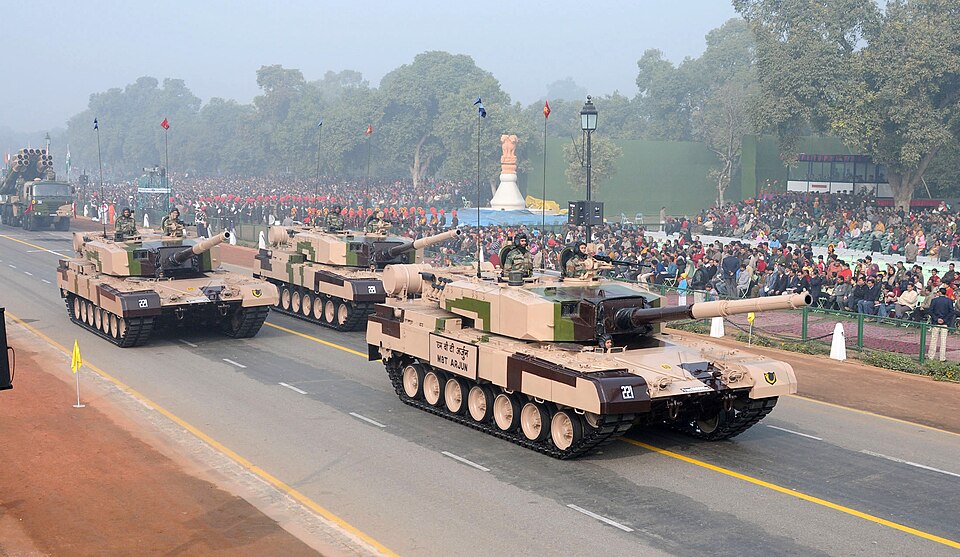
- (b)Main Battle Tank (MBT) Arjun
- (c)Advanced Towed Artillery Gun System (ATAGS)
- (d)More than one of the above
Answer
Why
Correct — D, More than one of the above. Exactly two of the three named platforms are Indian, and they are (b) MBT Arjun and (c) ATAGS; the third, the F-35 Lightning II, is American and fails the test outright. Because two options qualify and no single lettered option can hold both, the combined code is the only choice that can be marked. Take them in turn. Arjun is India's own main battle tank: the programme was authorised in 1974, the Combat Vehicles Research and Development Establishment was raised under DRDO in 1976 expressly to build it, design work ran from 1983 to 1996, and the tank entered service with the Indian Army in 2004, the 43rd Armoured Regiment receiving it first. It carries a 120 mm rifled main gun and indigenous Kanchan composite armour, and it is manufactured at the Heavy Vehicles Factory, Avadi, near Chennai. ATAGS is India's own towed howitzer: a 155 mm / 52-calibre gun developed by DRDO's Armament Research and Development Establishment, Pune, with Bharat Forge Limited and Tata Advanced Systems Limited as production partners, with a stated range of more than 40 km. On 26 March 2025 — barely six months before this paper — the Ministry of Defence signed contracts worth roughly ₹6,900 crore for 307 ATAGS guns and 327 High Mobility 6x6 gun-towing vehicles, enough to equip 15 artillery regiments, and it did so under the strictest procurement head available, Buy (Indian–IDDM). The F-35 Lightning II is none of this. It is a fifth-generation stealth strike fighter built by Lockheed Martin of the United States with Northrop Grumman and BAE Systems, descended from the X-35 that won the American Joint Strike Fighter competition against Boeing's X-32 in 2001; it first flew on 15 December 2006 and is flown by the US services and a set of NATO and allied air forces. India neither designs it, builds it, nor operated it as of the September 2025 exam. Both Arjun and ATAGS are named, in one sentence, on the Government's own April-2025 listing of platforms whose development Make in India enabled — a list that also runs to the Dhanush Artillery Gun System, Light Specialist Vehicles, High Mobility Vehicles, LCA Tejas, the Advanced Light Helicopter, the Light Utility Helicopter, Weapon Locating Radar, 3D Tactical Control Radar and Software Defined Radio. The F-35 appears on no Indian indigenous list, and never could.
Why the others are wrong
- (a)F-35 Lightning II — The only genuinely false item, and the one that unlocks the question. The F-35 Lightning II is a Lockheed Martin fifth-generation stealth fighter of United States origin, produced in three variants — the conventional-takeoff F-35A, the short-takeoff/vertical-landing F-35B and the carrier-capable F-35C — and funded principally by the US Department of Defense with NATO and Australian participation. It is not an Indian programme, is not made under Make in India, and India did not operate it as of the 13 September 2025 exam. Once you see that (a) is out, the question can only resolve to a combined option, because a single-item answer would mean the other two both failed.
- (b)Main Battle Tank (MBT) Arjun — True, but incomplete — which in this format means wrong. Arjun is India's indigenous third-generation main battle tank, designed by DRDO's Combat Vehicles Research and Development Establishment, armed with a 120 mm rifled gun, protected by Kanchan armour and built at the Heavy Vehicles Factory, Avadi; the Mk-1A weighs about 68 tonnes against the Mk-1's 58.5 tonnes. It is on the Government's Make-in-India list by name. But ATAGS is on the same list, so marking (b) alone reports half the correct answer and the paper's own code sends you to (d).
- (c)Advanced Towed Artillery Gun System (ATAGS) — Also true and also incomplete. ATAGS is a 155 mm / 52-calibre towed howitzer from DRDO's Armament Research and Development Establishment, Pune, produced with Bharat Forge and Tata Advanced Systems, ranging beyond 40 km — and it is the flagship Buy (Indian–IDDM) artillery order of 2025, 307 guns plus 327 towing vehicles for about ₹6,900 crore signed on 26 March 2025. Everything the option says is correct. It still is not the answer, because Arjun is equally correct, and a question that offers 'More than one of the above' is asking you to count qualifying items, not to pick the best one.
Concept
'Make in India' in defence is a procurement-category story rather than a slogan, and the categories are what the question is quietly testing. The initiative was launched on 25 September 2014 with defence manufacturing among its original sectors, and the Defence Acquisition Procedure grades every purchase by how much of the design and the manufacture is Indian. The strictest head is Buy (Indian–IDDM) — Indigenously Designed, Developed and Manufactured — where an Indian agency must have designed the platform and Indian firms must build it, with a minimum indigenous content. Below that sit Buy (Indian), Buy and Make (Indian), and at the far end plain Buy (Global), which is simple import. Arjun and ATAGS sit at the strict end: DRDO laboratories designed them, Indian public and private firms build them. That distinction matters because 'assembled in India' is not the same as 'made in India' in the policy sense — a licence-built foreign design transfers jobs but not intellectual property, and it is the design ownership that lets a country upgrade, export and re-engineer the platform later. The supporting machinery is now substantial: 16 Defence PSUs, more than 430 licensed companies and roughly 16,000 MSMEs, with the private sector accounting for about 21% of defence production; over 14,000 items have been indigenised through the SRIJAN portal, and more than 3,000 of the 5,500 items on the five Positive Indigenisation Lists had been indigenised by February 2025. An imported platform, however capable, sits outside that ecosystem entirely — and that is exactly the line the examiner is asking you to draw.
The trap here is capability, not origin, and it is a deliberate one. The F-35 is by far the most advanced-sounding name in the list, and it is the only one many candidates will have seen in international headlines; a fast reader can slide from 'most impressive' to 'surely ours'. Refuse that slide and ask a single question of each item — who designed it and who builds it? — and the field collapses at once. F-35: Lockheed Martin, United States, out. Arjun: DRDO's CVRDE, built at Avadi, in. ATAGS: DRDO's ARDE with Bharat Forge and Tata Advanced Systems, in. Two qualify, so no single letter can carry the answer and (d) follows mechanically. That mechanical step is the discriminator and it is worth naming: in a 'More than one of the above' item, the moment your second item qualifies you can stop evaluating and mark (d), because the format makes every single-item option false by construction. The second-order trap is subtler. Candidates who half-remember that India has discussed buying foreign fifth-generation fighters may reason that a purchase or an offer would somehow bring the F-35 inside the ecosystem. It would not. Buying a finished aircraft is Buy (Global) — the opposite pole of the procurement scale from the Buy (Indian–IDDM) head under which ATAGS was ordered in March 2025. Import and indigenisation are not two shades of the same thing; the whole architecture of the policy exists to separate them.
Key facts
- MBT Arjun and ATAGS both appear by name on the Government's April-2025 listing of platforms developed under Make in India, alongside Dhanush, Light Specialist Vehicles, High Mobility Vehicles, LCA Tejas, ALH, LUH, Weapon Locating Radar, 3D Tactical Control Radar and Software Defined Radio. The F-35 Lightning II appears on no Indian indigenous list.
- Arjun was authorised as a programme in 1974; CVRDE was set up under DRDO in 1976 to develop it; design ran 1983–1996 and the tank entered Indian Army service in 2004 with the 43rd Armoured Regiment. It mounts a 120 mm rifled gun and Kanchan armour and is built at the Heavy Vehicles Factory, Avadi.
- ATAGS is a 155 mm / 52-calibre towed gun from DRDO's Armament Research and Development Establishment (ARDE), Pune, produced with Bharat Forge and Tata Advanced Systems, with a range of over 40 km; contracts of about ₹6,900 crore for 307 guns and 327 High Mobility 6x6 gun-towing vehicles — 15 artillery regiments' worth — were signed on 26 March 2025 under Buy (Indian–IDDM).
- India's defence production reached ₹1.27 lakh crore in FY 2023-24, and defence exports hit a record ₹23,622 crore in FY 2024-25 (private sector ₹15,233 crore, DPSUs ₹8,389 crore) against just ₹686 crore in 2013-14 — roughly a 34-fold rise, to more than 100 countries. The stated 2029 targets are ₹3 lakh crore of production and ₹50,000 crore of exports.
- The F-35 Lightning II is a United States fifth-generation stealth strike fighter, prime contractor Lockheed Martin with Northrop Grumman and BAE Systems; it grew out of the X-35 that beat Boeing's X-32 for the Joint Strike Fighter contract in 2001 and first flew on 15 December 2006, in F-35A, F-35B and F-35C variants.
- Make in India was launched on 25 September 2014 with defence manufacturing among its original sectors; by 2025 the sector counted 16 DPSUs, 430-plus licensed companies and about 16,000 MSMEs, with the private sector at roughly 21% of defence production and 14,000-plus items indigenised through the SRIJAN portal.
Study next
Common traps
- Equating 'advanced' or 'in the news' with 'indigenous'. Origin and design ownership, not capability, is what the question tests — the most impressive name in the list is the one that fails.
- Confusing ATAGS with Dhanush. Both are Indian 155 mm artillery guns and both are on the Make-in-India list, but Dhanush came out of the erstwhile Ordnance Factory lineage from Bofors drawings while ATAGS is a clean-sheet DRDO design with private industry partners.
- Assuming an Indian-assembled foreign design counts as indigenous. Buy (Indian–IDDM) requires Indian design as well as Indian manufacture; licence assembly of an imported design sits several categories lower.
- Mixing up Arjun the tank with 'Arjun' the wheat variety, which UPSC has actually asked about — a reminder that Indian defence and agricultural programmes share a lot of names.
BPSC's move is to set one obviously foreign platform beside two Indian ones and let 'More than one of the above' do the work, so the mark turns on origin-recognition plus format discipline; it also keeps the platform names verbatim from a recent government release, which rewards reading the release. UPSC does not use that code. It converts the same knowledge into a counting question — 'how many of the above pairs are correctly matched', as with the Rafale / MiG-29 / Tejas generation item in 2024 — or into a one-line identification of a single platform, where a wrong classification rather than a wrong country is the planted defect.
Related PYQs
Which one of the following is a modern tank?
- (a) Bhim
- (b) Akash
- (c) Arjun
- (d) Prithvi
Answer(c) Arjun
The identical platform, tested the classic way — placing each Indian defence name against the right kind of system. Bhim is self-propelled artillery, Akash a surface-to-air missile and Prithvi a ballistic missile; only Arjun is a tank, and it is the same tank BPSC put in option (b) nearly thirty years later.
Consider the following aircraft : 1. Rafael 2. MiG-29 3. Tejas MK-1 How many of the above are considered fifth generation fighter aircraft ?
- (a) Only one
- (b) Only two
- (c) All three
- (d) None
Answer(d) None
The same habit of mind in UPSC's counting format — classify each named platform by origin and generation instead of trusting how advanced the name sounds. It is also the direct counterpart to the F-35 distractor here, since the F-35 is genuinely a fifth-generation aircraft and none of UPSC's three were.
In the context of the Indian defence, what is ‘Dhruv’?
- (a) Aircraft-carrying warship
- (b) Missile-carrying submarine
- (c) Advanced light helicopter
- (d) Intercontinental ballistic missile
Answer(c) Advanced light helicopter
Another platform from the very same Make-in-India list BPSC drew its options from — the HAL-built Advanced Light Helicopter. UPSC asked what it is; BPSC asked whether it is ours. Between them the two questions cover both halves of every indigenous-platform item.
Practice
- practice — not a real PYQ
The Advanced Towed Artillery Gun System (ATAGS) is a
- (a)105 mm light field gun imported from Sweden
- (b)155 mm / 52 calibre towed howitzer developed by DRDO with Indian industry partners
- (c)Self-propelled tracked howitzer of Korean origin assembled in India
- (d)Shoulder-fired anti-tank guided missile
Answer(b) 155 mm / 52 calibre towed howitzer developed by DRDO with Indian industry partners — designed at ARDE Pune with Bharat Forge and Tata Advanced Systems, range over 40 km, ordered in March 2025 under Buy (Indian–IDDM). - practice — not a real PYQ
Which one of the following defence platforms is NOT of Indian design and development?
- (a)Light Combat Aircraft (LCA) Tejas
- (b)Advanced Light Helicopter (ALH) Dhruv
- (c)F-35 Lightning II
- (d)Dhanush Artillery Gun System
Answer(c) F-35 Lightning II — a Lockheed Martin (United States) fifth-generation stealth fighter; Tejas, Dhruv and Dhanush are all Indian programmes named on the Government's Make-in-India list.