
Xylem in plants is responsible for following function :
- (a)Transport of water and dissolved minerals
- (b)Transport of foods
- (c)Transport of oxygen and other gases
- (d)Transport of essential amino acids
Answer
Why
Correct — A, Transport of water and dissolved minerals. Xylem is the water-conducting half of a vascular plant's plumbing, and its traffic is one-way: water taken in at the root, with the mineral ions dissolved in it, carried up through the stem to every leaf. It is built from four cell types — tracheids and vessel elements, which do the conducting, plus xylem parenchyma for storage and short-range lateral movement and xylem fibres for mechanical strength. The two conducting types are dead at maturity: the protoplasm disintegrates and what remains is a hollow tube with a lignified wall, which is exactly what a low-resistance pipe under suction has to be. Vessels — short cells stacked end to end with their end walls perforated into a continuous pipe — are an angiosperm innovation; gymnosperms such as pine and deodar conduct through tracheids alone. The lifting mechanism is the transpiration pull of the cohesion-tension theory put forward by H. H. Dixon and J. Joly in 1894: water evaporating from the wet mesophyll cell walls inside the leaf lowers the water potential there and puts the whole column under tension, typically of the order of −1 to −2 megapascals; because water molecules hydrogen-bond to one another (cohesion) and to the lignified vessel wall (adhesion), that tension drags an unbroken thread of water upward instead of snapping it. The minerals simply ride that stream. Root hairs absorb nitrate, phosphate, potassium, calcium, magnesium and sulphate from the soil solution; the ions cross the root cortex and are actively loaded past the endodermis — whose Casparian strip of suberin blocks the cell-wall route and forces every ion through a living membrane — into the xylem, after which they travel wherever the water goes. That is why the option pairs the two: in xylem, water is the vehicle and the dissolved minerals are the cargo. The scale is unintuitive — the great bulk of the water a root absorbs is lost again as vapour at the leaf surface, and it is precisely that loss that pays for the lift.
Why the others are wrong
- (b)Transport of foods — This is the other vascular tissue's job, and it is the trap the question is built around. Food — sucrose made in the leaf — is translocated by the phloem, through sieve tube elements assisted by companion cells, on the pressure-flow (Münch, 1930) mechanism. Phloem is alive, moves sap in both directions from any source to any sink, and its sap is a syrup; xylem is dead, moves in one direction, and its sap is almost pure water.
- (c)Transport of oxygen and other gases — Plants have no circulatory system for gases at all, so no tissue can be named. Oxygen and carbon dioxide move by simple diffusion — in and out through the stomata on leaves, through lenticels on woody stems and roots, and then through the continuous intercellular air spaces of the spongy mesophyll and cortex. Because no plant cell is far from an air space, diffusion is fast enough on its own; a transport tissue is unnecessary.
- (d)Transport of essential amino acids — Two things are wrong here. 'Essential amino acids' is a term from animal nutrition — the ones an animal cannot make and must eat; a plant synthesises all twenty protein amino acids itself, so the category does not apply to it. And organic nitrogen in a plant, amino acids included, is redistributed mainly in the phloem, not the xylem, which is why nitrogen is remobilised out of old leaves before they are shed.
Concept
Land plants are split by one anatomical fact: whether or not they have vascular tissue. Mosses and liverworts do not, which is why they stay small and damp-bound. Tracheophytes — ferns, gymnosperms and angiosperms — have a conducting system of two complementary tissues, and every question of this type is really asking you to keep them apart. Xylem carries water and dissolved minerals upward from root to shoot; its conducting cells are dead, hollow and stiffened with lignin, and the flow is driven by tension generated at the leaf, not by any pump. Phloem carries the products of photosynthesis from wherever they are made or stored (the source) to wherever they are needed (the sink); its sieve tube elements are alive but have lost their nucleus, and they are kept working by adjacent companion cells. The two are packed together in vascular bundles: in a dicot stem the bundle is conjoint and collateral, xylem on the inner side and phloem on the outer, with cambium between; in a monocot stem the bundles are scattered and closed; in a root the two tissues alternate on separate radii. When the cambium of a dicot or a gymnosperm keeps dividing, it adds new xylem inwards year after year — and that accumulated secondary xylem is what we call wood.
Read the four options as two pairs and the question solves itself. Two of them name things a plant genuinely does transport in a dedicated tissue — water with minerals, and food — so one of those two must be right. The other two name things no plant has a transport tissue for: gases move by diffusion through stomata and lenticels, and amino acids are neither transported by xylem nor 'essential' in a plant, which makes both of them eliminable on principle rather than on memory. That leaves the real contest, (a) against (b), and here the discriminating fact is a single one: direction of travel. Xylem runs upward only, from soil to leaf, because its motive force is evaporation at the top; phloem runs from source to sink and therefore in either direction, upward to a growing bud and downward to a storing root in the same plant at the same time. Anything that starts in the soil — water, nitrate, potassium, calcium — must therefore be xylem cargo. Anything that starts in a green leaf — sucrose above all — must be phloem cargo. The trap works because option (b) is a perfectly true sentence about the wrong tissue, so a candidate who recalls only that 'vascular tissue transports things' is reduced to a coin flip; and with +1 for a right answer and, under this paper's own instruction 9, −1/3 for a wrong one, that coin flip is worth just a third of a mark against the full mark for knowing which pipe is which.
Key facts
- Xylem has four elements — tracheids and vessel elements (both dead and lignified at maturity, and the actual conduits), xylem parenchyma (living, for storage and lateral transfer) and xylem fibres (support). Vessels are an angiosperm feature; conifers such as pine and deodar manage on tracheids alone.
- The cohesion-tension theory of the ascent of sap was proposed by H. H. Dixon and J. Joly in 1894: evaporation at the leaf puts the water column under a tension of roughly −1 to −2 MPa, and hydrogen bonding between water molecules keeps that column unbroken all the way from root to canopy.
- Root pressure is the opposite, positive force — generated osmotically in the root, rarely more than about 0.1–0.2 MPa, strongest at night when transpiration stops. It is what forces liquid water out of hydathodes as guttation drops, but it is far too weak to supply a transpiring tree.
- Phloem is the contrast the question is testing: sieve tube elements plus companion cells, translocating sucrose bidirectionally from source to sink by Münch's pressure-flow hypothesis of 1930. Phloem sap is roughly 10–25% sugar by mass, whereas xylem sap is dilute — largely water with mineral ions.
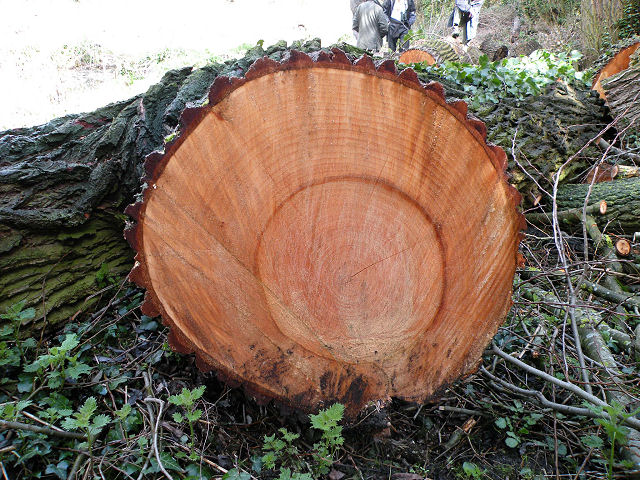
- Wood is secondary xylem laid down by the vascular cambium; one season's earlywood plus latewood makes one growth ring, which is what dendrochronology counts. In an old trunk only the outer, paler sapwood still conducts — the darker heartwood is plugged by tyloses and resins and serves only as support.
Study next
Common traps
- Reversing the two tissues — 'transport of foods' is a true statement about phloem, not xylem, and it sits in this question purely to catch a half-remembered answer
- Assuming a plant must have a gas-transport tissue because animals have blood — plant gas exchange is entirely by diffusion through stomata, lenticels and intercellular air spaces
- Reading 'essential amino acids' as a plant category — it belongs to animal nutrition, and in any case organic nitrogen is redistributed in the phloem
BPSC asks this as a flat NCERT-level one-liner — name the tissue, name its function, ten seconds, one mark — and the whole difficulty is the phloem option planted beside it, so a clean two-column memory of xylem versus phloem pays every cycle. UPSC has essentially stopped asking bare definitions in plant physiology; it wraps the same knowledge in an applied stem, such as why transplanted seedlings die (root hairs and water uptake, 2013) or why mycorrhizal inoculation rehabilitates degraded land (2013), where you must apply the transport idea rather than recite it.
Related PYQs
Many transplanted seedlings do not grow because
- (a) the new soil does not contain favourable minerals
- (b) most of the root hairs grip the new soil too hard
- (c) most of the root hairs are lost during transplantation
- (d) leaves get damaged during transplantation
Answer(c) most of the root hairs are lost during transplantation
The intake end of the very pathway this BPSC question asks about: root hairs absorb the water and dissolved minerals that the xylem then carries up, so tearing them off in transplanting starves the transpiration stream and the seedling wilts.
Match List I (Physiological processes) with List II (Cell organelles) and select the correct answer by using the codes given below the lists: List I I. Photosynthesis II. Mineral uptake III. Respiration IV. Protein Synthesis List II A) Plasma membrane B) Chloroplast C) Mitochondria D) Ribosomes Codes:
- (a) I-A, II-B, III-C, IV-D
- (b) I-A, II-B, III-D, IV-C
- (c) I-B, II-A, III-C, IV-D
- (d) I-B, II-A, III-D, IV-C
Answer(c) I-B, II-A, III-C, IV-D
Item II, mineral uptake, is the step immediately before xylem transport — ions enter through the selectively permeable plasma membrane of the root cell and only then join the water stream, which is the same water-and-mineral pathway tested here from the cellular end.
Practice
- practice — not a real PYQ
The ascent of sap in tall trees is best explained by which one of the following?
- (a)Root pressure
- (b)Capillary action alone
- (c)Transpiration pull and the cohesion of water
- (d)Imbibition by the cell walls
Answer(c) Transpiration pull and the cohesion of water — the cohesion-tension theory of Dixon and Joly (1894). Root pressure is positive but rarely exceeds about 0.1–0.2 MPa and disappears in a rapidly transpiring plant; capillarity in a vessel of a few tens of micrometres lifts water only about a metre; imbibition explains a dry seed swelling, not the ascent of sap. - practice — not a real PYQ
Which one of the following is a component of phloem and not of xylem ?
- (a)Tracheid
- (b)Vessel element
- (c)Companion cell
- (d)Xylem fibre
Answer(c) Companion cell — a living, nucleated parenchyma cell that keeps the enucleate sieve tube element functioning. Tracheids, vessel elements and xylem fibres are all xylem elements, and the first two are dead at maturity.