
In short circuit, the value of electric current in a time circuit :
- (a)Very low
- (b)Do not change
- (c)Increases very high
- (d)Continuously changing
Answer
Why
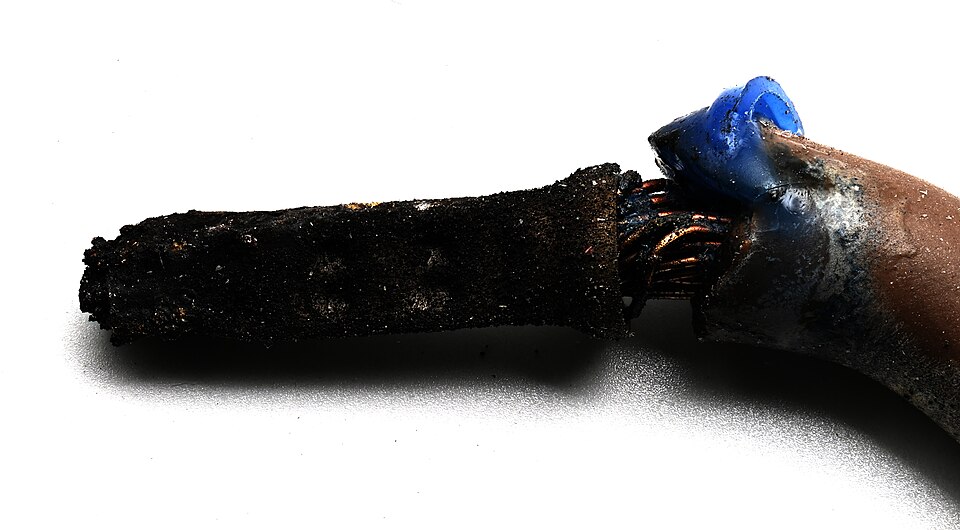
Correct — C, Increases very high. The whole answer sits in Ohm's law, I = V/R. A short circuit is what happens when the live wire and the neutral wire come into direct contact — through insulation that has cracked or been chewed, a nail driven into a wall, water bridging a socket, or a fault inside the appliance itself. The moment they touch, the current stops flowing through the appliance and takes the new, shorter path instead, so the appliance's resistance drops out of the loop and all that is left is the resistance of the copper wiring, a few hundredths of an ohm. The supply, meanwhile, does not change: the mains is a constant-voltage source pinned at 220 V. With V fixed and R collapsing towards zero, I = V/R has only one way to go, and it goes there steeply. That is precisely how the Commission itself justified this key when it disposed of candidate objections on 31 October 2025 — in a short circuit the resistance becomes close to zero, so by Ohm's law the current rises to a very high value. Put numbers on it. A 100 W bulb on 220 V draws 0.45 A and presents about 484 Ω. Let a fault leave only 0.1 Ω of copper in the loop and Ohm's law demands 220/0.1 = 2,200 A — thousands of times the normal current. And because Joule heating obeys H = I²Rt, the heat released rises with the SQUARE of the current, so a hundredfold current means a ten-thousandfold heating rate. That is why a short circuit melts insulation, welds wires together and starts a fire in seconds, and why the circuit must be broken by a fuse or a miniature circuit breaker within milliseconds. Two notes on the paper itself. The printed English is garbled — 'in a time circuit' is a mis-set rendering of 'at the time of short circuit' — while the Hindi column reads cleanly, which is a standing reason to check the Hindi text of a bilingual BPSC booklet whenever the English reads oddly. And the item is NCERT Class X Science, 'Magnetic Effects of Electric Current' — Chapter 12 with this as Exercise 2 in the book currently in print, Chapter 13 question 5 in older editions, reproduced with all four options in their original sense.
Why the others are wrong
- (a)Very low — The exact inverse of what happens, and it is chosen because the word 'short' sounds like 'small'. It refers to the shortened path the current takes, not to a small current. A very low current is the signature of the opposite fault, an OPEN circuit — a broken wire, a blown fuse or an off switch — where the resistance of the path becomes effectively infinite and I = V/R falls to zero. Short circuit and open circuit are the two extreme faults, and they sit at opposite ends of Ohm's law.
- (b)Do not change — This would require the fault to leave the total resistance of the loop untouched, which bridging live and neutral plainly does not. The option is attractive only to a candidate who pictures the mains as pushing a fixed current into the house. It does not: the supply holds the VOLTAGE constant at 220 V, and the current is then whatever Ohm's law demands for the resistance connected across it. Mistaking a voltage source for a current source makes every domestic-circuit question unanswerable.
- (d)Continuously changing — True of ordinary household current at all times, and therefore a well-designed trap. Indian mains is alternating current at 50 Hz, so it reverses direction 100 times every second whether or not anything has gone wrong — but that is the normal state of the supply, not a description of a fault. The question asks what the MAGNITUDE of the current does when a short occurs: it jumps to a very high value and stays there until the fuse or MCB interrupts the circuit.
Concept
A house is wired as a constant-voltage system. Power arrives on two conductors — the live wire, insulated red, and the neutral wire, insulated black — with 220 V maintained between them in India. A third conductor, the earth wire with green insulation, runs to a metal plate buried deep in the ground near the house; it carries no current in normal use and exists purely as a low-resistance escape path so that if current leaks to the metal body of an iron, toaster or refrigerator, the body stays at earth potential and the user is not shocked. Inside the house the supply is split into separate circuits, typically one rated 5 A for lights and fans and another rated 15 A for geysers and air coolers, and the appliances on each are connected in PARALLEL so that every one of them receives the full 220 V and can be switched independently. Each appliance is, electrically, just a resistance across those 220 V, and how much current it draws is fixed by Ohm's law. Three distinct things can then go wrong, and they are routinely confused. A SHORT CIRCUIT is live meeting neutral directly, so the resistance collapses and the current explodes. An OVERLOAD is too many appliances drawing from one circuit, or an accidental rise in supply voltage, so the current climbs above the wiring's safe rating without any insulation failing. An EARTH LEAKAGE is current escaping to the metal casing of an appliance, which may be far too small to trouble a fuse yet more than enough to kill a person.
The route to the answer is one line long if you set it up correctly. Write I = V/R and ask which of the two quantities on the right the fault actually changes. It is not V: the distribution system is designed to hold the voltage at 220 V regardless of what is plugged in, which is the entire reason appliances are wired in parallel rather than in series. So the fault must act on R — and a short circuit acts on R in the most violent way available, by removing the appliance from the path altogether and leaving only bare copper. R falls towards zero, and the quotient V/R therefore rises without any competing effect to hold it back. The single discriminating idea is that the mains is a voltage source, not a current source. Get that right and options (a) and (b) collapse immediately; get it wrong and no amount of formula-memorising will help. Two further separations are worth fixing before the exam. First, short circuit versus open circuit: both are faults, both change R drastically, but in opposite directions — R → 0 sends the current up, R → ∞ sends it to zero. The English word 'short' pushes candidates towards the wrong one. Second, the magnitude of a current versus its direction: household AC is always changing direction, 100 times a second at 50 Hz, and option (d) trades on a candidate half-remembering that fact while the question is asking about size, not sign.
Key facts
- Ohm's law I = V/R with the mains voltage pinned at 220 V: as R collapses towards zero the current rises steeply. The Commission's own remark disposing of objections on 31 October 2025 states exactly this — in a short circuit the resistance becomes close to zero so the current increases to a very high value.
- NCERT's definition: short-circuiting occurs when the live wire and the neutral wire come into direct contact, because the insulation of the wires is damaged or there is a fault in the appliance, and the current in the circuit then abruptly increases.
- Order of magnitude: a 100 W bulb on 220 V draws 0.45 A and presents about 484 Ω; if a fault leaves roughly 0.1 Ω of copper in the loop, Ohm's law gives 220/0.1 = 2,200 A. Real fault currents are limited by the supply's own impedance, but they run to hundreds or thousands of amperes.
- Joule's law of heating, H = I²Rt, makes the consequence non-linear: heat scales with the SQUARE of the current, so a hundredfold current means a ten-thousandfold rate of heating — the reason a short circuit melts wiring and ignites fires within seconds.
- Indian domestic supply: 220 V between the live wire (red insulation) and the neutral (black), alternating at 50 Hz so the direction reverses 100 times a second; houses carry separate circuits rated about 5 A for lights and fans and 15 A for geysers and air coolers, with all appliances in parallel.
- Short circuit is not the same as overloading. Overloading is too many appliances on one socket or an accidental hike in supply voltage; short circuit is live and neutral touching. A fuse or MCB guards against both, while the green earth wire guards against a third and quite different hazard — leakage current reaching the metallic body of an appliance.
Study next
Common traps
- Reading 'short' as 'small' and concluding the current falls — 'short' describes the shortened path, and it is an OPEN circuit, not a short one, that reduces the current to zero
- Treating the mains as a source of fixed current; it is a source of fixed voltage at 220 V, and the current is whatever the connected resistance permits
- Confusing a short circuit with an overload: both raise the current and both blow a fuse, but an overload is too much load on an intact circuit while a short circuit is live meeting neutral through failed insulation
BPSC lifts this straight from the NCERT Class X exercise and keeps even the four answer choices, so the preparation is literally to work the textbook exercises; and because the paper is bilingual, the Hindi column is often the cleaner text when, as here, the English has been mis-set. UPSC has never asked what a short circuit does in a one-liner. Its treatment of the same chapter is causal and comparative — why domestic wiring must be a parallel connection, what property a fuse wire must have, why a metal wire heats when current passes through it, what a choke does in a fluorescent tube. The BPSC candidate needs the statement; the UPSC candidate needs the mechanism behind it.
Related PYQs
Domestic electrical wiring is basically a
- (a) series connection
- (b) parallel connection
- (c) combination of series and parallel connections
- (d) series connection within each room and parallel connection elsewhere
Answer(b) parallel connection
The same circuit, tested from the design side. Houses are wired in parallel so that every appliance sits across the full 220 V and can be switched independently — and it is exactly that constant voltage which makes a short circuit so dangerous, because with V fixed the collapsing resistance has nothing to restrain the current.
Two wires have their lengths, diameters and resistivities, all in the ratio of 1 : 2. If the resistance of the thinner wire is 10 ohms, the resistance of the thicker wire is
- (a) 10 ohms
- (b) 5 ohms
- (c) 20 ohms
- (d) 40 ohms
Answer(a) 10 ohms
Both questions turn on the fact that current is decided by the resistance in the path, through I = V/R and R = ρL/A. UPSC makes you compute how the geometry and material of a conductor set that resistance; BPSC asks what happens to the current when the resistance is suddenly taken almost to zero.
Practice
- practice — not a real PYQ
An electric oven of 2 kW power rating is operated in a 220 V domestic circuit whose current rating is 5 A. What is the expected result ?
- (a)The oven will work normally, since 2 kW is within the rating
- (b)The oven will draw about 9.1 A, the circuit will be overloaded and the fuse will blow
- (c)The oven will draw about 0.4 A and work at reduced power
- (d)The supply voltage across the oven will rise to 440 V
Answer(b) The oven will draw about 9.1 A, the circuit will be overloaded and the fuse will blow — from P = VI, the current is 2000/220 = 9.09 A, which is well above the circuit's 5 A rating, so the fuse melts and breaks the circuit. This is overloading, not short-circuiting: the insulation is intact and the load is simply too large for the wiring. - practice — not a real PYQ
In a domestic electric circuit, the earth wire is provided mainly to
- (a)reduce the current drawn by the appliance
- (b)protect the user from a severe electric shock if current leaks to the metallic body of an appliance
- (c)raise the voltage available at the socket
- (d)connect all the appliances of the house in series
Answer(b) protect the user from a severe electric shock if current leaks to the metallic body of an appliance — the green-insulated earth wire runs to a metal plate buried near the house and offers a low-resistance path to the ground, keeping the metallic body of an iron, toaster or refrigerator at earth potential. It is a safety measure for the person, whereas the fuse is a safety measure for the circuit and the appliance.