
Bihar produces ________% of pyrite of whole India?
- (a)75
- (b)85
- (c)95
- (d)100
Answer
Why
No official answer — BPSC DELETED this question, so no option stands as correct and the mark was credited to every candidate. When the Commission disposed of the objections it recorded the reason in one sentence: Bihar does not produce any pyrite at present, although its reserves are about 95% of India's. The stem asked for a share of PRODUCTION, and the true share of production is nothing at all, so 75, 85, 95 and 100 fail alike. The primary source is unambiguous. The Indian Bureau of Mines, in the Sulphur and Pyrites chapter of the Indian Minerals Yearbook, records that Pyrites Phosphates and Chemicals Ltd ran two pyrite units, at Amjhore in Bihar and Saladipura in Rajasthan; the Government approved the closure and hiving off of both in July 2002 and of the Amjhore unit in June 2003, 'and since then no activity is reported'. The same chapter states flatly that 'there was no production of pyrites since 2003'. India as a whole has mined no pyrite for over two decades, so no state can hold a percentage of a national output that does not exist — and 100% of zero is not a percentage either. What the textbook figure actually describes is the resource in the ground. On National Mineral Inventory data under the UNFC system as on 1 April 2015, India's total pyrite reserves and resources stood at 1,674,401 thousand tonnes, of which Bihar held 1,574,561 thousand tonnes and Rajasthan 90,876 thousand tonnes. That makes Bihar's share 94.04%, which the Bureau's own narrative rounds as 'Bihar (94%) and Rajasthan (5%)'. Roughly 94–95%, therefore — and of the resource, never of the output.
Why the others are wrong
- (a)75 — Cannot be right on either reading. There is no pyrite production anywhere in India to divide into shares, and 75% does not correspond to Bihar's resource share either — the National Mineral Inventory figure is about 94%. The number appears to be a filler placed below the remembered textbook value so that the option list runs upward.
- (b)85 — Same double failure. Bihar's share of national pyrite production is zero because national production is zero, and 85% understates its share of the resource, which the Indian Bureau of Mines puts at 1,574,561 of 1,674,401 thousand tonnes. No published mineral statistic supports 85% for Bihar on any measure.
- (c)95 — The intended answer, and the reason the question had to go. 'Bihar has about 95% of India's pyrite' is the line in every state-geography textbook, and the Commission itself repeated it — but it is a statement about reserves in the ground, not about production from them. A candidate who knew the fact perfectly would still have been marking a false claim, because the stem's verb is 'produces'. On the Bureau's own table the resource share is nearer 94% in any case.
- (d)100 — Superficially the most defensible guess: Rajasthan's Saladipura unit shut along with Amjhore, so if anyone were mining pyrite in India today it would indeed be only Bihar. But nobody is. Since 2003 national output has been nil, and a 100% share of nothing is undefined rather than correct, which is precisely why the Commission deleted the item instead of shifting the key to (d).
Concept
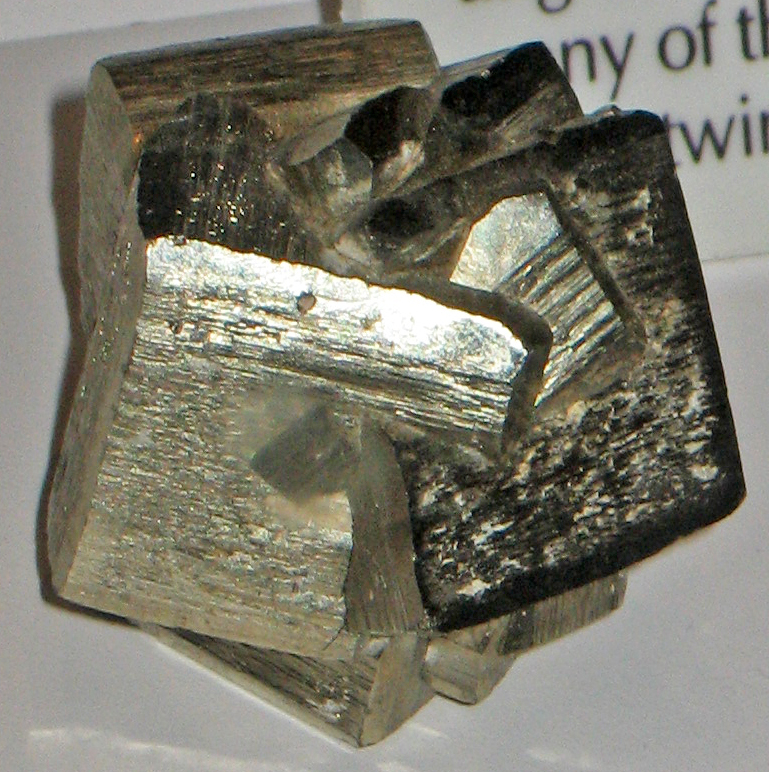
Pyrite is iron disulphide, FeS2 — brass-yellow, metallic in lustre, with a brownish-black streak and characteristic cubic crystals, which is why it earned the name fool's gold. Industrially it matters as a sulphur carrier: it was roasted to make sulphuric acid, and it is also used as a direct feed for soil conditioning on alkaline soils. Bihar's deposit lies at Amjhore in Rohtas district, on the Kaimur plateau in the state's south-west. India has essentially no mineable elemental sulphur — native sulphur resources amount to just 210 thousand tonnes, all of it in the Puga Valley of Leh district (now in Ladakh), at grades of 9% to 24% sulphur — so for decades pyrite was the domestic substitute. What killed it was a cheaper rival rather than exhaustion of the mineral. Modern refineries and fertiliser plants strip sulphur out of crude oil and natural gas as a by-product, and that recovered sulphur is purer and far cheaper than acid made by roasting low-grade pyrite. India recovered 890 thousand tonnes of by-product sulphur in 2018-19 against 825 thousand tonnes the previous year, with Indian Oil alone contributing about 69% of it; Bihar's own Barauni refinery in Begusarai district carries a sulphur recovery capacity of 12,000 tonnes a year. So the state that sits on 94% of India's pyrite now gets its sulphur from an oil refinery, and its pyrite mine has been shut since 2003.
The verb is the whole question, and that is the transferable lesson. Read 'Bihar produces ___% of pyrite' quickly and the eye supplies the familiar textbook sentence, 'Bihar has about 95% of India's pyrite', so option (c) feels like recall rather than a guess. The two sentences are not the same claim. Behind them sits a three-step ladder that Indian mineral statistics keep strictly apart. A RESOURCE is a geological estimate of what is in the ground. A RESERVE, under the United Nations Framework Classification that the National Mineral Inventory uses, is the part of that resource shown to be economically extractable. PRODUCTION is what actually comes out in a given year. Pyrite fails at every rung after the first: India's 1,674 million tonnes are entirely classified as 'Remaining Resources' with no Reserves at all, 1,555 million tonnes of it is low grade, and 1,500 million tonnes of Bihar's own share sits in the lowest-confidence Inferred category; production has been nil since 2003. Carry the habit into the very next question on this paper, which asks about gold in Jamui: Bihar holds a large share of India's gold-bearing ore but produces no gold, while Karnataka does the producing. When a stem says produces, refuse to answer it with a reserves figure.
Key facts
- The Indian Bureau of Mines records that 'there was no production of pyrites since 2003': Pyrites Phosphates and Chemicals Ltd ran units at Amjhore (Bihar) and Saladipura (Rajasthan), the Government approved closure and hiving off of both in July 2002 and of Amjhore in June 2003, and no activity has been reported since.
- National Mineral Inventory data under the UNFC system as on 1 April 2015: India's pyrite reserves and resources total 1,674,401 thousand tonnes, of which Bihar holds 1,574,561 and Rajasthan 90,876 — a Bihar share of 94.04%, which the Bureau's narrative rounds to 'Bihar (94%) and Rajasthan (5%)' while BPSC and most textbooks say about 95%.
- India has no pyrite 'Reserves' in the UNFC sense at all — the entire 1,674 million tonnes falls under Remaining Resources, with 1,555 million tonnes graded low and 1,500 million tonnes of Bihar's holding sitting in the lowest-confidence Inferred (STD 333) category.
- Pyrite is FeS2, iron disulphide, brass-yellow with a metallic lustre, a brownish-black streak and cubic crystals — 'fool's gold'; it is used to manufacture sulphuric acid and as a direct feed for soil conditioning, and Bihar's deposit is at Amjhore in Rohtas district on the Kaimur plateau.
- India's sulphur now comes as a by-product: 890 thousand tonnes recovered in 2018-19 against 825 thousand tonnes the year before, Indian Oil contributing about 69%, with the Barauni refinery in Begusarai district of Bihar rated at 12,000 tonnes a year; native sulphur resources are only 210 thousand tonnes, entirely in the Puga Valley of Leh district.
Study next
Common traps
- Answering a 'produces' question with a 'reserves' figure — the single mistake this deleted question was built on, and the reason it had to be withdrawn
- Attributing a bare 95% to the Indian Bureau of Mines; the Bureau's own inventory table gives 94.04% for Bihar, and 95% is the textbook rounding, so write 'roughly 94–95% of the resource'
- Assuming a large national share implies working mines: India's pyrite output has been nil since 2003 and the entire tonnage is classed as resource, not reserve
BPSC asks mineral questions as one-line percentage or district recall about Bihar, and this item shows the risk in that format — a single loose verb turned a well-known statistic into an unanswerable question and cost the Commission a mark on 150. UPSC almost never asks for a bare percentage; it builds statement or pair sets that turn on exactly the distinction BPSC tripped over — resources against reserves, occurrence against mining, domestic availability against imports — so the same fact is tested by making you judge a claim rather than recall a number.
Related PYQs
With reference to the mineral resources of India, consider the following pairs: Mineral — 90% Natural sources in 1. Copper — Jharkhand 2. Nickel — Orissa 3. Tungsten — Kerala Which of the pairs given above is/are correctly matched?
- (a) 1 and 2 only
- (b) 2 only
- (c) 1 and 3 only
- (d) 1, 2 and 3
Answer(b) 2 only
The same claim-form as the BPSC stem, done carefully: 'Mineral — 90% natural sources in State'. UPSC is explicit that it is testing natural SOURCES, not output, and the answer turns on the actual concentration figures — about 92% of India's nickel resources are in Odisha, while copper is led by Rajasthan rather than Jharkhand. Bihar's pyrite is the same kind of claim, and the BPSC item failed only because it swapped 'sources' for 'produces'.
Consider the following statements : 1. Natural gas occurs in the Gondwana beds. 2. Mica occurs in abundance in Kodarma. 3. Dharwars are famous for petroleum. Which of the statements given above is/are correct?
- (a) 1 and 2
- (b) 2 only
- (c) 2 and 3
- (d) None
Answer(b) 2 only
Kodarma, in the mica belt of what was undivided Bihar until 2000, carries exactly the nuance this deleted question missed: the mineral occurs there in abundance, which is a statement about what is in the ground and not about how much is mined today. UPSC asks you to judge the occurrence claim; BPSC asked for a production percentage of a mineral nobody produces.
Practice
- practice — not a real PYQ
The Amjhore pyrite deposit, which holds the bulk of India's pyrite resources, is located in which district of Bihar?
- (a)Rohtas
- (b)Jamui
- (c)Munger
- (d)Gaya
Answer(a) Rohtas — the Amjhore deposit lies on the Kaimur plateau in Rohtas district; its mine, run by Pyrites Phosphates and Chemicals Ltd, was closed in June 2003. Jamui is associated with gold ore, Munger with bauxite and Gaya with mica and building stone. - practice — not a real PYQ
Under the UNFC system used for India's National Mineral Inventory, the term 'Reserves' refers to
- (a)all mineral occurrences reported by geological surveys
- (b)the part of a resource established as economically extractable
- (c)the quantity of a mineral produced in a financial year
- (d)mineral deposits held by the Central Government only
Answer(b) the part of a resource established as economically extractable — resources are geological estimates, reserves are the economically workable portion of them, and production is the annual output. India's pyrite is instructive because its entire 1,674 million tonnes is classed as Remaining Resources with no Reserves at all.