
Where is “Ground Zero”?
- (a)Greenwich
- (b)New York
- (c)Indira Point
- (d)Sriharikota
Answer
Why
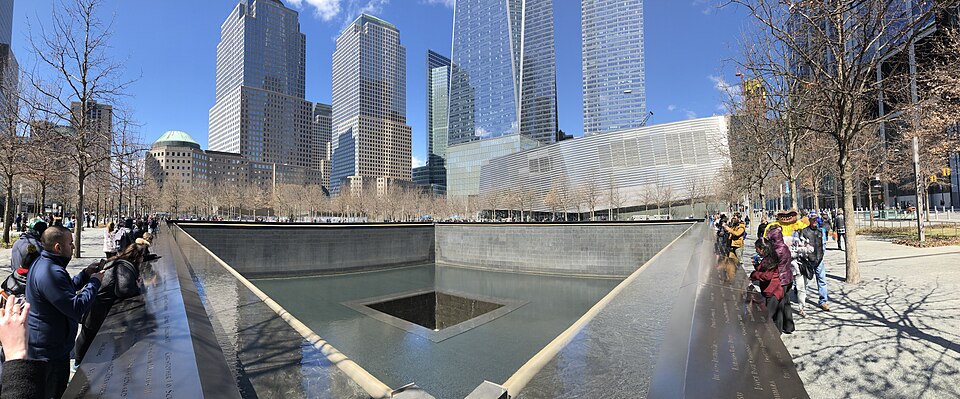
Correct — B, New York. 'Ground Zero' is the name that attached itself to the World Trade Center site in Lower Manhattan after the twin towers were destroyed on 11 September 2001, and the Commission's own remark on the final answer key says exactly that — it identifies Ground Zero as the location of the twin towers in New York. The name was not coined by officials or the press for the occasion: hospital workers and law-enforcement officers on the scene began calling the 14.6-acre (5.9-hectare) ruin 'Ground Zero' within hours of the collapse, and it stuck. The scale of what happened there is why the name stuck so hard: 2,606 people were killed at the site and in the surrounding area — 2,192 civilians, 343 firefighters and 71 law-enforcement officers — besides the 147 civilians and 10 hijackers aboard the two airliners. The site has since been rebuilt around a memorial: the National September 11 Memorial opened on 11 September 2011, the tenth anniversary; the museum opened to the public on 21 May 2014; and One World Trade Center, rising to 1,776 feet (541 m) with its spire — a height chosen for the year of American independence — opened on 3 November 2014. It is worth knowing that the term is older than 2001 and has a technical sense: the US Strategic Bombing Survey defined 'ground zero' in June 1946 as the point on the ground directly beneath the point of detonation of an air burst, the usage growing out of 'Zero', the code name for the Trinity test spot in 1945, and the Oxford English Dictionary's earliest general citation is a 1946 New York Times report on Hiroshima. In seismology it names the hypocentre, the origin itself; the surface point vertically above it is the epicentre. But as a proper noun with a definite article — 'Ground Zero', a place you can go to — it means the World Trade Center site in New York, and that is the sense the question is asking about.
Why the others are wrong
- (a)Greenwich — Greenwich, in London, holds the world's other famous zero — the prime meridian of 0° longitude, running through the Royal Observatory and defined by the Airy Transit Circle (built 1850, in use from January 1851). It was adopted as the world standard by the International Meridian Conference of 41 delegates from 25 nations at Washington DC in October 1884. That is zero *longitude*, not ground zero; the shared word 'zero' is the whole of the trap.
- (c)Indira Point — Indira Point is a village at the southern tip of Great Nicobar at 6°46′50″N 93°49′33″E — India's southernmost point, formerly called Pygmalion Point and Parsons Point and renamed for Indira Gandhi in 1985. Its tip subsided 4.25 metres in the 2004 Sumatra–Andaman earthquake, and it lies 145 km (80 nautical miles) from Indonesia's Rondo Island. It tempts because it is India's own terminal reference point, but no source calls it Ground Zero.
- (d)Sriharikota — Sriharikota is the barrier island off the Andhra Pradesh coast that carries ISRO's Satish Dhawan Space Centre, India's launch range. It attracts guesses because rocket launches end their countdown at zero and 'ground zero' sounds like launch-pad vocabulary — but a launch pad has never been called ground zero, and the technical sense of the phrase belongs to explosions, not launches.
Concept
This is a term-to-place question, the type that tests whether a candidate has actually met an expression in use rather than merely seen it in a list. 'Ground zero' began as military-technical vocabulary: after the Trinity test of July 1945, where the detonation spot carried the code name 'Zero', the US Strategic Bombing Survey formalised the phrase in June 1946 to mean the point on the ground directly beneath the point of an air burst — 'air zero' being the burst point itself — and the earliest general-language citation is a 1946 report on Hiroshima. In that sense every nuclear or large explosive detonation has a ground zero, and seismologists use it for the hypocentre — the point of origin itself, underground, where the strain energy is first released. The phrase acquired a single dominant referent on 11 September 2001, when two hijacked airliners were flown into the twin towers of the World Trade Center in Lower Manhattan. The 14.6-acre site of the collapse became 'Ground Zero' in ordinary speech, in news copy and eventually on maps, and it is now the site of the National September 11 Memorial and Museum and of One World Trade Center. New York City's mayor Michael Bloomberg later urged that the name be retired in favour of the site's official titles — a useful reminder that the nickname is journalistic usage, not an official designation.
Two of the four options are deliberate 'zero' traps and one is a distance trap, so it pays to name them before answering. Greenwich is the world's zero of longitude; Sriharikota is where countdowns reach zero. Neither has anything to do with an explosion. Indira Point is India's southernmost extremity, a terminal point rather than a zero point, and it is on the paper because the paper is Indian and a candidate hunting for an Indian answer will reach for it. Only New York carries the phrase as an established proper name. The single discrimination to hold on to is one of capitalisation and article: lower-case 'a ground zero' is a generic technical noun that any blast has, whereas 'Ground Zero' with the definite article names one place on earth — the World Trade Center site. A second, independent check for this particular paper is that the Commission published its reasoning: BPSC's remark on the final key states plainly that the term applies to the location of the twin towers in New York, so this is not a key that has to be defended against sources — it is a key the Commission itself explained.
Key facts
- The World Trade Center site covers 14.6 acres (5.9 hectares) in Lower Manhattan; hospital workers and law-enforcement officers began calling it 'Ground Zero' immediately after the twin towers collapsed on 11 September 2001.
- 2,606 people were killed at the site and around it — 2,192 civilians, 343 firefighters and 71 law-enforcement officers — besides 147 civilians and 10 hijackers aboard the two airliners.
- The National September 11 Memorial opened on 11 September 2011 and the museum on 21 May 2014; One World Trade Center, 1,776 feet (541 m) to its spire, opened on 3 November 2014.
- Technically 'ground zero' is the point on the ground directly beneath the point of detonation — the definition given by the US Strategic Bombing Survey in June 1946, growing out of the 'Zero' code name for the 1945 Trinity test site.
- The three distractors placed: Greenwich holds the prime meridian, 0° longitude, fixed by the International Meridian Conference at Washington DC in October 1884; Indira Point (6°46′50″N) on Great Nicobar is India's southernmost point and subsided 4.25 m in the 2004 tsunami; Sriharikota hosts ISRO's Satish Dhawan Space Centre.
Study next
Common traps
- Reading 'zero' and jumping to Greenwich, which is zero longitude, not ground zero
- Choosing Sriharikota because launch countdowns end at zero — the technical phrase belongs to detonations, not launches
- Treating the generic sense as the answer. Any blast has a ground zero; the question is asking for the proper name, which belongs to the World Trade Center site
BPSC asks the news-idiom flat out — 'Where is X?' with four places from four different contexts — so the whole question is a single act of recognition. UPSC prefers to bury the same knowledge in a matching set of 'Region often mentioned in the news — Country' pairs and ask how many are correctly matched (2022), or to ask which broad region a place in the news belongs to (Golan Heights, 2015), so partial knowledge is punished rather than rewarded.
Related PYQs
The area known as ‘Golan Heights’ sometimes appears in the news in the context of the events related to
- (a) Central Asia
- (b) Middle East
- (c) South-East Asia
- (d) Central Africa
Answer(b) Middle East
The same question in UPSC's phrasing — a name that reaches candidates only through the news, and the task is to place it on the map rather than to explain it.
Consider the following pairs: Region often mentioned in the news — Country 1. Anatolia — Turkey 2. Amhara — Ethiopia 3. Cabo Delgado — Spain 4. Catalonia — Italy How many pairs given above are correctly matched?
- (a) Only one pair
- (b) Only two pairs
- (c) Only three pairs
- (d) All four pairs
Answer(b) Only two pairs
The identical skill scaled up — four news place-names to be fixed to their countries at once, where a candidate who knows three of four still loses the mark.
Practice
- practice — not a real PYQ
The Prime Meridian (0° longitude) passes through which of the following?
- (a)Greenwich
- (b)New York
- (c)Rome
- (d)Cairo
Answer(a) Greenwich — the Royal Observatory at Greenwich, adopted as the world's prime meridian by the International Meridian Conference at Washington DC in October 1884. - practice — not a real PYQ
Indira Point, the southernmost point of India, is located on which island?
- (a)Little Andaman
- (b)Great Nicobar
- (c)Car Nicobar
- (d)Rutland Island
Answer(b) Great Nicobar — earlier called Pygmalion Point, renamed in 1985; its tip subsided about 4.25 m in the 2004 Sumatra–Andaman earthquake.